
Transforming Morocco's Defense Capabilities
On September 5, 2026, the Moroccan defense sector is witnessing a remarkable evolution, driven by innovative projects that integrate artificial intelligence, autonomous systems, and drone combat. Recent reports highlight a collaboration between the French company Harmattan AI, renowned for its expertise in defense AI and autonomous systems, and the Royal Moroccan Armed Forces. This partnership aims to operationalize the Gobi Tempest interceptor system while simultaneously establishing and developing Harmattan's industrial presence in Morocco.
The significance of this project goes beyond merely acquiring a ready-made system; it encompasses local manufacturing, assembly, and the transfer of technology and expertise to Moroccan competencies. Such initiatives align with Morocco's strategic objective of building a national defense industrial base capable of producing and developing advanced systems domestically.
According to the latest information regarding the deal, the Royal Moroccan Armed Forces are set to acquire 24 batteries of the GOBI Tempest system, originating from initial discussions about supplying between 20 and 30 batteries, with an estimated initial local integration rate of around 30% for the interceptor drones. The contract also includes the supply of 1,000 interceptor drones as an initial batch, of which approximately 300 will be manufactured locally within Morocco. The project is expected to expand further, with plans to produce an additional 3,000 interceptor drones in Morocco between 2027 and 2029, targeting an annual production rate of around 1,000 drones.
If these figures materialize, the project will stand as one of the most significant local production programs in the field of unmanned systems designed for close air defense. It will facilitate a gradual transition from importing systems to establishing a local production capability that can be scaled up in the future according to the needs of the armed forces. One of the key pillars of the agreement is the execution of assembly and manufacturing operations by Moroccan hands, coupled with technology transfer and local competency development. This aspect could prove to be more crucial than the number of drones themselves, as it contributes to establishing a national industrial chain capable of maintaining, developing, and producing these systems instead of relying entirely on external suppliers.
Furthermore, sources indicate that Harmattan AI is currently accelerating the pace of establishing and developing its presence in Morocco, with ambitions to eventually scale up production levels. This reflects a vision to position the kingdom as an industrial hub for the development and production of systems related to artificial intelligence and autonomous technologies, rather than merely being a market for receiving finished products.
Integrating Local Sensors into the Defense System
A notable aspect of the project is that Harmattan AI's role will extend beyond supplying the interceptor drones; it will also involve the integration of the defense system, command and control systems, and drone launchers into a cohesive defense infrastructure. Reports suggest that the company will work on integrating these components with locally manufactured radar systems and thermal and optical sensors, rather than relying on French-made radars and sensors. Should this approach be implemented, it would grant Morocco greater autonomy in the realms of sensing, command, and control, allowing for the integration of the GOBI Tempest system with the local air defense architecture and command and sensing centers.
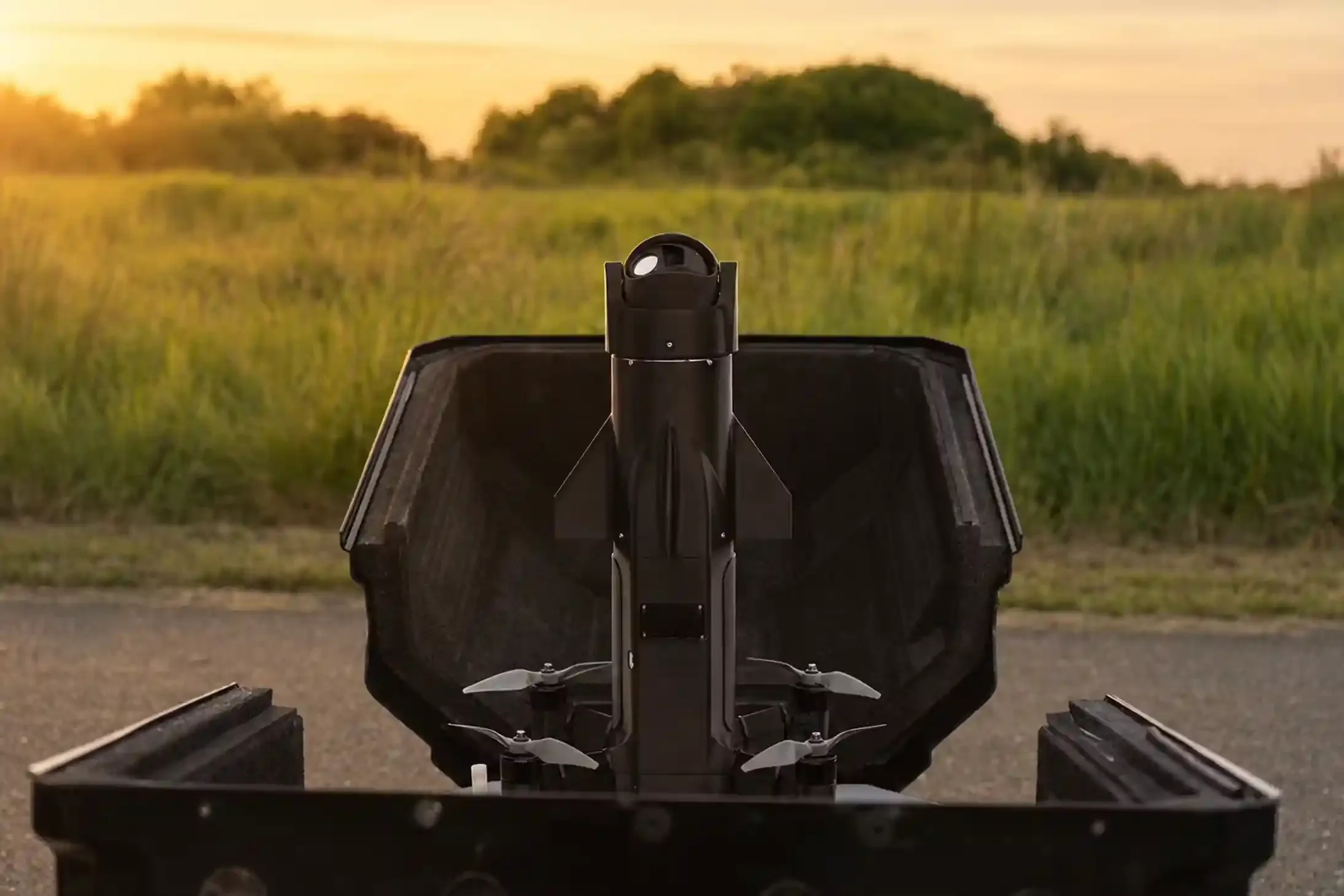
This aspect is particularly important because the effectiveness of the interceptor drone does not solely depend on its speed or collision capability; it relies significantly on the speed of threat detection, classification, localization, and subsequent interception guidance. Therefore, linking GOBI Tempest with local radars and sensors could transform the system from a mere counter-drone into a component of an integrated air defense network. GOBI operates under a different concept than traditional air defense systems, being launched from a closed ground platform and autonomously navigating towards its target using artificial intelligence technologies before engaging in direct collision, or Hit-to-Kill, without relying on a conventional warhead.
According to the announced specifications, GOBI can reach speeds of approximately 350 kilometers per hour, with the capability to operate day and night and achieve semi-instantaneous launch readiness, weighing around 2.2 kilograms. These features enable it to serve as a dedicated defense layer against drone threats, especially those that may pose challenges for conventional air defense missiles due to the cost-effectiveness of the drones compared to interceptor missiles.
The GOBI Tempest represents the advanced version designed to tackle more complex environments and threats, including armed drones, loitering munitions, and faster, more challenging targets.
Harmattan AI's system extends beyond the interceptor drone, encompassing a suite of systems aimed at constructing a complete engagement cycle that begins with reconnaissance and culminates in interception. Notably, the Sahara SAR system, a synthetic aperture radar mounted on drones, is designed to provide accurate battlefield imagery even under conditions where conventional optical sensors become less effective. The Sahara system operates day and night and in various weather conditions, enabling it to detect targets, track movements, and generate high-resolution radar maps and images while processing data directly on board the drone.
The announced specifications indicate that the SAR radar functions within the L and S Band, with imaging accuracy of up to 0.25 meters at two kilometers and 1.2 meters at ten kilometers, while the system weighs less than 3.5 kilograms and consumes less than 65 watts of power. These capabilities are linked to the Kalahari command and control system, which represents the decision-making and battle management component, while GOBI Tempest carries out the interception mission. This encapsulates the system's concept in a straightforward equation: Sahara sees, Kalahari decides, and GOBI intercepts.
As per the circulated information regarding the program, the GOBI Tempest systems aim to provide protection for cities and military and civilian installations against suicide drone attacks, particularly medium and large drones that may pose threats to vital facilities, military bases, command centers, and infrastructure. The importance of using interceptor drones for this mission lies in the potential to offer a flexible and relatively low-cost interception layer compared to traditional air defense missiles against low-cost drone targets. Furthermore, relying on direct collision opens avenues for developing a defensive concept capable of addressing large numbers of targets within environments experiencing dense drone attacks.
For Morocco, the industrial dimension of the project may prove to be the most critical aspect in the long run. Achieving an annual production of 1,000 interceptor drones signifies the establishment of a substantial local production capability in the field of unmanned systems and defense-related artificial intelligence, with the potential for future development to include other systems. Thus, the GOBI Tempest project is not merely a contract for acquiring interceptor drones; it can potentially evolve into a comprehensive industrial and technological initiative that combines French expertise with Moroccan competencies, featuring local manufacturing, technology transfer, and the integration of Moroccan sensors and systems. If these plans are realized, Morocco will take a significant step towards building a national defense industry, particularly in counter-drone operations, autonomous systems, and military artificial intelligence, with self-sufficient local production capabilities rather than relying solely on imported ready-made systems.
As reported by defense-arabic.com.