
Understanding Morocco's Strengthened Position in International Relations
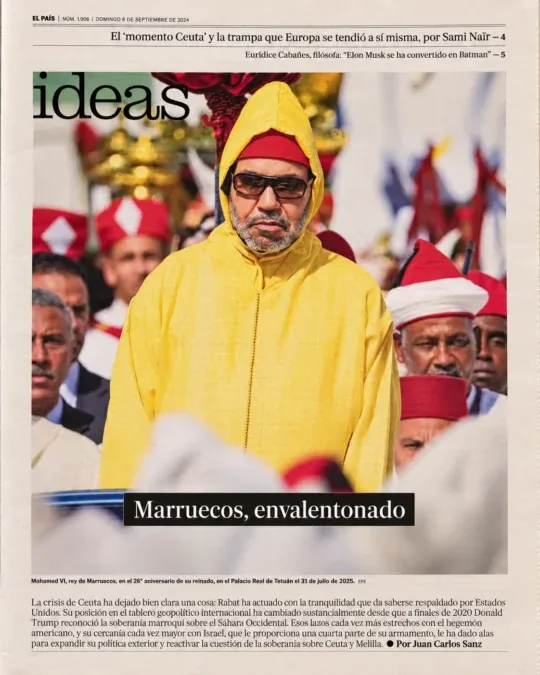
On September 6, 2026, a comprehensive analysis published by _EL PAÍS_ highlights Morocco's increasing influence on the international stage, bolstered by the support of the United States and its alliance with Israel, alongside a rearmament strategy and an expanding diplomatic network. Despite these advancements, the article recognizes a persistent issue: the status of Western Sahara remains unresolved, and Rabat continues to struggle for full international recognition of its annexation. This analysis, authored by Juan Carlos Sanz, begins with an undeniable observation: Morocco is currently experiencing one of its strongest moments in international relations. The 2020 U.S. recognition, along with a strategic partnership with Israel, enhanced military capabilities, and growing support from various Western governments for its autonomy proposal, has significantly broadened Morocco's operational latitude. _EL PAÍS_ specifically points to Donald Trump's decision as a crucial turning point, one made outside the United Nations framework that, according to Arabist Bernabé López García, has emboldened Rabat and hardened its foreign policy stance.
Moreover, the article emphasizes an important aspect for those following the Western Sahara situation: the territory is a central element of Morocco's foreign strategy. It is not merely a secondary issue; the relationship with Washington, normalization with Israel, African diplomacy, the establishment of consulates in Laayoune and Dakhla, movements in Latin America, and even the classification of international partners by King Mohammed VI are all linked to this goal. The king has officially stated that Morocco gauges its foreign relations based on each country's stance on Western Sahara. However, a notable weakness in this analysis emerges as it increasingly centralizes Western Sahara within the narrative while marginalizing the voice of the Sahrawi people. The article is populated with insights from Spanish specialists, academics, and Moroccan officials, examining the positions of the U.S., France, the U.K., Russia, China, and Spain, alongside discussions on arms, consulates, alliances, and investments. Yet, the lack of Sahrawi representation discussing the implications of Morocco's diplomatic advancements from occupied territories, refugee camps, or Sahrawi political representation is glaring.
Diplomatic Gains Versus Sovereignty: The Sahrawi Perspective
This approach to the conflict is not uncommon: it tends to analyze who gains ground around the territory while Western Sahara becomes a diplomatic chessboard, neglecting the fundamental legal right to self-determination of the Sahrawi people. Acknowledging Morocco's diplomatic successes does not negate this absence; in fact, the existence of these advancements underscores the necessity of differentiating between an increasingly favorable political position and the legal resolution of decolonization. The United Nations Security Council Resolution 2797 serves as a pertinent illustration of this distinction. It marked a significant step forward for Rabat, granting unprecedented centrality to the Moroccan autonomy proposal without recognizing Moroccan sovereignty over Western Sahara or dismissing the Sahrawi people's right to self-determination within the U.N. framework. The article notes a crucial clarification from Professor Irene Fernández Molina: MINURSO remains operational, the resolution retains some previous ambiguities, and Morocco is still far from achieving complete international recognition of its annexation.
This nuance is particularly significant as a series of political developments over the years have created a misleading impression. The establishment of consulates in Laayoune and Dakhla, unilateral recognitions, foreign investments, and military agreements undeniably hold strategic value for Morocco. However, gaining support does not equate to acquiring sovereignty. A consulate does not fulfill decolonization, an investment does not automatically alter the status of a territory, and a unilateral decision by another state cannot replace the pending process in the United Nations. The article also sheds light on the alliance with Israel, as Morocco has acquired air defense and missile systems, developed military and technological cooperation, and significantly bolstered its capabilities. _EL PAÍS_ even mentions the deployment of Israeli systems in Western Sahara, helping to explain why Rabat feels more secure today and why its foreign policy has become more assertive. Nevertheless, it raises a pertinent question that remains largely unaddressed: what are the implications of deepening the militarization of a territory whose international status remains unresolved?
Finally, the article links Morocco's strengthening to renewed pressure on Ceuta and Melilla. This connection warrants attention, especially since Pedro Sánchez justified his support for the autonomy proposal in 2022 as the beginning of a new phase based on stability and mutual trust. Four years later, _EL PAÍS_ describes a stronger Morocco that has reintegrated Ceuta and Melilla into its political discourse and has been involved in a new migration crisis at the Spanish border. This raises an uncomfortable political conclusion for Madrid: the Spanish concession regarding Western Sahara does not seem to have quelled Moroccan claims and may have, in fact, convinced Rabat that pressure yields results.
Therefore, this extensive article from _EL PAÍS_ deserves to be read, as it provides vital insights into Trump, Israel, rearmament, Africa, Latin America, Ceuta, and Melilla, and, importantly, how Morocco has positioned Western Sahara as the focal point of its diplomacy. However, it also allows for a critical realization that can often get lost amid so many diplomatic triumphs. Morocco has indeed gained support, exerted pressure, and received political recognition for its proposal. Yet, it still has not succeeded in transforming this backing into internationally recognized sovereignty over Western Sahara. As long as this distinction exists, the territory will continue to be what it has been for half a century: a pending decolonization whose future is not for Washington, Paris, Madrid, or Rabat to decide, but rather the Sahrawi people.
As reported by noteolvidesdelsaharaoccidental.org.