
For years, Morocco's presence in Europe was primarily marked by the export of **tomatoes, fish, phosphates, and returning tourists** sharing stories from their vacations. However, the landscape is rapidly changing as Moroccan products now encompass **Renault vehicles, Airbus components**, and soon, batteries for European electric cars. A mere 14 kilometers separate Morocco from Europe, yet this transformation is underpinned by nearly two decades of significant investment in factories, ports, roads, and training that have established the country as one of the most intriguing industrial experiments on the outskirts of the European Union.
According to the latest update from the World Bank, Morocco's economy experienced a robust growth of **4.9% in 2025**, marking the largest advancement in a decade, with an anticipated growth of another **4.2% this year**. Inflation has decreased to **0.8%**, and the budget deficit has been reduced to **3.5% of GDP**. Furthermore, Morocco regained its investment grade from Standard & Poor's in 2025, following an upgrade of its sovereign debt from BB+ to BBB-, a rating confirmed again in March this year.
The pivotal question arises: what has Morocco done to attract European and Asian multinationals to set up facilities that could easily have been established in Turkey, Eastern Europe, or China?
The Straits Factory
Renault's production in Morocco surpassed **394,000 vehicles** in 2025, making the country its second-largest global manufacturing base by volume. More importantly, **one in six cars sold by the group** worldwide now originates from Morocco, with **82% of that production destined for international markets**. While it might be tempting to attribute Renault's presence to lower production costs, this explanation alone cannot account for the hundreds of thousands of cars shipped annually to France, Spain, Italy, and Germany. If it were merely about wages, numerous countries could compete with Morocco.
So, what does Morocco offer that others do not? To begin with, Renault has established **87 top-tier suppliers** surrounding its factories, along with a railway connection that facilitates direct transport of vehicles to **Tangier Med**. Last year, this port handled **11.1 million containers**, an increase of **8.4%**, and processed over **535,000 international trucks**. The real distinction lies in having not just a cost-effective manufacturing facility, but also the suppliers, rail links, and one of the Mediterranean's largest ports all within the same industrial corridor. This synergy results in reduced transit times for components and faster vehicle deliveries, with Europe just hours away.
Stellantis recognized this potential early on. The group has expanded its **Kenitra plant** and commenced production of new models based on its Smart Car platform this summer. It has the capacity to boost production to **535,000 vehicles annually**, including micromobility options. Moreover, the company aims to source over **€6 billion** annually from Moroccan suppliers by 2030, targeting a **75% local integration** rate.
This shift signifies Morocco's ambition to evolve from being merely a location for multinational assembly operations benefiting from lower labor costs, to a hub where components are manufactured locally, thereby increasing the complexity for future investments to shift elsewhere.
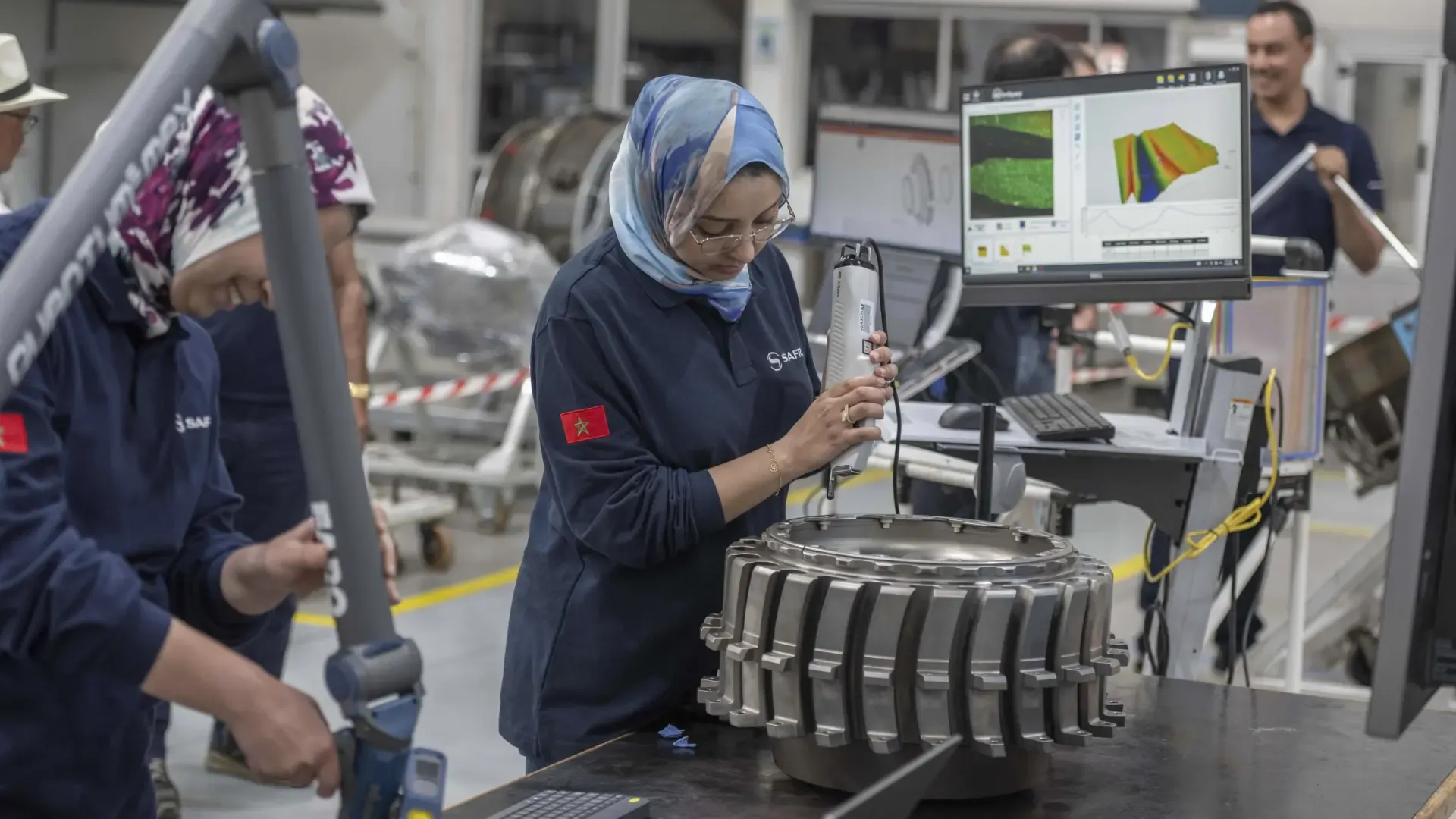
If the primary attractions for companies like Renault or Stellantis were simply low wages, proximity to Europe, and a capable port, it would be understandable. However, the decision by **Safran** to establish its only LEAP-1A engine assembly plant outside France in Morocco poses a more complex question. This facility, dedicated to manufacturing engines for the Airbus A320neo, represents an investment of **€200 million** with a capacity to assemble **up to 350 units annually**. The rationale for relocating such high-tech operations to Morocco is multifaceted; salaries remain a factor, but the presence of approximately **150 aerospace companies** around Casablanca employing nearly **25,000 people** in the sector, along with exports exceeding **26 billion dirhams** in 2024, plays a significant role.
Safran's commitment goes beyond just engine assembly; they are also building another facility for the repair and maintenance of **150 engines annually** and announced an additional **€280 million investment** for landing gear systems. When considering cars, aircraft engines, aerospace maintenance, and landing systems together, the narrative of cheap labor becomes insufficient to explain Morocco's industrial ascent.
Adding another layer to this narrative, the Chinese company **Gotion High-Tech** is establishing Africa's first **battery gigafactory** in Morocco, with an initial investment of nearly **$1.3 billion** and support from the African Development Bank. This facility will produce **LFP batteries** and materials for cathodes and anodes, much of which is destined for European markets.
As Europe aims to lessen its industrial dependency on China, European companies are seeking shorter supply chains, while a Chinese firm builds a massive battery factory right at Europe’s doorstep. Who benefits from these developments? Morocco.
Returning to the initial 14 kilometers, being so close to Spain is an extraordinary advantage. However, Morocco has been within this distance for centuries, yet it was not until recently that it was envisioned as a manufacturing platform for **cars, aircraft engines, or batteries for Europe**. Geography plays a part, but it cannot be the sole explanation.
The Genesis of an Economic Miracle
The roots of this transformation likely trace back to **2003**, when Morocco began constructing Tangier Med. The port opened four years later, leading to the establishment of industrial zones, highways, railways, and factories, culminating in a corridor that now enables Renault to transport cars almost directly from its plant via train to the port. Last year, Tangier Med processed **11.1 million containers**.
Today, Morocco boasts **over 150 industrial zones** spread across approximately **12,000 hectares**, complemented by trade agreements that allow companies operating there to sell under preferential conditions in markets far larger than the domestic one.
However, the statistics also highlight the limits of this model. Between January and July 2026, exports rose by **8.4%**, while imports surged by **15.9%**, resulting in a **26.5% increase in the trade deficit**, nearing **245 billion dirhams**. New factories require machinery, energy, and components that Morocco continues to source from abroad.
The other significant challenge lies in employment. Despite strong economic growth, the World Bank estimates that **22.5% of the workforce is unemployed, working fewer hours than desired, or is out of the labor market despite being available for work**. Attracting factories was the initial goal, and Morocco has made strides; now, it must capture a larger share of the value generated within them. The **75% local integration** target set by **Stellantis** precisely aims in this direction, providing a litmus test for whether Morocco can build its own industry around multinationals or continue to rely heavily on imported technology, components, and energy.
As reported by 20minutos.es.