
Marocotel 2026: Shaping the Future of Hospitality in Morocco
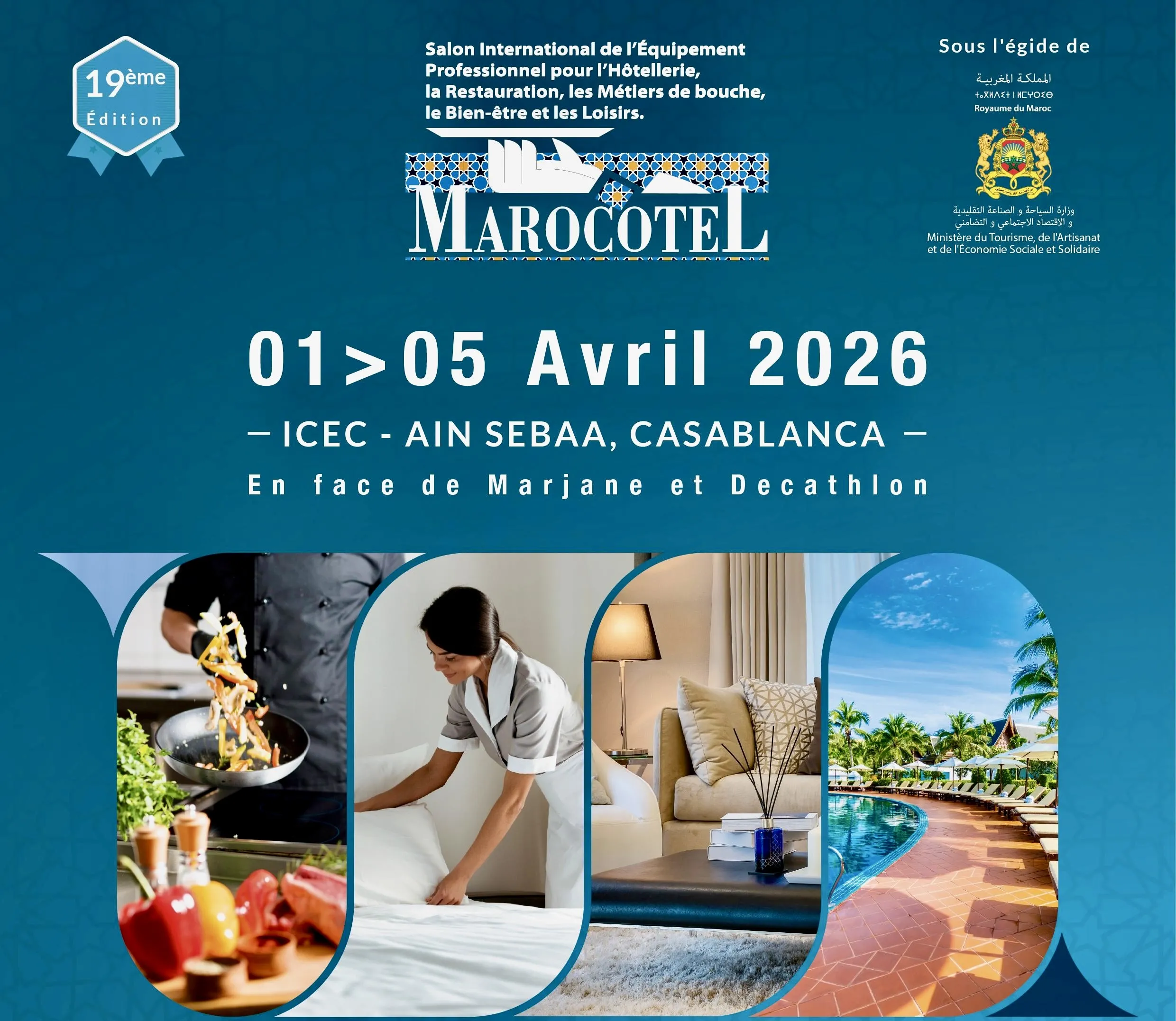
From April 1 to April 5, 2026, Casablanca will host the 19th edition of Marocotel, the international trade fair dedicated to the equipment and services for the hospitality, catering, and food service industries. Taking place at the ICEC in Aïn Sebaâ, under the esteemed royal patronage and supported by the Ministry of Tourism, this event continues to forge a significant path within the CHR ecosystem.
Since its inception in the late 1980s, Marocotel has established itself as one of the few African events solely focused on professional equipment for the CHR sector. Over nearly four decades, the fair has kept pace with the evolution of Morocco’s hospitality landscape, from the considerable investment waves of the early 2000s to the more recent transformations driven by digitalization and enhanced customer experiences.
The 2026 edition anticipates over 300 exhibitors representing more than 2,400 brands across a sprawling 30,000 square meters of exhibition space. This extensive offering encompasses the entire equipment supply chain: professional kitchens, tableware, bedding, laundry solutions, hotel management technologies, furniture, wellness equipment, and aquatic infrastructures. This broad spectrum positions Marocotel as a crucial platform for witnessing industry transformations, with innovations on display likely to showcase the future of hospitality.
Embracing the Challenge of 2030
The 2026 edition is explicitly themed around "Challenge 2030," a fitting focus as Morocco gears up for an extraordinary tourism phase with the co-hosting of the 2030 World Cup and the acceleration of its national strategy aimed at establishing the country as a leading global destination. A significant portion of the hotels built during the investment cycles of the 1990s and 2000s are now visibly aging, suffering from poorly soundproofed rooms, energy-intensive equipment, outdated kitchens, and obsolete management systems. Renovation is not merely an economic necessity but also a matter of brand image.
Within this context, Marocotel serves as a technical marketplace where operators can identify solutions to enhance operational performance, energy savings, kitchen automation, digital reservation management, and new comfort standards. Beyond its technical aspects, the fair represents a strategic market. In a hotel development project, equipment typically constitutes between 15% and 25% of the total investment, depending on the establishment’s stature. For a hotel with 200 rooms, this can amount to several tens of millions of dirhams.
High-end bedding, professional kitchens, intelligent air conditioning systems, and centralized management solutions represent substantial but critical expenditures. A poor equipment choice can weigh heavily on operating costs due to excessive energy consumption, frequent maintenance, and a degraded customer experience. International hotel groups have long understood this, imposing stringent specifications on their franchisees and operators, which explains the growing interest from these players in trade fairs that can present certified solutions compatible with their standards.
One noteworthy evolution at Marocotel in recent years has been the increased prominence of influencers: architects, designers, and specialized hospitality consulting firms. The Archi & Design Club embodies this trend, transforming the space into a venue where models, prototypes, and layout concepts converge for upcoming hotel projects. Among the fair's hallmark activities is the Resto des Chefs-Arabesque, a pop-up gourmet restaurant that will feature a rotation of several renowned chefs, including Badr Chguifi, Issam Rhachi, Myriam Ettahri, and Aissam Aït Ouakrim. Each service will serve as a live demonstration of culinary techniques, plating, and brigade management, providing a valuable opportunity for young chefs to integrate temporarily into the brigades and observe the methods of established chefs. In an industry facing a growing shortage of skilled labor, such knowledge-sharing spaces become invaluable.
Another visible transformation at the stands will be the increasing role of digital technologies. Exhibitors now offer integrated hotel management platforms, energy management systems for rooms, mobile check-in, artificial intelligence for analyzing customer reviews, and predictive maintenance management. Automation allows for adjustments to air conditioning based on actual room occupancy and predicts technical interventions before a breakdown occurs. For operators, these technologies promise both efficiency and an investment that can be challenging to amortize, especially for independent establishments.
The fair reflects the ambitions of a country aiming to elevate its tourism industry to a higher international level. In this regard, the 2026 edition could be one of the most significant in the history of the fair, as the question looms whether the entire Moroccan tourism chain—investors, operators, architects, restaurateurs, and suppliers—will be able to modernize swiftly enough to meet international standards.
As reported by premiumtravelnews.com.