Morocco's Military Developments in Western Sahara
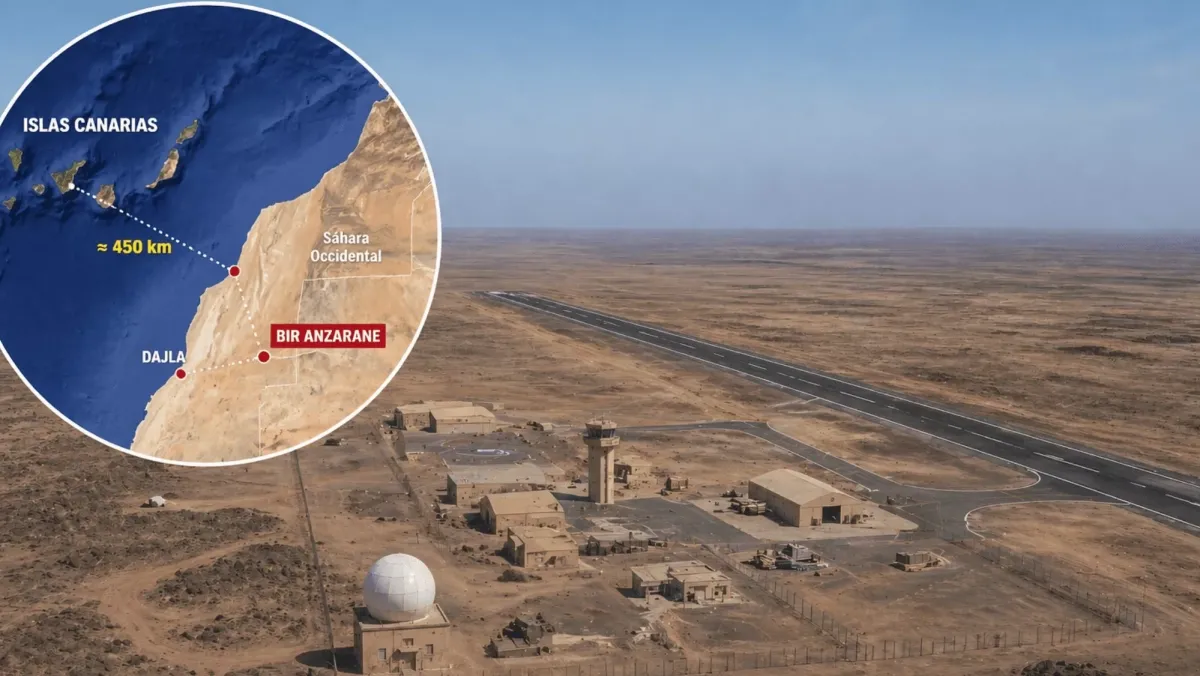
The military deployment of Morocco in Western Sahara has entered a new phase that is significantly impacting the strategic environment surrounding the Canary Islands. The activation of the Bir Anzarane airbase, alongside plans to incorporate submarines beginning in 2027, strengthens Rabat's position in the eastern Atlantic and necessitates a more careful evaluation from the Canary Archipelago. Located approximately 140 kilometers from Dakhla and over 450 kilometers in a straight line from the Canary Islands, the Bir Anzarane base has become a crucial element in maintaining military balance in the nearby Atlantic region.
Constructed between 2021 and 2023, this facility has transformed from a former helipad into a comprehensive air infrastructure featuring a long runway, hangars, a control tower, and advanced surveillance systems. Its primary function is to enhance aerial coverage in the southeastern Sahara, an area that has previously faced operational limitations. The deployment of drones and attack helicopters enables Morocco to maintain constant surveillance over vast territories while bolstering security along the sand wall and the border with Mauritania. This extension of control reduces gaps in oversight and enhances Morocco's operational range.
Geostrategic Implications for the Canary Islands
This military reinforcement occurs in the context of increased military activity following the breakdown of the ceasefire in 2020, marked by recent episodes of attacks and precision response systems. The new capabilities at Bir Anzarane enhance the Moroccan surveillance system's responsiveness and effectiveness. For the Canary Islands, this translates to a more active geostrategic environment in their vicinity, where the evolution of military capabilities in Western Sahara becomes a critical factor in regional security considerations.
Simultaneously, Morocco is exploring the acquisition of three submarines by 2027 as part of a broader plan to modernize its Royal Navy, according to Defensa.com. This move would signify Morocco's entry into an operational domain where it has not previously had a significant presence. Potential options on the table include the South Korean KSS-III submarine and the French Scorpène, although the bidding process is still ongoing. The integration of these systems would allow Morocco to expand its maritime surveillance and control capabilities in the Atlantic, particularly along strategic shipping routes.
For the Canary Islands, which rely heavily on maritime traffic, the potential presence of submarines in the nearby Atlantic region introduces an additional variable in the oversight of maritime space, traditionally monitored by the Spanish Navy. Beyond the Sahara conflict, Morocco is adapting its strategy to counter the growing instability in the Sahel. The expansion of jihadist groups toward the north underscores the significance of southern Morocco as a containment area, explaining the push for infrastructure such as Bir Anzarane.
This strategy, which may involve international cooperation, positions Morocco as a key player in the security of Europe’s southern flank, with indirect implications for the Canary Islands in areas such as migration and the control of transnational threats. The combination of enhanced aerial capabilities in the Sahara and Morocco's naval modernization is redefining the strategic context surrounding the Canary Islands. While it does not entail a confrontation scenario, it does indicate a shift in the balance of capabilities in the immediate environment.
Spain maintains a significant military presence in the archipelago; however, the transformation of Morocco's military apparatus necessitates constant monitoring and strategic adaptation in a landscape where technology and foresight dictate the pace of regional security.
As reported by atlanticohoy.com.