
The acquisition of the **HIMARS missile launch system**, manufactured in the USA, represents a significant advancement in Morocco's military capabilities, making it one of the most sought-after assets by governments in regions of international tension. The High Mobility Artillery Rocket System, which the HIMARS acronym stands for, enables deep strike capabilities with **ATACMS M57 missiles that can reach targets up to 300 kilometers away**. This technology contributes to one of the most formidable artillery systems globally, with countries like Poland and Jordan also in possession of this advanced weaponry, thanks to their close ties with the United States. In 2023, amid ongoing Russian bombardments, Ukraine was desperately seeking more HIMARS systems from the West for defense. However, on April 11 of that year, the US State Department authorized the sale of a significant batch of HIMARS to Morocco instead.
The deal, valued at **$524 million**, includes 18 launchers and 40 missiles, along with 36 other guided rocket systems intended for precision strikes at shorter distances. Additionally, it encompasses launch vehicles, artillery software, and communication systems, all being produced by **Lockheed Martin**. The Moroccan army is expected to receive the first 10 launchers by 2027, marking a notable enhancement in its military arsenal.
This transaction stands out as one of the most significant arms purchases by Morocco from the United States, resulting from a well-crafted alliance backed by substantial investments from Rabat in lobbying efforts directed at Washington. Since 2016, American arms sales contracts aimed at **Morocco's rapid rearmament** have totaled approximately **$12.728 billion (11.186 billion euros)**, covering fighter jets, attack helicopters, tanks, and an extensive range of missiles.
Strengthening Military Ties
On July 13, Moroccan Armed Forces Inspector General **Mohamed Berrid** and General **Dagvin Anderson**, head of the Pentagon's Africa Command, signed an agreement to establish an operational headquarters in the arid region of Tan-Tan, Morocco. This center, which includes a training field, an innovation center, and a **drone operation school**, is set to enhance Morocco's military training and capabilities significantly.
The Trump Administration, in its two iterations, has authorized more arms sales and transfers of American military technology to Morocco than its Democratic predecessors, **Barack Obama and Joe Biden**. The most intensive supply occurred during Trump's first term, although the Biden administration approved the HIMARS launcher supply in April 2023, concluding with another strategic rearmament for Morocco in 2024. In December of that year, Morocco received approval for a **batch of AMRAAM air-to-air missiles to equip its F-16 fighter jets**, among the most advanced weapons for combat aircraft. This agreement was complemented with an additional **$86 million in precision-guided GBU bombs**.
On December 20, 2024, just a month before a change in the US presidency, another significant arms sale was approved. In April 2025, shortly after Trump's return to office, the State Department notified Congress of its approval for the sale of **600 Stinger short-range antiaircraft missiles**, designed to target low-flying aircraft.
Military Collaboration and Training
The Stinger deal is the latest authorization of arms sales from Washington to Rabat, marking the beginning of the current Trump administration's term. Thus far, arms sales have not been as abundant as military training initiatives. The **African Lion exercises**, particularly this year with the Israeli army invited, are at the center of a new era in the US-Morocco military alliance.
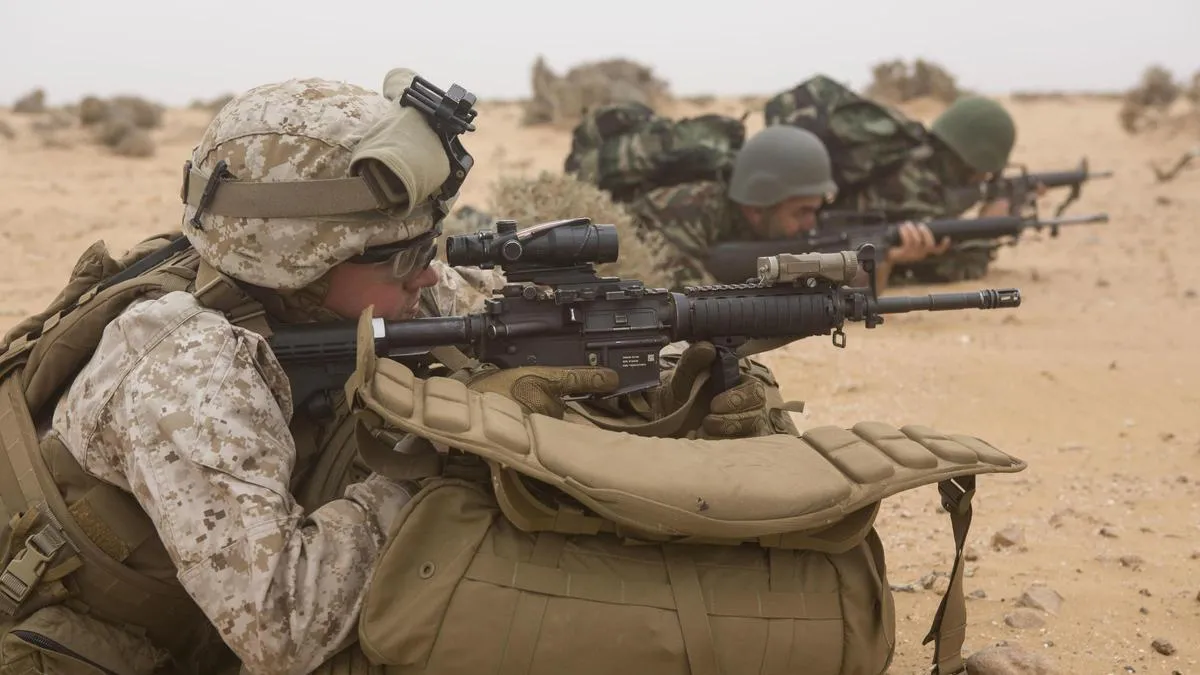
Among their achievements is the **training of non-commissioned officers**—a long-standing deficiency in the Moroccan army—along with the gradual integration of Moroccan staff officers into the command and control network of maneuvers that began bilaterally, featuring Marines alongside Moroccan soldiers, now accommodating over 10,000 military personnel from various African and European countries, with the Moroccan desert as the central backdrop.
Spanish military sources highlight the **intensive training in mines and explosive traps** that Moroccan forces receive during joint exercises, as well as American training for Moroccan sailors in the **use of underwater drones**, an economical weapon that helps bridge the significant naval gap between Morocco and Spain, as well as Algeria.
The military modernization efforts undertaken by Morocco, marked by significant arms purchases and strategic training partnerships, illustrate a clear shift in the regional power dynamics and underline the growing military capabilities of the North African nation. As Morocco continues to enhance its military infrastructure, the implications for regional security and defense strategies are profound.
As reported by elperiodico.com.