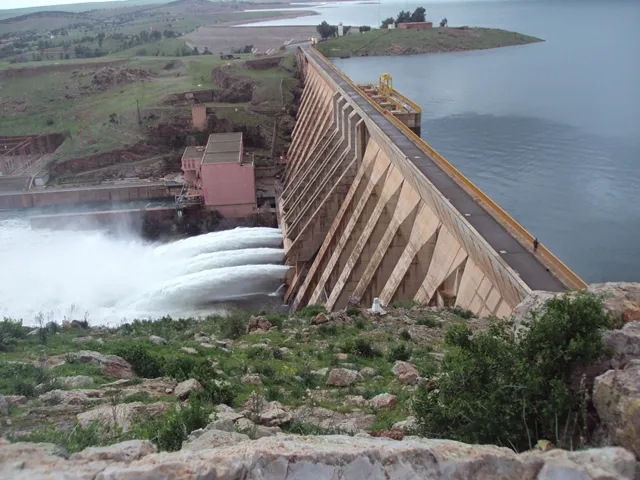

Significant Increase in Water Reservoir Levels
Recent official data released by the Ministry of Equipment and Water reveals a remarkable increase in the water levels of Morocco's dams, which have reached 71.40% capacity as of mid-March. This translates to a total storage reserve of approximately 12.38 billion cubic meters, indicating a significant improvement in water resources following an exceptionally rainy and snowy season.
This current level marks a substantial rise compared to the same period last year when the reservoir capacity was only around 32%, according to official statistics. The data highlights a variation in storage levels across different water basins, with particularly high percentages observed in the northern regions of the country. The Loukkos basin leads the way with a remarkable filling rate of nearly 91.7%, while the Sebou basin, one of the most crucial water reserves in Morocco, stands at approximately 84% capacity.
The Sebou basin includes the Al-Wahda Dam, the largest in the country, which has surpassed an 85% filling rate, boasting a storage capacity of over three billion cubic meters. Meanwhile, the Abid Raqraq basin, which supplies water to major cities along the Atlantic coast, has achieved a filling rate of about 92.7%, bolstered by high levels in the Sidi Mohammed Ben Abdallah Dam.
In central Morocco, the data reflects an improved situation for the Oum Er-Rbia basin, where the filling rate has increased to approximately 53.9% after several years of drought. However, the storage levels at the Al-Masira Dam, the second-largest in the kingdom, are still in the recovery phase, although they have improved compared to last year.
Other basins have also witnessed enhancements, including Tensift, which recorded a filling rate of around 89%, Souss-Massa at approximately 54.8%, and the Moulouya basin in the east with a filling rate close to 69%. Experts believe that the increase in water storage offers Morocco greater flexibility in ensuring access to potable water and supporting agricultural activities. They emphasize the need to continue implementing water resource management policies, including desalination projects and inter-basin transfers, in light of the challenges posed by climate change.
As reported by lakome2.com.