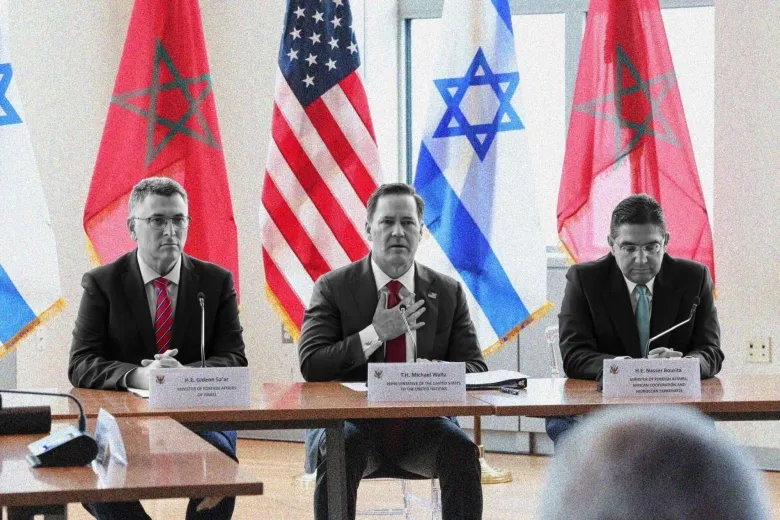

In a significant development, Morocco has committed to deploying troops to Gaza as part of the broader peace initiative proposed by former President Donald Trump. According to informed sources from Morocco, this enhancement of diplomatic relations to an ambassadorial level came after extensive behind-the-scenes negotiations. These discussions, some of which were facilitated by the United States, were strategically timed, with the announcement being withheld until all parties deemed the regional context conducive for such a move.
Since the establishment of the Abraham Accords, Morocco has temporarily suspended direct flights to Israel on two occasions: first during the COVID-19 pandemic and again amid the ongoing conflict in Gaza, which has witnessed severe civilian casualties and widespread destruction. The newly forged trilateral agreement between the US, Morocco, and Israel is seen as binding and aims to foster comprehensive, peaceful diplomatic relations. This agreement not only encompasses cooperation in technological research and defense but also reaffirms the United States' recognition of Moroccan sovereignty over the disputed Sahara region.
Despite the eagerness to implement this agreement swiftly, uncertainty looms regarding its actual commencement. Israeli Foreign Minister Gideon Sa'ar has provided minimal information, merely indicating that the details of the economic agreements would be finalized through liaison offices before the year's end. Meanwhile, the US administration is grappling with the repercussions of the ongoing conflict in Iran and its political ramifications ahead of the midterm elections scheduled for November 3rd.
Analysts suggest that the upcoming UN Security Council meetings on Western Sahara, set for October 31st, will serve as a critical litmus test for this agreement. Morocco seeks the United States' assistance in resolving the longstanding dispute based on its sovereignty claim, which includes granting local autonomy to the inhabitants of the territory, as outlined in Resolution 2797. Additionally, Rabat is advocating for clearer and more explicit language in the forthcoming Security Council resolution to minimize any potential for misinterpretation. The sponsorship of this agreement by US Ambassador to the UN, Mike Waltz, underscores Morocco's expectation of a pivotal role for Washington in these negotiations.
The public's acceptance of this new phase of the Abraham Accords may hinge significantly on the US's ability, as the penholder of the UN Security Council on Western Sahara, to facilitate a political resolution regarding the territory's status. A considerable segment of Moroccan society remains opposed to normalization with Israel; however, a resolution to the Sahara conflict could potentially shift domestic sentiments favorably towards normalization. Reports indicate that Washington recognizes that addressing the Sahara dispute may bolster public support for the Abraham Accords, enhance confidence in the US administration, and improve its credibility throughout the Maghreb region, ultimately broadening prospects for peace and stability.
Since the signing of the Abraham Accords, Morocco has gained substantial diplomatic traction on the global stage, with an increasing number of nations endorsing its 2007 autonomy plan for Western Sahara as a viable solution to the dispute. Nevertheless, the reaction to this new agreement has not elicited the same level of condemnation as the original Abraham Accords did in 2020. Algeria remains wary of the shifting dynamics in the region and the growing influence of external powers, concurrently engaging in discreet discussions with Washington regarding potential economic and geopolitical advantages.
Trump's advisor on Arab and African affairs, Massad Boulos, recently met with Algerian President Abdelmadjid Tebboune, marking their third encounter within a few months, just two days prior to trilateral discussions in New York. Leaked information suggests this meeting coincided with the UN Security Council's preparations for a draft resolution on Western Sahara, which reportedly characterizes Morocco's autonomy proposal as "the only viable solution to conclude the dispute." This draft could also lead to the cessation of the UN Mission for the Referendum in Western Sahara and the dismantling of the Sahrawi refugee camps in Tindouf.
Washington is reportedly seeking Algeria's backing for the proposed UN resolution in exchange for increased US investment in energy exploration and enhancements to Algeria's energy infrastructure. Such investments could amplify revenues, foster development, and attract additional foreign capital. Analysts assert that Algeria's primary concern is less about US recognition of Moroccan sovereignty over the Sahara but rather the shifting balance of military power in the region as Morocco gains access to advanced defense technologies from both Israel and the United States.
As part of its military modernization efforts, Morocco is anticipated to request up to 32 US F-35A fighter jets, as part of a procurement package valued between $17 billion to $18 billion. This deal would encompass the aircraft, necessary equipment, training, and logistical support. In recent years, Morocco has embarked on an ambitious trajectory to modernize its military capabilities, including local production of drones and armored vehicles in collaboration with China, Türkiye, and India. Additionally, Morocco has secured Israel's Barak MX air defense system in a deal worth approximately $500 million, alongside acquiring the PULS rocket artillery system at a cost of around $150 million.
Moreover, military cooperation with Israel has facilitated Morocco's acquisition of the ATMOS 2000 self-propelled artillery system, developed by Israeli defense contractor Elbit Systems. The integration of drones has become a crucial aspect of Morocco's military strategy, with ongoing initiatives to produce these systems locally, in partnership with Israel and Türkiye. The drones in question include tactical models such as the WanderB and ThunderB from BlueBird Aero Systems, as well as Elbit Systems' Hermes 450 and MALE-class drones. Furthermore, cooperation between Morocco and Israel extends to sensitive domains such as cybersecurity and electronic intelligence.
Reflecting on the historical context, I recall attending the Middle East Economic Summit in Casablanca in 1994, following the Oslo Accords. At that time, Shimon Peres, the Israeli Prime Minister, expressed optimism about collaborative futures for the region. However, three decades later, discussions about peace have become increasingly discouraged, with advocates often facing accusations of betrayal or submission. The pressing question now is whether there remains a viable pathway to peace amidst the complexities of the current geopolitical landscape.
As reported by en.majalla.com.