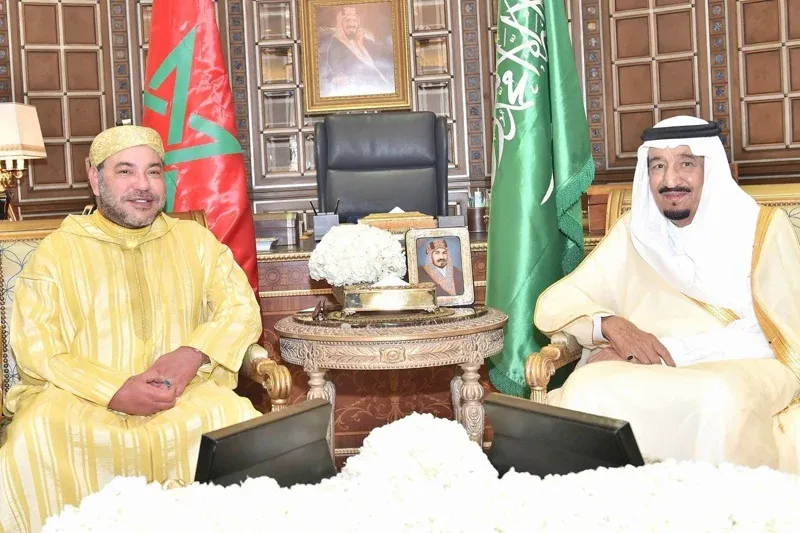

In a decisive move reflecting Morocco's unwavering support for Gulf security, King Mohammed VI has sent two messages to King Salman bin Abdulaziz Al Saud and Crown Prince Mohammed bin Salman. This correspondence comes in response to the ongoing attacks orchestrated by Houthi militias against Saudi territory, which, according to a statement from the royal palace issued on Saturday, have reached a level of "desperate and malicious attempts to target the holiest sites on earth, sacred to every Muslim." This clear reference underscores the recent threats to the sacred locations of the two holy mosques: Mecca and Medina.
The royal messages arrive amidst a troubling escalation of Houthi aggression against Saudi Arabia, which has intensified since the beginning of September. Notably, Saudi air defenses recently intercepted a ballistic missile aimed at the capital, Riyadh, marking a dramatic and unprecedented event since July of the previous year, when the capital was last directly targeted.
In these messages, King Mohammed VI articulated a position that transcends mere condemnation of the attacks, invoking the foundational principles that underpin Morocco's steadfast stance on Gulf security. This echoes the famous speech delivered by the king at the Moroccan-Gulf summit in Riyadh in April 2016, as well as his numerous visits to various Gulf nations aimed at fostering bilateral and fraternal relations.
The king affirmed that "the security and stability of the Kingdom of Saudi Arabia... is an integral part of the security of the Kingdom of Morocco," emphasizing that these attacks represent a "blatant assault on the feelings of over one billion eight hundred million Muslims" worldwide, in addition to being a "flagrant violation of international law" and United Nations Security Council resolutions 2216 and 2722.
Consistent Diplomatic Stance
This position does not exist in isolation; rather, it fits within a recurring pattern of statements released by the royal palace and the Moroccan Foreign Ministry whenever Gulf nations face aggression, regardless of its source. In late February, following Iranian missiles targeting the UAE, Bahrain, Qatar, Kuwait, and Jordan amidst the U.S.-Israeli war against Iran, Morocco's Foreign Ministry issued a statement condemning the attacks as a "flagrant violation of the national sovereignty of these countries," reaffirming its complete solidarity with them. King Mohammed VI also conducted a direct phone call with the President of the UAE, Sheikh Mohammed bin Zayed, to offer his support following the assaults on Emirati territory.
A similar scenario unfolded at the end of July when Iranian attacks targeted Saudi oil facilities. The Moroccan Ministry of Foreign Affairs promptly released a statement condemning the attack as a "serious violation of the sovereignty of the Kingdom of Saudi Arabia and a grave threat to its national security," reiterating its unequivocal support for Riyadh in confronting what it termed a threat to the stability of the Gulf region and the broader Middle East.
Shared Foundations of Policy
This diplomatic consistency is not a recent development but rather has deep roots extending over the past decade. The Moroccan Foreign Ministry's initial statement on March 25, 2015, just hours after the launch of "Operation Decisive Storm," announced Morocco's "solidarity with Saudi Arabia," followed by a commitment to provide all forms of support to the coalition, culminating in the official participation of six Moroccan fighter jets alongside nine other nations in the Arab coalition supporting legitimacy in Yemen.
When analyzing these developments collectively, it becomes apparent that Morocco’s official discourse regarding Gulf security is predicated on two unchanging common denominators, regardless of the aggressor—whether Houthi or Iranian. The first is a strategic-sovereignty aspect, which views the security of Gulf nations as an organic extension of Morocco’s own security. The second is a religious-symbolic dimension, which evokes the sanctity of Islamic holy sites and the sentiments of the Muslim ummah, implicitly highlighting the Moroccan monarch’s role as the Commander of the Faithful.
Thus, the succession of these statements, from "Operation Decisive Storm" in 2015 to the recent messages condemning Houthi attacks, reflects not merely reactive responses to successive security events but rather establishes a stable diplomatic discourse that positions Morocco strategically within the Gulf security framework, despite not being an official party in the structures of the Gulf Cooperation Council.
Ultimately, this effort is part of a broader series of communications and official messages that the royal palace consistently sends to affirm the strength of the strategic partnership and the historical fraternal ties that ensure the continuity of relations between Rabat and the Gulf Cooperation Council countries.
As reported by hespress.com.