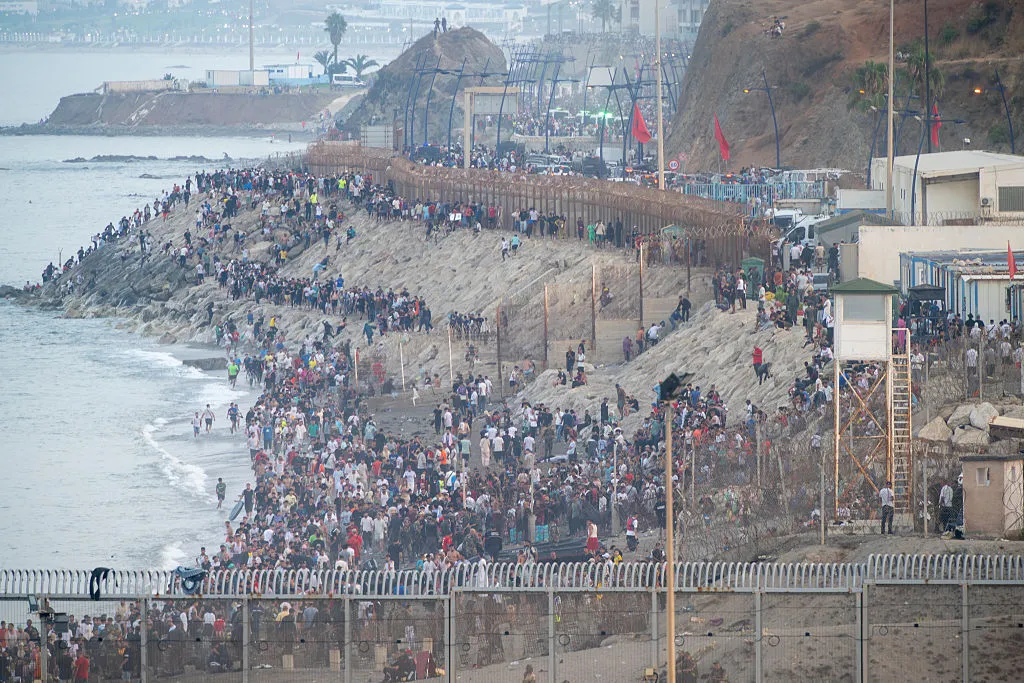

The ongoing territorial claims of Morocco over the Spanish exclaves of Ceuta and Melilla in North Africa are significantly influencing the recent migration crisis faced by Ceuta, as articulated by Jorge Dezcallar, a former Spanish ambassador to Morocco. The arrival of over 72,000 migrants in this small Spanish enclave during late July sent shockwaves throughout Spain and Europe, reigniting a long-standing territorial dispute that has persisted for decades. Dezcallar, who has also held the position of director of Spain’s National Intelligence Center, asserted that Morocco has consistently maintained its claims over both Ceuta and Melilla, and these unresolved tensions have contributed to the overwhelming influx of migrants that has tested the city’s resources and response capabilities.
Dezcallar elaborated on the situation by suggesting that Morocco is effectively "testing the waters," particularly at a time when it perceives the Spanish government, led by Prime Minister Pedro Sánchez, as weak. Sánchez’s administration has been grappling with a series of corruption scandals that have implicated several high-ranking officials and raised questions about the integrity of his leadership. Furthermore, his pro-immigration policies and critical stance towards the United States have often positioned him at odds with other European leaders, complicating Spain’s diplomatic landscape.
In terms of relations between Spain and Morocco, Dezcallar remarked that interactions are characterized more by emotional responses than rationality, describing a pattern that is akin to a saw-tooth graph. Despite this tumultuous history, the two nations are inextricably linked through trade and essential cooperation on various issues including migration management, counterterrorism, and regional security. This complex relationship underscores the delicate balance that both countries must maintain to address shared challenges.
Morocco’s assertions regarding sovereignty over Ceuta and Melilla have gained momentum, particularly through the statements of Moroccan officials and state-affiliated media. Justice Minister Abdellatif Ouahbi reaffirmed Morocco’s commitment to the claim, stating, “This matter is still on the table. Every time we meet with the Spanish, we raise the issue.” He emphasized the intention to resolve the matter through negotiations, highlighting Morocco’s determination to assert its territorial integrity.
In response to these claims, Spain’s Defence Minister Margarita Robles firmly stated that Ceuta and Melilla are unequivocally Spanish territories. Her declaration comes amid significant tension, as the Spanish monarchy has historically refrained from visiting these territories, with King Felipe VI never having set foot in Ceuta or Melilla. The recent visit by a Spanish foreign minister marks a significant moment in modern democratic history, aimed at mitigating potential diplomatic fallout with Morocco.
The aftermath of the migrant influx reveals that while Madrid and Rabat attribute the crisis to human-smuggling networks exploiting new judicial rulings in Spain, there is an underlying sentiment that Moroccan authorities may have played a role in allowing this surge to occur. Dezcallar pointed out that there appears to be a level of permissiveness or negligence on the part of Morocco, complicating the situation further.
Looking ahead, Dezcallar expressed concern over Spain’s capacity to manage future surges of migrants, warning that the recent events were not isolated incidents. He recalled a diplomatic rift that occurred in 2021, during which Spain’s decision to grant medical treatment to a Sahrawi leader was met with retaliation from Morocco, leading to the influx of nearly 10,000 migrants into Ceuta. This history of tension raises alarms about the potential for renewed crises, particularly with intelligence sources indicating a call for another surge of migrants in mid-August.
Ultimately, Dezcallar concluded with a stark warning: “If anyone thinks Morocco will abandon its claim over Ceuta and Melilla, they are mistaken.” This statement encapsulates the enduring complexities of the territorial dispute, which continues to have profound implications on migration patterns and regional stability.
As reported by euractiv.com.