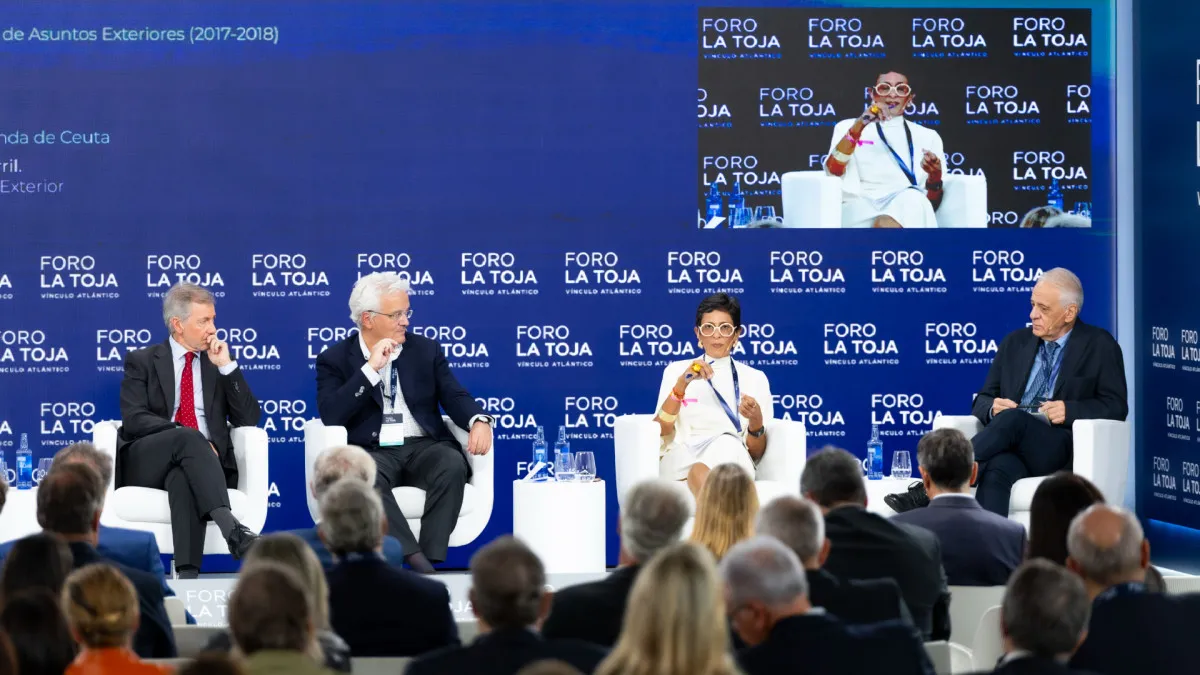

The discussion surrounding the current and future dynamics of Spain-Morocco relations took center stage at the La Toja Forum, featuring a diverse panel that included diplomat Bernardino León, former Deputy and Secretary of State for Foreign Affairs Ildefonso Castro, journalist specializing in the Maghreb Ignacio Cembrero, and Ceuta's Vice President Kissy Chandiramani. The session aimed to delve into the events that transpired between July 30 and 31 in Ceuta, analyze the repercussions of nearly 80,000 individuals entering the autonomous city, and understand the essential role the Spanish government must play in this critical issue for the country's foreign policy.
León set the tone for the conversation by emphasizing the pragmatic nature of international relations, stating, "Foreign policy represents states, and states are cold monsters: there are no friends or emotions, only interests viewed in a detached manner." From this perspective, he argued that labeling the situation merely as a migratory episode is inadequate for grasping the extent of the problem at hand.
In León's assessment, the underlying issue extends far beyond a mere surge in population flows; it signifies a very serious political crisis involving trust, social dynamics, humanitarian aspects, and even security concerns. He pointed out that "Ceuta has overshadowed the entire relationship with Morocco," reflecting a structural deterioration compared to past stages characterized by high-level institutional contacts or regional balances where relations with Algeria and the Euro-Mediterranean framework were priorities. Although it is common in diplomatic circles to maintain political disagreements without disrupting stability, the current situation indicates a concerning loss of mutual trust between Madrid and Rabat.
In evaluating the causes of the current crisis, both Castro and Cembrero highlighted the direct involvement of Moroccan authorities in the events, dismissing the notion of mere chance or spontaneous border mismanagement. Castro, a prominent figure in the People's Party regarding foreign policy, remarked, "It is impossible to move 80,000 individuals without some sort of direction," suggesting that Morocco acted either by commission or omission in destabilizing the border. Cembrero characterized the episode as an "orchestrated operation and action, not omission," facilitated by the inaction of what he termed a "cardboard government". He expressed concern that the central government failed to heed prior warnings from the Government Delegation and Ceuta's institutions, which indicated that the situation was deteriorating and required immediate intervention.
This deterioration in bilateral relations also stems from a series of diplomatic missteps on the part of Spain. Castro cited several instances, including the break from the unwritten tradition of making the first official visit of the legislature to Rabat—seen by Moroccan authorities as "a lack of respect"—a lukewarm response to evidence of the closure of commercial borders, and the controversial handling of Brahim Gali's transfer without prior notification to Morocco. Furthermore, he noted the perception of vulnerability projected by Spanish foreign policy in a context where Rabat viewed the Spanish government as being constrained by its internal political obligations and increasingly isolated on the international stage. Even the joint organization of the 2030 World Cup, seen by many analysts as a long-term diplomatic firewall, failed to halt the escalation of tensions, with Castro lamenting, "We all believed that hosting the World Cup would provide a truce, but it did not."
Chandiramani, offering an autonomous perspective, provided a grounded interpretation of the social realities in Ceuta. While acknowledging the humanitarian crisis faced by migrants seeking better living conditions, she asserted the rights of local residents to reclaim normalcy in their lives and streets, stating, "The people of Ceuta also have rights; they want to regain their space." Her intervention resonated with the audience, as she called for a straightforward assessment of the crisis's impact on the territory, saying, "Spaniards have complex feelings about calling what happened an invasion." She continued, "As a Ceutian, I feel invaded, and I feel my city is invaded." In light of this situation, she rejected the resignation to what some may define as a new normal and called for the orderly return of adults and minors on a case-by-case basis, applying existing legislation, the Emergency Plan (PEMA), and strict legal compliance.
Chandiramani was particularly firm in her stance regarding national defense and border sovereignty, questioning the excessive strategic dependence on the neighboring country. She stated, "The security of Ceuta should depend on Madrid and Brussels, not Rabat." After denouncing that "not a single brick has been laid to secure the border" and reminding that the promised national security plan of 2021 remains unexecuted, she advocated for a relationship of neighborhood without subjugation, asserting, "You are my neighbor; I want to get along with you, but we will not trample on each other."
When it comes to envisioning future alternatives, the panel concurred that maintaining the previous relationship framework is impossible without significant changes. León cautioned against the error of proceeding as if nothing had happened, emphasizing that Morocco must provide clear explanations regarding its management south of the border to build a new model characterized by intense dialogue and predictability. Achieving this requires a restoration of state consensus regarding North Africa and the understanding that "foreign policy must be forward-thinking."
Castro argued for returning the international debate to the parliamentary arena for greater transparency, stating, "Foreign policy must return to Congress." This necessitates adapting national regulations to the community framework and actively supporting the Pact on Migration and Asylum. The community dimension thus emerges as a vital lever of Spanish diplomacy, with an ongoing deployment of Frontex in Ceuta, Melilla, the Canary Islands, and the Mediterranean axis deemed essential under the premise that "with Europe, we are stronger in every aspect." Ultimately, Cembrero maintained that "Spain has greater leverage and deterrent capabilities than it has exercised in recent years," arguing that rebuilding trust with Rabat cannot depend on unilateral concessions or ambiguity but must be rooted in mutual respect, national security, and the non-negotiable guarantee of territorial integrity.
As reported by agendapublica.es.