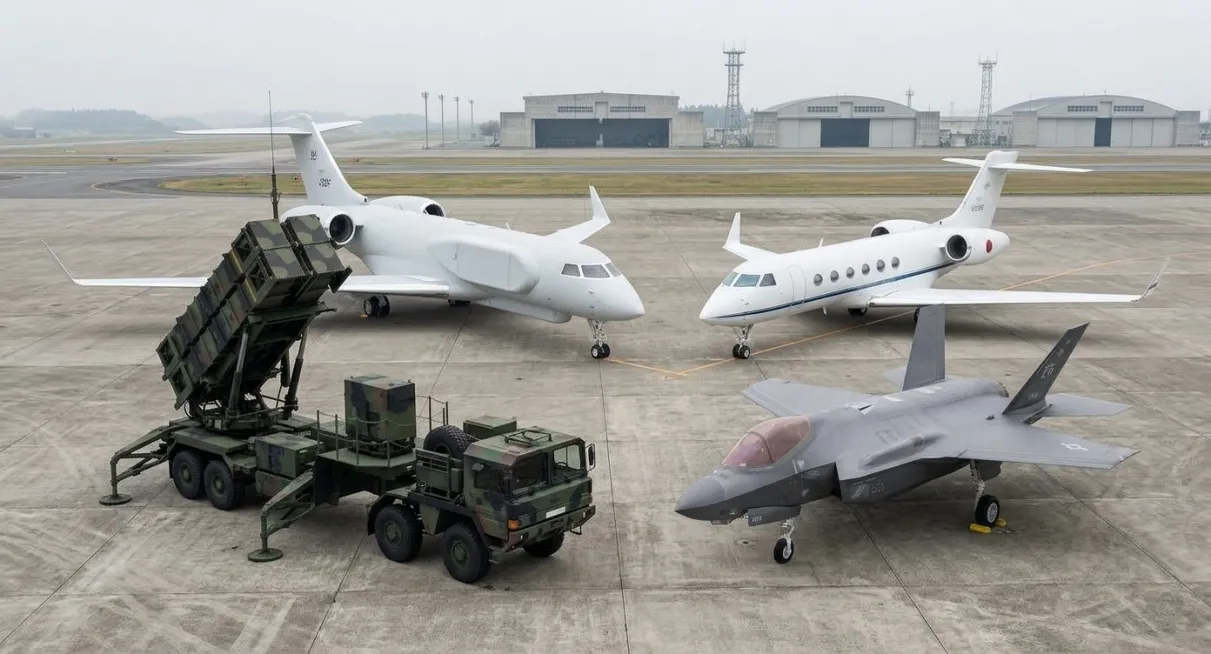

Last week, Brigadier General Tad Clark, the Deputy Director of Regional Affairs at the U.S. Air Force's International Affairs Subsecretariat, arrived in Rabat leading a delegation from the Department of Defense. The primary objective of this visit was to reaffirm Washington's ongoing commitment to the strategic alliance between the two nations. During his stay, General Clark engaged in discussions with Lieutenant General Mohammed Berrid, Inspector General of the Royal Armed Forces, and Major General Mohammed Gadih, Inspector of the Royal Air Forces. The conversations centered around current plans and future projects aimed at modernizing Moroccan aviation and enhancing bilateral cooperation.
In a departure from conventional diplomatic norms, Clark openly stated that the mutual relations are at their peak, emphasizing the vitality of this partnership and the shared interest in deepening it further. The appointment of such a technical and operational profile for the visit to Morocco clearly illustrates the significance of the issues at hand and the new phase that military cooperation is entering.
General Tad Clark possesses a robust background in strategy and air operations. In his current role, he coordinates international military ties, training programs, and global arms sales, overseeing an estimated 3,600 military sales cases valued at nearly $275 billion. This visit is also supported by an already established framework guided by the defense cooperation roadmap signed between the two nations, designed to steer defensive industries, cybersecurity, and long-term training initiatives until 2036.
The annual African Lion exercise, the largest joint training event organized by the U.S. Military Command for Africa, also forms part of this framework. The latest edition saw participation from thousands of personnel from over forty countries. For Rabat, these exercises go beyond mere troop preparation; they facilitate the operational integration of Moroccan units in multinational environments under U.S. doctrine, ultimately streamlining the future absorption of new American equipment.
The discussions currently revolve around the F-16 fighter jet fleet, which is at the core of ongoing talks and evolves along three simultaneous fronts. The first involves the acquisition of twenty-five new units of the F-16 Block 72 version, a program facing significant delays in production and delivery chains, resulting in scheduling tensions for the Moroccan air command. The second avenue includes upgrading the existing twenty-three aircraft to the Viper standard—a qualitative leap that will incorporate AN APG 83 active electronically scanned array radars, enhancing detection, tracking, and attack capabilities, although this process is also experiencing considerable delays.
Complementing this landscape are support agreements for AMRAAM air-to-air missiles of the C8 variant and participation in the development of the C9 model that will equip these aircraft in the future. The overarching goal of these efforts is to transform Moroccan doctrine from individual combat to full integration with command, control, and early warning networks. Finally, a more discreet topic concerns Rabat's interest in the fifth-generation F-35A fighter jet. Should this acquisition materialize, it would significantly alter the air balance across the region, although it raises substantial budgetary, logistical, and political authorization challenges in Washington.
Achieving airborne early warning and control capabilities ranks among the highest priorities for the Moroccan military leadership. The operational value of these platforms lies in their ability to provide an integrated aerial picture at long distances to both fighter jets and air defense systems, far surpassing the reach of ground stations and radars mounted on combat aircraft. This need becomes urgent in light of the proliferation of low-altitude threats, such as cruise missiles and suicide drones, which are critical elements in contemporary conflicts.
Moreover, there is a pressing requirement to track low radar cross-section vectors, such as the Su-57E fighters being introduced into neighboring forces, making long-range detection a decisive factor for any future deterrent calculations. Without this superior level of surveillance, the effectiveness of modern fighters and long-range missile systems would be significantly diminished.
In parallel with early warning, Morocco is examining its integration into the U.S. HADES project. This deep reconnaissance system is being developed on the Bombardier Global 6500 executive platform, with adaptations undertaken by Sierra Nevada, emerging as an alternative after challenges were encountered in a previous initiative focused on modified Gulfstream G550 aircraft. These aircraft provide extensive flight autonomy at very high altitudes, enabling continuous strategic surveillance over borders and areas of interest covering Western Sahara, the Atlantic coast, and the inland coastal regions.
Its strengths lie in electronic intelligence and signal interception, ideal tools for geolocating hostile radars and adversarial air defense networks to generate real-time tactical intelligence. Additionally, the use of American technology ensures high operational compatibility with fighters, early warning radars, and integrated ground defenses.
In the domain of air defense, Rabat maintains a sustained technical interest in the U.S.-made Patriot system, examining PAC-3 MSE interceptor missiles specialized in neutralizing ballistic missiles through direct kinetic impact, as well as PAC-2 GEM-T projectiles designed to down aircraft at distances of up to 160 kilometers. Despite this interest, Moroccan authorities are acting prudently and prefer not to rely on a single supplier, opting for a layered defensive architecture that incorporates medium- and long-range batteries from various sources. The pursued goal is to establish an integrated air defense network capable of safeguarding national airspace and closing the upper layer gap against tactical ballistic projectiles and short-range threats.
This military dynamic is inextricably linked to the surrounding strategic environment. In light of Algeria's procurement programs and the arrival of advanced vectors in the region, Morocco seeks to compensate for numerical asymmetry with qualitative sophistication, promoting a networked combat doctrine based on electronic warfare, advanced surveillance, and layered defense. This landscape is further supported by political backing from Washington, which has reaffirmed its recognition of Moroccan sovereignty over Western Sahara. This stance provides robust diplomatic cover for military agreements, framing them within a broader scheme of economic cooperation and regional security where various strategic interests converge.
Ultimately, General Tad Clark's visit conveys a dual message. On one hand, it reaffirms the U.S. administration's institutional commitment to Rabat in a complex regional context. On the other, it certifies that military cooperation has advanced beyond general statements to address technical and deployment aspects, tackling pending deliveries of F-16 Block 72 fighters, the initiation of Viper upgrades, the provision of advanced munitions, and contacts for incorporating early warning vectors, strategic reconnaissance, and long-range air defense capabilities. The catalog of projects discussed confirms that the Royal Armed Forces are moving forward with a clear vision aimed at building a fully connected and technologically advanced military system.
As reported by defensa.com.