
The French philosopher Alain Badiou draws inspiration from Socratic dialogues, titling his work "Platonic Dialogues" to reclaim the significance of meaning, as the essence often dissipates when the end and the means, the signifier and the signified, and the necessities and luxuries blur together. A society is deemed healthy when the purpose does not intertwine with the means, the signifier does not mix with the signified, and when luxuries do not overshadow necessities. Governance should be conducted in the name and for the benefit of the majority, rather than being hijacked by an oligarchy imposing its vision and subjugating the community to its dominance.
The ultimate goal of thought is to liberate concepts, a mission that has been distorted by neoliberalism, which commodifies everything and reduces all to mere products. Money, as articulated by German philosopher Georg Simmel in his work "The Philosophy of Money," has transformed from a unit of measurement into a value itself. When money becomes a 'value', all other values decay. Badiou concludes that it is impossible to reconcile the worship of money, in any nation, with public life. The middle classes, having seen their purchasing power erode, become susceptible to all forms of political ventures.
We have been scorched by these trends, leading us to become societies devoid of meaning, where the signifier and the signified become confused. We mistakenly equate elections with democracy, wealth with progress, and the absence of purpose justifying the means, while luxuries seem to replace necessities. According to the neoliberal perspective, the state has morphed into a joint-stock company focused on facilitation—a term that sounds alluring. Public services have become arenas for investment, subjected to profit and loss metrics, viewed only through the lens of potential financial returns. However, no society can sustain itself without core values such as solidarity, belonging, and sacrifice.
Technocrats have become the priesthood of global direction, transforming market systems into dogmas, as noted by economist Joseph Stiglitz, a Nobel Prize laureate. The economy has shifted from being a servant to a master. The tail now wags the dog, contrary to the natural order of things, and politics has subsequently devolved into mere representation. When societal issues surface amid rising tensions, they are treated as administrative deficiencies resolved through a "dialogic approach"—an outlook fraught with shortcomings that has instigated numerous upheavals around the globe.
Our societies are characterized by what Durkheim termed anomie, a state of normlessness or disintegration of bonds, as they navigate transitional phases. This disintegration leads to various forms of social deviance; statistics can signal trends, yet they should not obscure the realities of human conditions. Victor Hugo's "Les Misérables" offers a poignant illustration of human suffering in 19th-century France, while Dickens captures the difficulties of England during the same era, conveying insights that raw data cannot.
The human being is a repository of memory, and when stripped of it, they wander aimlessly. This reality is often overlooked by market references, and no technocratic approaches can fully encapsulate it. Interestingly, French economist Thomas Piketty has focused his research on a brief history of equality, referencing literary accounts of poverty in 19th-century Europe, shunning numerical language that merely serves as indicators needing interpretation, which may not reveal the full truth.
The essence of thought is to alert and caution; it reminds us that shadows are not reality, as is the first lesson learned in philosophy. Meaninglessness cannot substitute for meaning, nor can form eclipse substance. How do we transition from a state of meaninglessness to one of meaning? From societies without norms to those bound by collective consciousness? Societies devoid of belonging resemble bricks in a wall without mortar to hold them together, susceptible to collapse at the slightest gust.
Confronting this drift towards a world devoid of meaning necessitates a collective aspiration; humanity is not solely tied to the present but also to a future filled with hope for oneself, one's descendants, and society at large. The individual carries within them a memory, and when that memory is stripped away, they risk being reduced to mere machines—producing, consuming, and devoid of any allegiance beyond profitability and gain, possibly turning into a predatory beast.
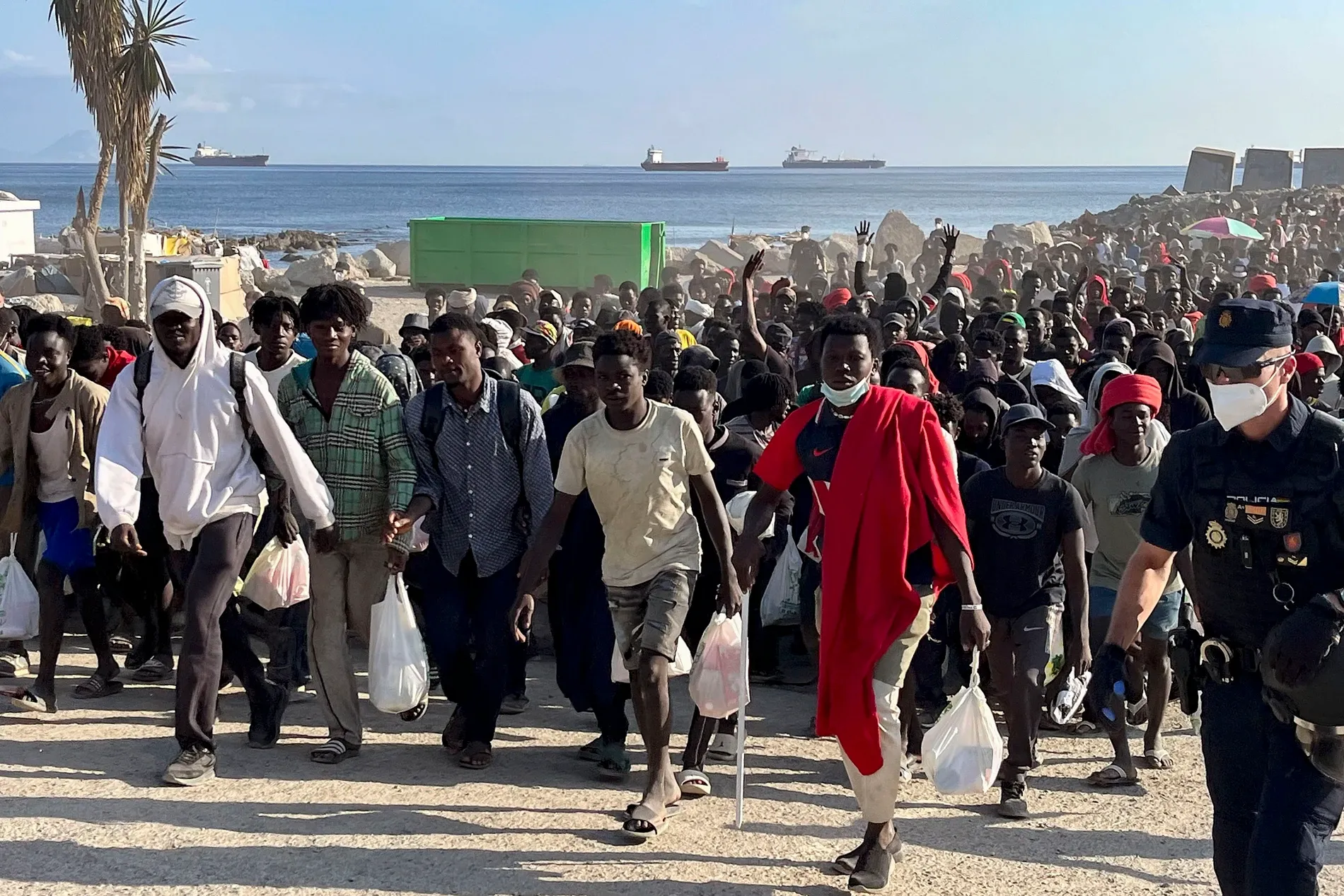
The elite or the vanguard is not merely about occupying positions of power; it encompasses carrying a vision or collective ambition and serving as role models to break free from meaninglessness. "In this, let the competitors compete." When a Moroccan child sings in Spanish as they tread upon occupied Ceuta, it signifies that the entire educational and value system intended to shape them in their homeland is fraught with issues. Is national identity merely an entry in the civil registry or a document used as needed?
The Arab world has faced an existential challenge, having been colonized and subjected to foreign rule under the guise of a civilizational mission. The Arab world had the resilience to rise up, reclaim its land, and assert its identity. However, that surge has largely disintegrated, and today, the Arab world confronts a challenge greater than that of colonialism due to its diminished resilience—now a victim of meaninglessness, value disintegration, and the dominance of superficiality, as interpreted by some from Canadian philosopher Alain Deneault as 'the trivialization' seen in this troubling amalgamation of purpose and means, signifier and signified, prioritizing luxuries over necessities, and allowing oligarchs to manage public affairs. The worship of money, or the 'value' of money, radically alters values, even obliterating them.
Two fundamental elements underpin societal cohesion and should take precedence above all else: family and education, provided they do not replicate models from entirely different contexts. Family is not merely a legal arrangement among contracting parties; it is a complex societal and anthropological phenomenon. Education transcends instruction; it is inseparable from collective ambition and is fundamentally a transformative process. Successful education cannot forgo the presence of good role models.
Is this not what a 19th-century philosopher expressed when he asked, "Who educates the educators?" Is this not reflected in the ancient poet’s proverbial lines: "People do not thrive in chaos without leaders, nor will there be leaders if the ignorant prevail." The elite or the vanguard is not merely about leading but embodying a vision or collective ambition, serving as exemplary figures to eradicate meaninglessness. "In this, let the competitors compete."
As reported by aljazeera.net.