
Unveiling the Secrets of the Bronze Age
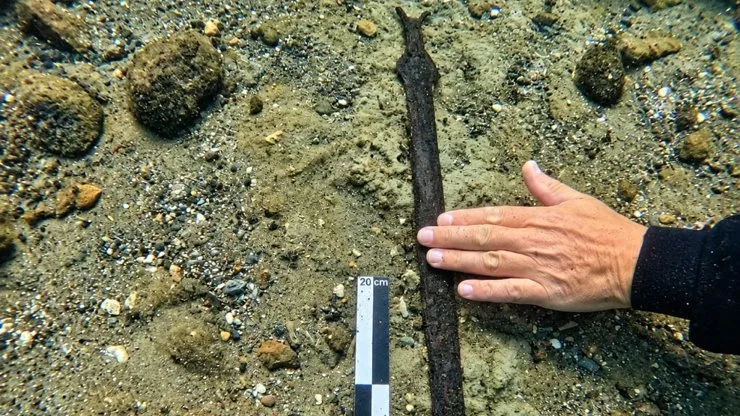
Recent archaeological discoveries in Lake Mizano, located in the Lazio region of Italy, have reignited discussions regarding the existence of ancient bronze artifacts and weapons submerged in the lake for thousands of years, as revealed by the latest underwater research. During excavation efforts conducted in a less-explored area of the southern shore near the town of Valentano, researchers unearthed a new sword alongside intact pottery, a bronze axe, and a razor blade, prompting further inquiry into the reasons behind these valuable artifacts congregating at a single point.
A Bronze Age Settlement
The bottom of Lake Mizano harbors remnants of a vast settlement constructed on wooden stilts, believed to have been in use between 1700 and 1150 BC. Although the site was first discovered in the early 1970s, renewed underwater research initiated in 2025 identified over 600 wooden posts protruding from the muddy lakebed, while the studied area covers only about one-third of the total settlement space. Studies have indicated that the site is rich in bronze artifacts; researchers have previously retrieved more than 25 items, including axes, spearheads, jewelry, needles, and a well-preserved sickle, along with ingots that suggest metalworking practices were carried out at the location.
The Mystery of the Submerged Weapons
Archaeologists are confronted with a fundamental question regarding how these weapons and precious artifacts ended up at the bottom of the lake. While some suggest they may have accidentally fallen due to the construction of the settlement on wooden platforms and changes in water levels or shoreline, other hypotheses point towards a ceremonial aspect. Researchers note that one of the previously discovered swords was not sturdy enough for combat use, indicating it may have been prepared for ritual purposes and deliberately cast into the water. Although the motives behind the recent discovery of the third sword remain uncertain, the frequency of finding swords, axes, and spearheads in the same area increases the likelihood of intentional offerings rather than mere coincidence, particularly with the concentration of recent discoveries in the less-studied southern part of the lake.
As reported by newturkpost.com.