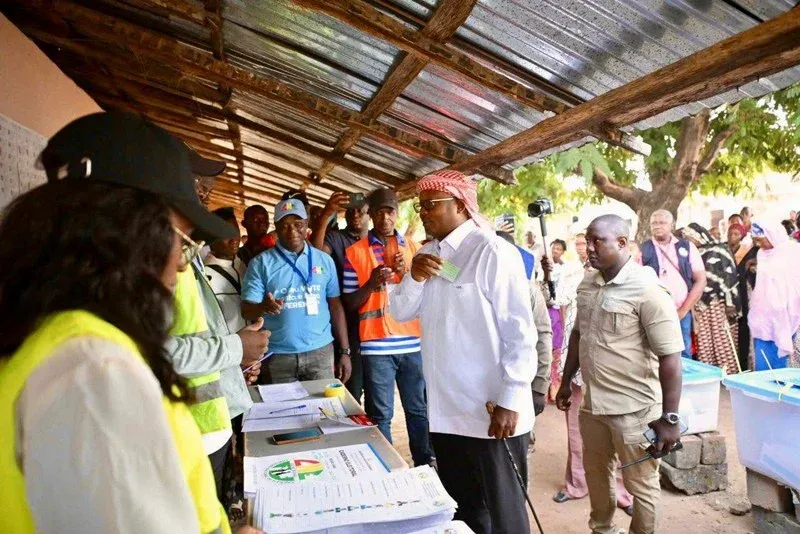

Omaru Sissoco Embalo Sets His Sights on Returning to Guinea-Bissau
Omaru Sissoco Embalo, the former president of Guinea-Bissau, who has been residing in exile in Morocco since being ousted from power, has declared his intention to return to his homeland as a candidate in the upcoming presidential elections scheduled for December 6, 2026. This announcement, made on Monday, comes ten months after a military coup that removed him from office, with the forthcoming elections expected to restore constitutional order in the country.
In a statement to Agence France-Presse (AFP), Embalo expressed his determination to be a presidential candidate, emphasizing his desire to return “home,” albeit without specifying an exact date for his return. Recent social media discussions among supporters of the Democratic Alternation Movement – Group 15 (abbreviated as Madem G15) have suggested that Embalo's return could take place on October 4.
When questioned last week about the possibility of Embalo’s return, General Horta Ntam, who is currently heading the transitional period, affirmed that “every citizen of Guinea-Bissau is free to return to their country as long as they are not held accountable for anything.” He further remarked, “Even those who criticize me on social media can come back if they choose to.” It is noteworthy that a transitional charter established in December 2025 prohibits General Ntam from running in the upcoming presidential elections.
Since November 26, 2025, military leaders have governed the nation after staging a coup against Embalo, effectively suspending the electoral process just prior to the anticipated announcement of preliminary election results. Observers have raised doubts regarding whether Embalo orchestrated the coup to halt an electoral trajectory that appeared to be unfavorable to him.
While the military justified their actions by asserting the need to ensure “national security and restore order,” they also claimed that intelligence agencies uncovered a plot to destabilize the country involving local drug lords. Subsequently, the military council organized a constitutional referendum aimed at transitioning from a “semi-parliamentary” system to a strong presidential system. On August 30, voters approved the new constitution with a 70 percent majority.
The new constitution grants the head of state the authority to appoint and dismiss the prime minister and government, as well as dissolve parliament. The opposition, including the African Party for the Independence of Guinea and Cape Verde, a historical party that led the country to independence in 1974, called for a boycott of the referendum, condemning its organization amid a climate of “restrictions on public freedoms.”
The general elections set for December 6 are anticipated to mark a return of civilian governance amid a tense political atmosphere. Guinea-Bissau, located on the west coast of Africa between Senegal and Guinea-Conakry, is one of the Portuguese-speaking African nations that has experienced significant political instability, with a history of four coups and numerous attempts since its independence from Portugal.
Instability and poverty have facilitated the infiltration of drug traffickers in the country, which has become a transit point for cocaine smuggling between Latin America and Europe.
As reported by hespress.com.