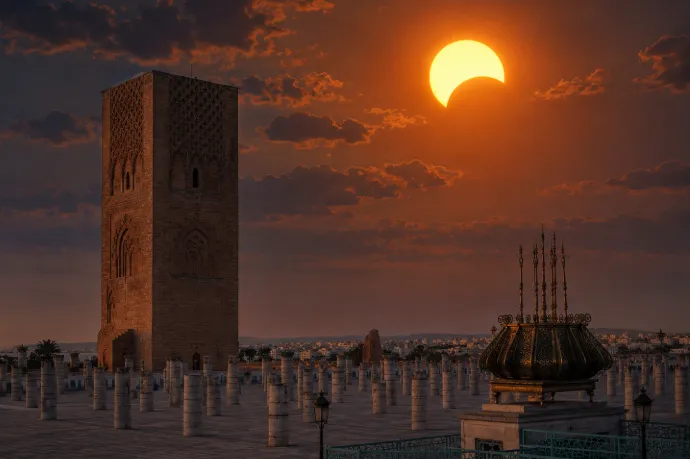

Partial Solar Eclipse to Occur Across Morocco
On the evening of Wednesday, August 12, 2026, Morocco will witness a captivating astronomical event—a partial solar eclipse that will be visible across various regions in the northern hemisphere. Notably, this eclipse will be total in specific areas, including parts of Spain, Iceland, Greenland, and northern Russia. The solar eclipse occurs when the moon passes between the Earth and the sun, obscuring a portion of the sun's light from certain locations on the Earth's surface. The shape of the eclipse and the extent of the sun's obscuration depend on the observer's geographical position relative to the moon's shadow and penumbra.
In regions where the moon's central shadow passes, a total eclipse will be observed, while areas within the penumbra will experience a partial eclipse, with varying degrees of obscuration based on proximity to the path of totality. In Morocco, the eclipse will not be total, as the country lies outside the path of the moon's complete shadow. However, a significant partial eclipse will be visible, with the degree of obscuration differing across various regions of the kingdom.
Timing and Visibility of the Eclipse Across Morocco
The partial eclipse will commence in Morocco during the evening hours, starting shortly after the afternoon prayer and continuing until just before sunset. The exact timing of the beginning, peak, and conclusion of the eclipse will vary from one city to another. For instance, in Tangier, the eclipse will begin around 18:44 Moroccan time, reaching its peak around 19:40. In Rabat, it will start at approximately 18:47 and achieve maximum obscuration around 19:43. Casablanca will see the phenomenon begin at 18:48, peaking at approximately 19:43, while Marrakech will experience it starting around 18:52 with the peak at 19:46. Agadir's eclipse will commence around 18:54 and peak at 19:49. The end of the eclipse will depend on the geographical location and the sunset time, with some areas concluding the event before sunset, while others will extend close to it.
Northern Morocco is expected to be the prime location for observing the eclipse due to the higher percentage of obscuration compared to southern regions. In some northern areas, the obscuration could exceed 92%, particularly in Nador, Tangier, Tetouan, and Al Hoceima. Rabat will see an obscuration of around 88%, while Casablanca will experience about 87%, and Fes will exceed 89%. The obscuration percentage gradually decreases as one moves southward, reaching lower levels in Marrakech and Agadir, and dropping significantly in the southern provinces, where it may reach about 70% in Laayoune and around 60% in Dakhla.
Internationally, the path of the total eclipse traverses specific regions of the North Atlantic, parts of Greenland, Iceland, and northern Russia, reaching Spain, where northern and eastern areas will witness a total eclipse. In contrast, large parts of Europe and North Africa, including Morocco, will experience the phenomenon as a partial eclipse. The experience will vary by locality; the closer an observer is to the moon's central shadow path, the greater the percentage of the sun's disk will be obscured.
Experts caution against looking directly at the sun during the partial eclipse, even when much of its disk is obscured. The remaining part of the solar disk can still inflict serious, permanent damage to the retina. It is recommended to use specialized solar viewing glasses that meet safety standards, emphasizing that regular sunglasses do not provide adequate protection. Additionally, one should avoid looking at the sun through cameras, binoculars, or telescopes without proper solar filters, as these instruments can concentrate sunlight and cause severe eye injuries.
For those without specialized equipment, indirect viewing methods such as projecting an image of the sun through a small aperture onto another surface can be utilized instead of directly gazing at it. Given that the phenomenon occurs close to sunset, choosing a location with an unobstructed western horizon will be crucial for optimal observation, with a strong recommendation against using eclipse glasses while driving or observing the sun during transit.
Furthermore, the Moroccan Ministry of Awqaf and Islamic Affairs has announced that there will be no eclipse prayers held due to the timing of the phenomenon occurring after the afternoon prayer and before sunset, a time deemed inappropriate for voluntary prayers. Instead, it recommends engaging in supplications and seeking forgiveness. The eclipse on August 12 presents Moroccans, especially those in the northern regions, with an opportunity to observe a noteworthy astronomical event, as the sun's obscuration may approach 93% in certain areas. However, even with a high obscuration percentage, protecting one's eyes remains essential for safely enjoying the eclipse.
As reported by lakome2.com.