
Leadership and Cooperation in Times of Crisis
Just a month after his appearance in Ceuta, Spanish Prime Minister Pedro Sánchez reemerged on Monday following his vacation to discuss the current situation in the Spanish enclave in Africa. During this address, he reiterated his gratitude towards Morocco for its significant role in managing the ongoing migration crisis, distancing the Moroccan government from any alleged involvement in the mass influx of immigrants crossing into Ceuta from its territory. "I have received no information from the Security Forces that would suggest any doubt about Morocco's involvement in this entry," Sánchez stated in an interview with Cadena Ser. He further questioned the motives behind such criticisms, asking, "What does Rabat gain from these tactics?" This sentiment echoes the views expressed by several of his ministers in the Congress of Deputies last week, highlighting the strong bilateral relationship founded on collaborative efforts to combat human trafficking and enhance border security.
Sánchez emphasized that cooperation with Morocco on migration is essential, asserting, "We must acknowledge that this crisis can only be resolved through cooperation with Morocco." He candidly admitted that without Morocco's intervention, the situation in Ceuta would have significantly worsened. The Moroccan authorities reportedly provided an "immediate" response alongside the Spanish government from the onset of the crisis, maintaining communication on July 30 and 31. This narrative aligns with the government's position since the crisis began and serves to commend Morocco's efforts during what is described as the most severe migration crisis in modern Ceuta's history.
Security Concerns and Government Response
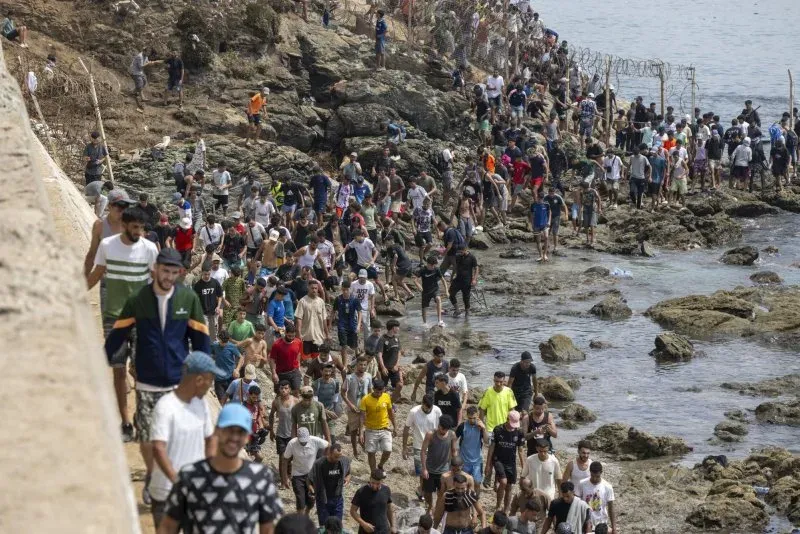
In his remarks, Sánchez did not shy away from addressing the divergent statements made by his Interior and Defense ministers. He aligned himself with the assertions of Fernando Grande-Marlaska, emphasizing that no prior reports from Spanish Security Forces indicated the scale of the crisis at the Tarajal border. "There was no information that conveyed the severity and the magnitude of the crisis we were about to face," he affirmed. While acknowledging that the National Intelligence Center (CNI) did share situational reports in the days leading up to the crisis, he clarified that none predicted that 70,000 individuals would attempt to enter the city. "Certainly, there were CNI situational reports, which led to increased resources being allocated at Ceuta’s borders, but no one anticipated such a massive influx," he explained. Additionally, he attempted to dispel the notion of contradictions among ministerial statements, asserting, "It may seem like there are contradictions, but there are none."
Sánchez conceded that the government cannot guarantee 100% security in Ceuta, emphasizing the necessity of ongoing collaboration with countries of origin and transit regarding migration movements. He stated, "The reality we face is that attacks on a border can originate from networks. We continue to investigate, but the government must act based on certainties. We must collaborate with the countries of origin and transit." Despite the majority of irregular migrants having returned to Morocco through the Tarajal border crossing, about 5,000 individuals, including unaccompanied minors, still remain within Spanish territory. When questioned about the repatriation process for these individuals, Sánchez promised that returns would occur within "reasonable" timeframes and would be carried out in the "most agile" manner possible. He revealed plans to increase the humanitarian assistance capacity in Ceuta from 500 to 6,000 places, stating that this expansion would occur as swiftly as possible. "In just 30 days, the government has expanded from 500 to 6,000 places. We will be able to accommodate all migrants," he proudly declared. However, he remained silent when asked if any of these individuals would be transferred to the mainland.
Sánchez also faced criticism regarding the perceived slow government response to the crisis, which began on July 30, just two days before he commenced his summer vacation at the official residence in La Mareta, Lanzarote. He received backlash not only from opposition parties but also from within his own party, including Ceuta deputy Melchor León. Nonetheless, he defended his right to take vacations, insisting that he remained informed about the crisis throughout. He dismissed claims of a slow response, justifying that a unified command declaration in the city was unnecessary at the time, stating that it was only activated because Ceuta requested it and because every crisis "evolves." This declaration had been sought by Juan Jesús Vivas a day prior to the crisis, on July 29, as dozens of migrants were already crossing the Tarajal pier.
As reported by abc.es.