
The question arises whether **Pedro Sánchez**, the Prime Minister of Spain, has reached any agreements with **Morocco** regarding the autonomous cities of **Ceuta** and **Melilla** that are so lenient and humiliating that he now hesitates to make them public. Alternatively, did he fail to present any significant proposals to defend the Spanish identity of these territories, which have become targets of expansionist ambitions from King Mohammed VI, especially after having 'gifted' the Sahara to Morocco?
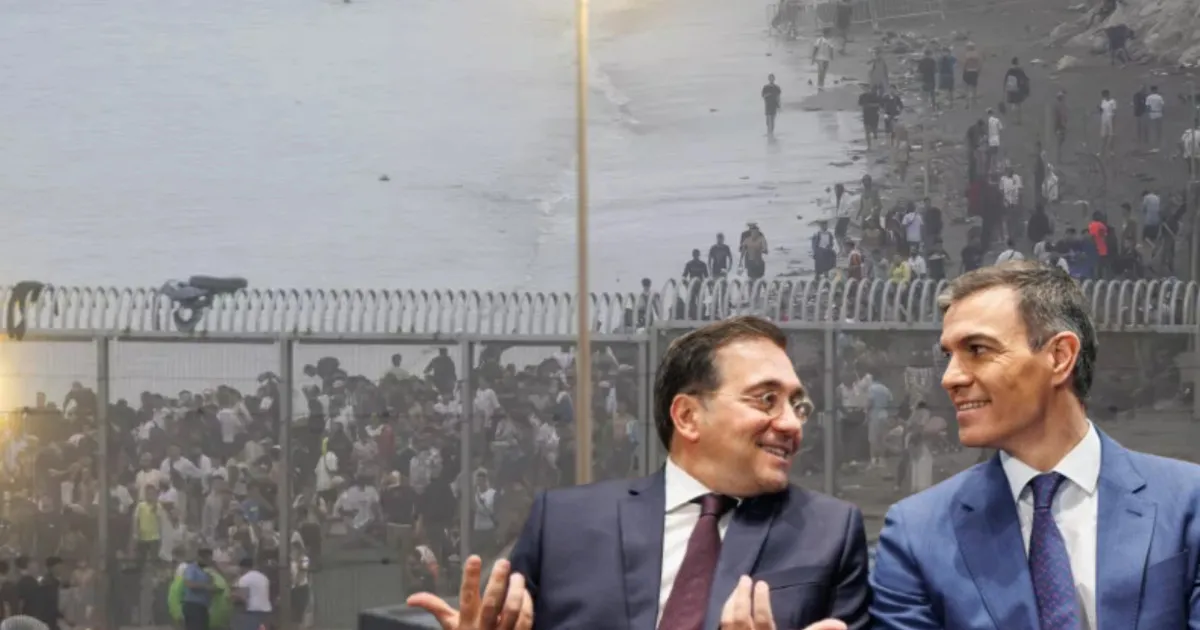
In light of the ongoing surveillance controversy involving the Pegasus spyware, **El Debate** has revealed exclusive documents that shed light on Sánchez's questionable relationship with Rabat. The recent influx of migrants into Ceuta, with approximately 72,000 individuals crossing the border from Morocco, has once again highlighted the fragility of Spain's diplomatic ties with the North African kingdom, leading to a rift within the **Government** itself. While Sánchez and Interior Minister **Fernando Grande Marlaska** have pointed fingers at 'mafias' for this surge, steering clear of implicating Morocco despite its monarch’s influence over events in the country, Defense Minister **Margarita Robles** has taken a firmer stance. She has called on Morocco to 'investigate and get to the bottom of what happened,' emphasizing that those responsible must be held accountable.
Political Leverage Through Migration Waves
Interestingly, **José Manuel Albares**, the Minister of Foreign Affairs, has gone further than others in praising Morocco, asserting that it is a 'reliable partner' because it 'offered its cooperation from the very beginning' to curb the flow of migrants. Such flattering remarks seem out of place given the current circumstances, as many doubt Morocco's commitment to taking all necessary measures to prevent the crisis. However, diplomatic protocols dictate that efforts to avoid upsetting the neighboring country involve endorsing its management, even concealing whether any agreements reached during the XIII High-Level Meeting in December included topics related to airspace management, commercial customs in Ceuta and Melilla, and the handling of migration surges, as per the documents accessed by **El Debate**.
These migration waves were previously employed by Morocco as a pressure tactic in **2021** after the Spanish government allowed the leader of the Polisario Front, **Brahim Ghali**, to receive treatment in a Spanish hospital. Since then, under circumstances that the **Government** has yet to clarify—amidst the looming threat of surveillance on **Sánchez** by Pegasus—Spain's relations with Morocco have consistently shown a pattern of concession to Moroccan demands. This is particularly evident in Sánchez's controversial decision to surrender sovereignty over **Western Sahara**, a significant departure from a position held for decades that was irrevocably altered in 2022 in response to Moroccan pressure.
Moreover, the issue of border control has become Morocco's primary leverage tool, corroborating the concerns of the **United States**, where congressional discussions have questioned the Spanish sovereignty over **Ceuta** and **Melilla**. This is music to the ears of King Mohammed VI, even as Sánchez and Moroccan Prime Minister **Aziz Akhannouch** declared in December that 'the principles of national sovereignty and territorial integrity, along with the protection of human rights, are cornerstones of peaceful coexistence between peoples.' Yet, such declarations appear to have fallen on deaf ears given the current situation in Ceuta.
Both **Sánchez** and **Albares** have opted to disregard inquiries posed by this newspaper regarding the recent surges at the borders. Based on documents obtained by **El Debate**, it seems the Prime Minister has distanced himself from the matter, leaving it to **Albares**, who also remains silent despite being instructed to clarify whether any agreements with Morocco were made concerning this issue during the December meeting. The only acknowledgment of this matter is found in the joint declaration signed by both leaders, which seems more like a token gesture in light of recent events. They reiterated their 'common commitment to dynamic mobility that enables safe, orderly, and regular movement of people,' while Sánchez endorsed Morocco's approach, which 'rests on an exemplary framework based on regularization, socio-economic integration, and the protection of migrants' rights.'
Additionally, both nations committed 'to strengthen their efforts against irregular immigration, human trafficking, document fraud, and human exploitation by adopting effective measures and enhancing cooperation with third countries, among other strategies.' Yet, these remain empty promises considering the ongoing situation.
During that period, the **Government** did sign **fourteen agreements** with Morocco covering a wide range of topics such as 'feminist foreign policy,' combating hate speech, digitalization and modernization of public administrations, education, disaster prevention, sustainability, and equality. Additionally, they addressed significant economic issues such as 'cooperation in maritime fishing, the development of aquaculture, and the fight against illegal fishing.'
As for whether Sánchez secured any agreements regarding the migratory surges akin to the 72,000 individuals overwhelming Ceuta, the **Government** is compelled to respond. The investigation by **El Debate** unveiled memoranda of understanding and intentions that Sánchez aims to use to ease tensions with Morocco, yet he has faced resistance from the Government in clarifying critical matters, as evidenced by the invasion of Ceuta. This newspaper specifically requested 'the agreements or protocols established with Morocco regarding airspace management, customs in **Ceuta** and **Melilla**, and migration waves,' but Moncloa's legal department deflected the inquiry to **Albares**.
Specifically, they indicated that they did not possess 'the requested information (...) as it does not fall within this body’s scope of competence,' thus passing the issue to the Ministry of Foreign Affairs 'so that said department can process the new request within its areas of responsibility.'
However, **Albares** has disregarded this and has not responded, prompting the Transparency and Good Governance Council to mandate him to do so in its resolution 2026-0640, issued on June 16. They further reminded him that the right to information is a constitutional right and, therefore, he is obligated to provide a response.
According to consulted sources, 'if Albares fails to comply with his legal obligation to disclose this information as mandated by an executive resolution, he will face legal action, similar to previous circumstances involving the private use of the Falcon by Begoña Gómez or Pedro Sánchez's 88 days of vacation at National Heritage residences along with his companions,' states Julio R. Naranjo, managing partner of ITCD, the law firm handling these matters.
As reported by eldebate.com.