
Political Dynamics in Nador Ahead of 2026 Elections
As the official process for submitting candidacies for the four parliamentary seats in the Nador constituency kicks off for the upcoming election scheduled for September 23, 2026, the local political arena is transitioning from a phase of subtle preparation to an overt confrontation measured by strategy and meticulous planning. This administrative step is not merely a routine formality but serves as a declaration of the commencement of a fierce political battle involving seasoned candidates who have accumulated significant electoral experience and entered the fray with clearly defined strategic maps, reminiscent of a chess game.
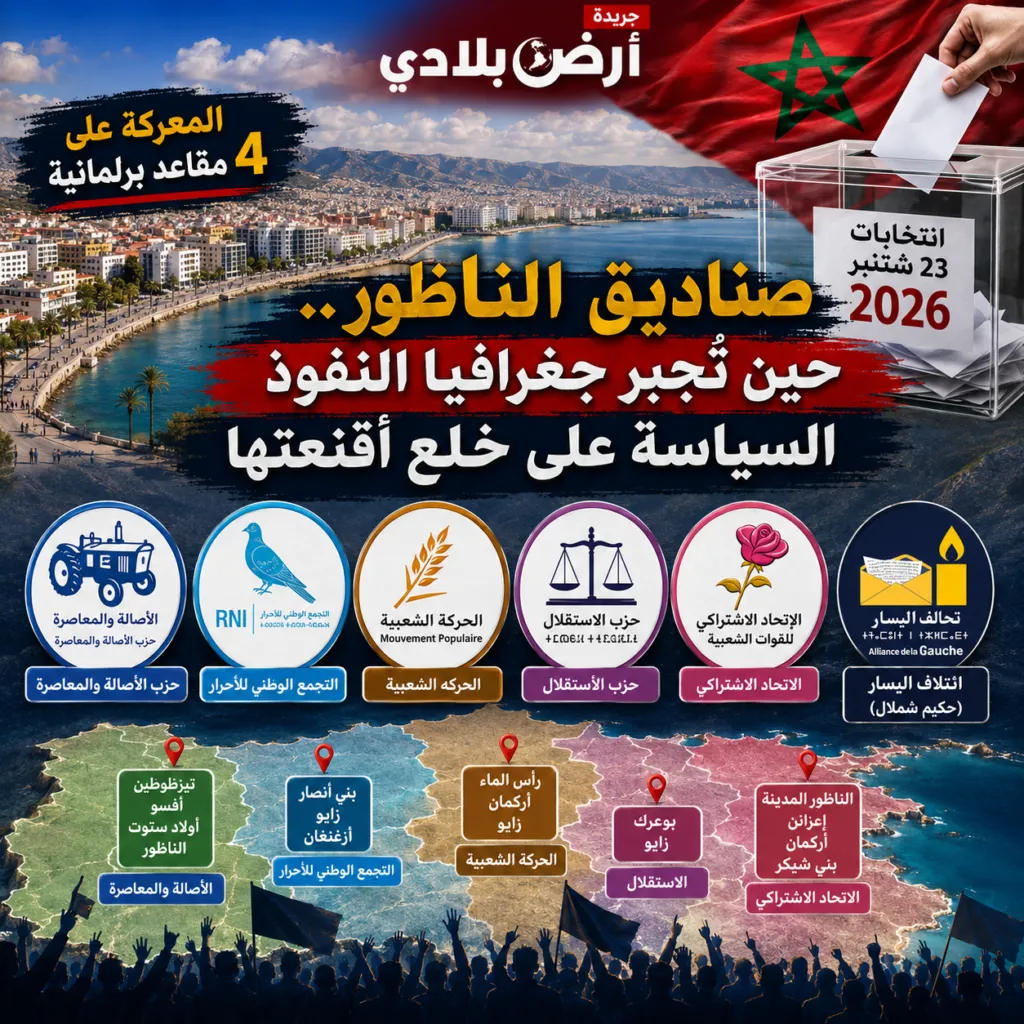
A closer examination of the submitted candidacy list reveals that the Nador region is not experiencing a renewal of its competitive elite; instead, it seems to be entering a 'round of Iad' among major players. Apart from the entrance of Hakim Shmallal, representing the leftist coalition, the remaining major parties are rallying behind familiar faces adept at crafting equations of influence. Notable candidates include Mohamed Moumini from the Authenticity and Modernity Party, Halim Fotat from the National Rally of Independents, Mohamed Boudo from the Popular Movement, Mohamadi Touhtouh from the Independence Party, and Mohamed Abrakan from the Socialist Union. This clearly illustrates the political entities' determination to secure their positions by nominating 'electoral engines' capable of direct mobilization.
However, a true analysis of the scene extends beyond mere names; it lies within the electoral geography that candidates have carved out as a distributed power map. The Authenticity and Modernity Party (PAM) is banking on its strongholds in Tiztoutin, Afsou, and Oulad Stout, alongside the city of Nador. In contrast, the National Rally of Independents (RNI) aims to consolidate results through three key areas: Beni Ansar, Zaiou, and Azghenghan. Meanwhile, the Popular Movement is striving to solidify its foothold by relying on the regions of Ras Elma, Arkman, and Zaiou, while the Independence Party bets heavily on the Bouarick and Zaiou blocs. The Socialist Union is also reorganizing its strategies within the urban precincts of Nador city, Iznane, Arkman, and Beni Cheker.
Implications of Electoral Geography
This implicit division of influential regions raises a critical question regarding the extent of ground strength and its resilience against changes in public sentiment. Relying solely on 'traditional reservoirs' is no longer a foolproof guarantee for securing the four seats, as the political landscape in an interconnected region like Nador has taught us that success is not only achieved by collating assured votes but also by candidates' abilities to penetrate rival territories and forge shifting alliances right up to the last moment. As candidates navigate their calculations and voters make their decisions, all possibilities remain on the table as the final verdict approaches.
As reported by ardbladi.com.