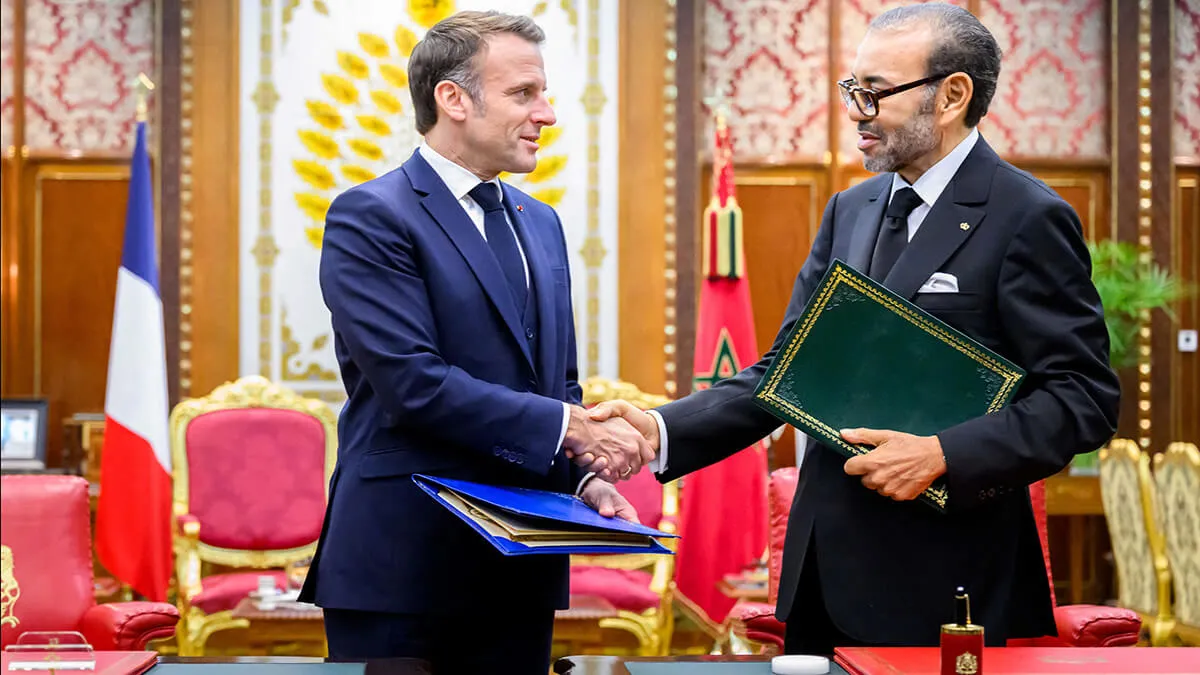

The negotiation of a treaty that marks the commencement of a new phase in the bilateral relations between Paris and Rabat has resulted in the postponement of Moroccan King Mohammed VI's visit to France until early 2027. This delay is attributed to the need for comprehensive political measures and the development of an integrated and long-term strategic agreement.
Beyond its symbolic significance, King Mohammed VI's visit to France could represent a pivotal moment in the relationship between the two nations, especially at a time when international alliances are being redefined and the global landscape is undergoing significant changes.
Towards a Long-Term Strategic Framework
In the context of a complex geopolitical landscape, Paris is seeking to enhance its strategic partnerships beyond the European Union, while Rabat aims to solidify its growing diplomatic, economic, and geopolitical influence in Africa and its regional environment. Both parties aspire to formulate a treaty that transcends a mere bilateral agreement, aiming to establish a political and strategic framework for long-term relations between Morocco and France.
To this end, a joint committee has been established to draft the text of this pact, reflecting the commitment of both parties to utilize King Mohammed VI's visit to Paris as an opportunity to sign a politically and strategically significant agreement. This committee is composed of eleven prominent figures, including six Moroccans and five French nationals, drawn from diplomatic, political, economic, industrial, cultural, and academic backgrounds, with the goal of laying the groundwork for a new architecture for bilateral relations.
On the French side, the committee's work is overseen by former Minister of Foreign Affairs Hubert Védrine, while the Moroccan team is coordinated by Chakib Benmoussa, High Commissioner for Planning and former ambassador to Paris. The committee also includes notable personalities such as Florence Parly, Ross McInnes, Sarah El Haïry, and Christian Masset from France, as well as Mostafa Terrab, Mounia Boucetta, Driss El Yazami, Leïla Slimani, and Rachid Benzine from Morocco. The group is addressing the key pillars of the future Franco-Moroccan partnership, encompassing areas such as economy, defense, diplomacy, culture, education, migration, and the ties between the two societies. The preparatory work of this committee will serve as a foundation for subsequent official negotiations between the two governments.
The Sahara at the Heart of the Debate
The preparations for the visit extend beyond merely setting the date for the royal protocol and the schedule of meetings; they also include the development of a political dossier and a comprehensive agreement that reflects the nature of this new phase, with the Sahara being a central political component. The issue of the Sahara is, therefore, considered one of the main points necessitating in-depth reflection in anticipation of the future treaty between Paris and Rabat. Despite France's stated position in 2024, which clearly supports the autonomy plan proposed by Morocco, Rabat seeks to have this position explicitly included in the text, affirming its sovereignty over the Southern provinces.
Consequently, the signing of this new bilateral treaty between the two nations would represent a significant diplomatic advancement, potentially contributing to a definitive resolution of the Sahara dispute and strengthening the new strategic alignment between the two countries. However, this evolution could also impact the balance of Franco-Maghreb relations, particularly concerning the ties between Paris and Algiers.
After several months of diplomatic tension, the rapprochement process between Morocco and France commenced in 2023, culminating more clearly in July 2024 when French President Emmanuel Macron announced his country's support for Morocco's claim over the Sahara, asserting that the autonomy initiative presented by Morocco represents the only viable path to a sustainable political solution under the auspices of the United Nations. This position marked a historic turning point in the relations between the two nations, which are now aspiring to evolve towards a 'new strategic framework' for their bilateral ties.
Morocco hopes that the French stance on its sovereignty and the autonomy plan will be clearly reflected in the new bilateral agreement, as it symbolizes a tangible demonstration of the depth of the new partnership with Paris and could become one of the most significant elements of the royal visit. In addition to political and strategic cooperation, the areas of security and defense, economy and investment, energy, migration, and cooperation issues in Africa and the Mediterranean will be integrated into the future agreement, transitioning the Sahara issue from a political declaration to a more substantial bilateral cooperation framework.
The postponement of King Mohammed VI's visit to Paris occurs at a crucial juncture in Franco-Moroccan relations. One of the most notable factors is the time required to successfully conduct the political and legal preparations for this new bilateral phase, with the future treaty and key commitments still under definition. The royal visit transcends simple agenda or protocol considerations, and this postponement appears to be linked to several reasons, including internal political calculations such as the upcoming legislative elections in Morocco on September 23 and the opening of the new parliamentary session in October, as well as French political considerations with the presidential elections scheduled for April 2027, making even the January date unlikely to be definitively secured.
This diplomatic event, postponed from autumn 2026 to early 2027, is intended to serve as a milestone in the consolidation of the strategic shift in Franco-Moroccan relations. Furthermore, the continuation of negotiations between the expert teams from both sides follows more than 40 ministerial meetings between the two countries since the revival of this new dynamic in bilateral relations. The sovereignty of Morocco over the Sahara is a pivotal point, with hopes that the French position will be accurately articulated in the new bilateral framework, necessitating delicate negotiations. Finally, the regional dimension remains a critical factor in formalizing commitments, as the evolution of Franco-Moroccan relations has repercussions that extend beyond the two countries, particularly due to Algeria's position on the Sahara.
As reported by atalayar.com.