
Implications of U.S. Military Base Relocation
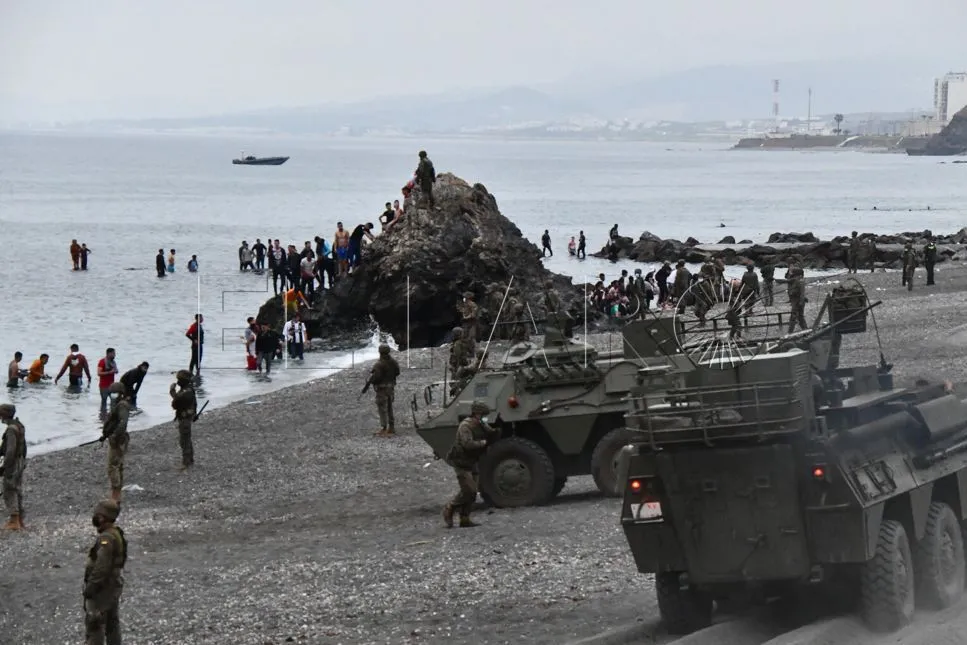
The possible reconfiguration of the United States military deployment within the framework of NATO has raised significant alarms in Spain, particularly concerning its implications for the territories of Ceuta and Melilla. Analysts are expressing concerns that a potential relocation of U.S. military bases from Spain to Morocco could disrupt the strategic balance in North Africa. This discussion has intensified following recent statements from former President Donald Trump, who is advocating for a reevaluation of the U.S. role within the Atlantic Alliance. Trump's criticisms of European allies, whom he accuses of insufficient contributions to defense, have fueled discussions about potential repercussions that could directly impact nations like Spain and Germany.
Political and Strategic Consequences
This scenario has been thoroughly examined on COPE's program, La Linterna, broadcasted by Grupo Faro in Ceuta, where various experts delved into the political, military, and strategic ramifications of a possible U.S. military withdrawal from Spanish territory. While there are debates about the real feasibility of a formal U.S. exit from NATO, the focus remains on the practical consequences that could arise from unilateral decisions. Journalist Mayte Alcaraz warned that NATO could find itself in an extremely precarious situation, suggesting it could be left 'mortally wounded.' According to her analysis, a formal withdrawal may not be necessary for the U.S. to weaken NATO; a reduction in its involvement or collaboration in critical scenarios, such as the conflict in Ukraine, may suffice.
In this context, Alcaraz noted a recent closed-door meeting between Trump and NATO Secretary General Mark Rutte, which has raised concerns given that Rutte seemed to validate some of Trump's propositions. Antonio Arráez emphasized NATO's origins as a 'containment wall' against the former Soviet Union, highlighting that it has historically been a structure led and financed by the U.S. However, he insisted it should be viewed as a 'defensive and cooperative element,' rather than a tool for 'manufacturing wars,' a perspective that contrasts sharply with Trump's political style, which he described as 'carnival-like' and 'egocentric.'
Yet, the most alarming aspect of these analyses is not merely the potential withdrawal of U.S. bases from Spanish soil but rather their potential relocation. Arráez was unequivocal in this regard: 'The problem is not just leaving Spain, but where they go.' The hypothesis that the U.S. could transfer its military infrastructure to Morocco introduces a significant shift in the geopolitical landscape of North Africa. Such a move would have direct implications for Spain, especially regarding the security and stability of Ceuta and Melilla. Arráez issued a stark warning that encapsulates the underlying concern: 'If they leave here for Morocco, be mindful of the next development, and in 15 years, what about Ceuta and Melilla?' This reflection points to a medium- to long-term scenario where the strategic balance could be substantially altered.
Despite the gravity of these hypotheses, analysts also noted that a complete U.S. exit from NATO is legally complex. U.S. legislation requires a qualified majority in both the House of Representatives and the Senate, a political backing that is not guaranteed in the current climate. Additionally, Ángel Expósito highlighted a social and political paradox, referencing the 'traditional left-wing individual' who has historically opposed NATO but may now witness the disappearance of military bases from Spain at the discretion of a U.S. president. Ultimately, the debate reveals that while NATO may not be at immediate risk of dissolution, it is undoubtedly entering one of its most uncertain phases. Decisions made by the United States, as the primary actor in the Alliance, could redefine Europe’s role in defense and open a new geostrategic landscape with direct consequences for Spain.
As reported by elfarodeceuta.es.