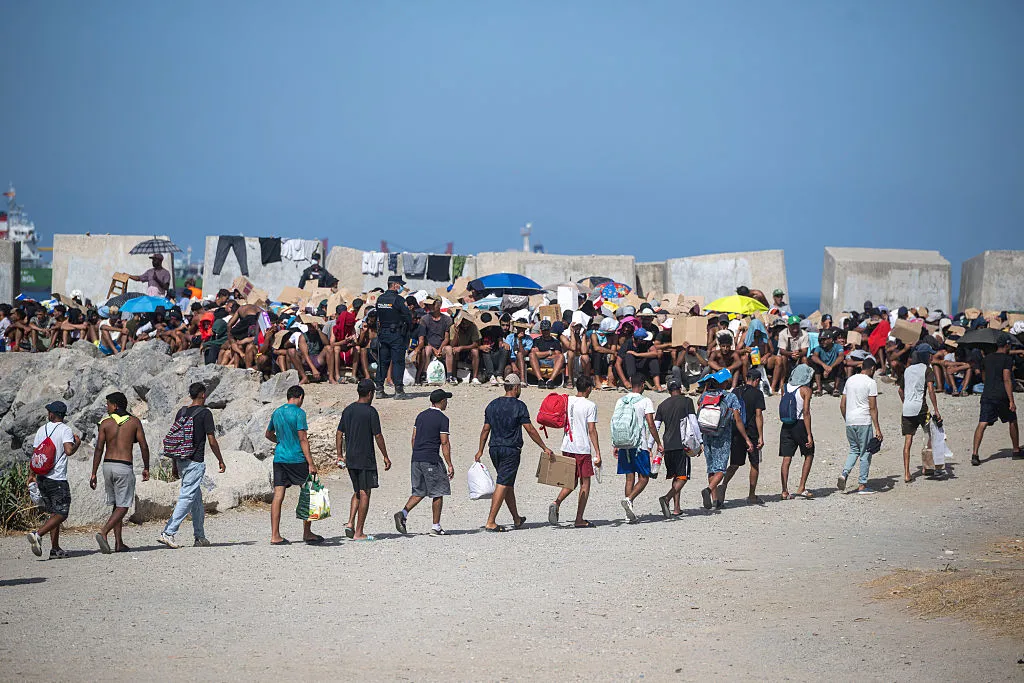

Allegations of Deliberate Migration Surge by Moroccan Authorities
Recent leaks from a report by the Spanish National Police have raised serious allegations that Moroccan authorities orchestrated a significant influx of migrants into Ceuta at the end of July, with the intent to destabilize Spain's border. According to this alarming report from the National Center for Immigration and Borders (CENIF), Moroccan gendarmes purportedly facilitated the movement of thousands of migrants to the border of this small Spanish city located in North Africa. The report, which was uncovered by the Spanish newspaper _El Español_, suggests that the planning and execution of the entry of approximately 72,000 migrants on July 30 and 31—though local authorities estimate the figure closer to 80,000—was closely supervised by Moroccan agents on the ground. This incident has tragically resulted in the loss of over 100 lives, marking a dark chapter in the ongoing migration crisis.
The CENIF report was commissioned by Spain's National Court, the highest criminal jurisdiction in the country, as part of a preliminary investigation into this extensive border crisis. This event is being viewed as potentially the most severe national security crisis in the recent history of Spain. The report indicates that the wave of migrants was intended to overwhelm the Spanish security forces stationed in Ceuta. Furthermore, the police's judicial unit has drawn connections between this event and Morocco's territorial claims over Ceuta and Melilla, another Spanish enclave in North Africa.
Political Repercussions and Calls for Accountability
Jorge Dezcallar, Spain's former ambassador to Morocco and former head of the National Intelligence Centre (CNI), has previously asserted that Morocco's territorial claims over these two cities were instrumental in the orchestrated influx of migrants. He suggested that by allowing such an unprecedented number of migrants to cross into Spain, Moroccan authorities were testing the waters, particularly at a time when they perceive the government in Madrid as weak. The CENIF report concludes that Morocco's ultimate goal was to breach the Spanish and European Union borders under the guise of a migration crisis. Notably, it also mentions that approximately 70,000 individuals who entered Ceuta voluntarily returned home within hours.
This explosive report has sent shockwaves through the political landscape in Madrid, leading to widespread scrutiny of the Socialist Party's (PSOE) complacency towards Rabat. While Prime Minister Pedro Sánchez initially condemned the influx as a violation of Spain's territorial integrity and acknowledged that Moroccan ministers publicly claimed sovereignty over Ceuta and Melilla, Madrid has yet to take concrete action against what it describes as a 'loyal ally.' In fact, the Moroccan ambassador in Spain has not even been summoned for questioning regarding these allegations.
Spain and Morocco's official narrative attributes the crisis to human trafficking networks and misinformation circulating on social media—a hypothesis that has been challenged by security forces and Spanish experts. Amid the political fallout, Interior Minister Fernando Grande-Marlaska has requested a briefing from the police chief, Francisco Pardo, regarding the content and veracity of the report. A spokesperson for the ministry emphasized that these 'essential' findings should have been brought to the attention of the executive branch and the National Security Council immediately. The report is currently in the hands of Judge Maria Tardón and the public prosecutor's office, which will soon determine whether a judicial investigation is warranted.
As reported by euractiv.com.