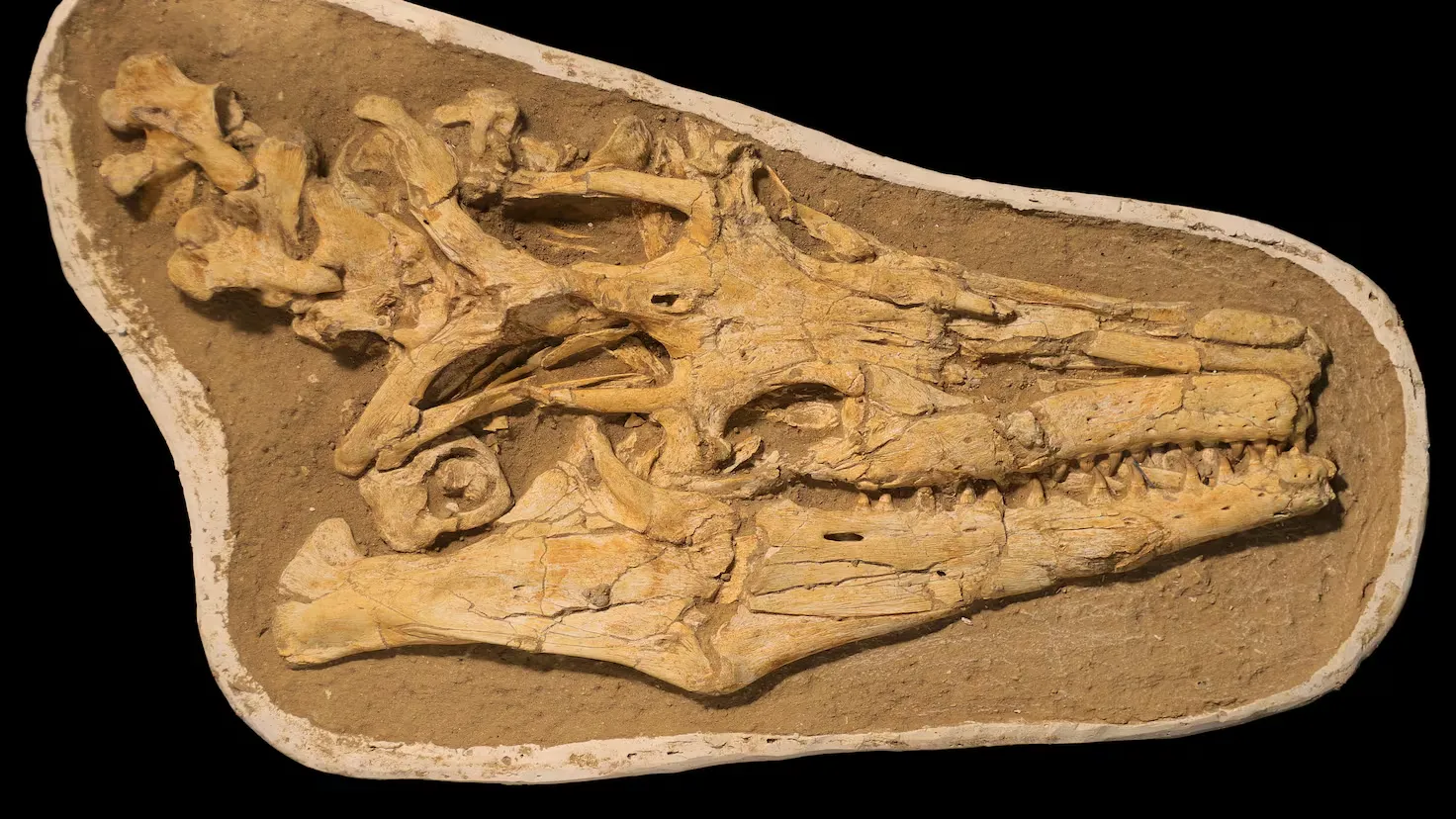

A groundbreaking discovery in Morocco has led scientists to reconsider the dynamics of marine ecosystems just before the mass extinction of the dinosaurs. Paleontologists have unearthed the fossil remains of a new giant mosasaur species, named Pluridens imelaki, which inhabited the Earth's oceans approximately 66 million years ago, right before the catastrophic event that wiped out the dinosaurs.
The excavation took place at the Sidi Chennane mining sites, where researchers uncovered fossils of this remarkable marine reptile. What has captivated scientists is how this colossal creature deviates from the established image of Cretaceous marine predators. Measuring between eight and nine meters in length, Pluridens imelaki does not possess the massive jaws typically associated with large marine predators of its time. Instead, it features a narrow, elongated snout filled with small teeth, suggesting adaptations aimed at capturing fast fish and smaller prey.
This unusual anatomy has puzzled researchers as it indicates that enormous marine reptiles did not solely compete for the largest prey in the ocean. Instead, some species, like Pluridens imelaki, developed much more specialized hunting strategies. Previously, some segments of the scientific community believed that large marine reptiles were in decline just before the asteroid impact that caused the mass extinction. However, the discovery of this unique mosasaur suggests otherwise. Researchers now posit that the northern African oceans remained rich and diverse ecosystems in the late Cretaceous period, teeming with highly evolved species and specialized predators that continued to adapt to their surroundings.
Furthermore, this find reinforces the notion that Morocco is home to some of the most significant paleontological sites on the planet. The discovered remains are currently undergoing analysis and conservation at the Museum of Natural History in Morocco, where experts are diligently studying the anatomy and evolution of this new marine species. Scientists believe that these fossils could provide crucial insights into how prehistoric ocean food chains functioned and how large marine reptiles evolved before their eventual extinction from Earth.
As reported by as.com.