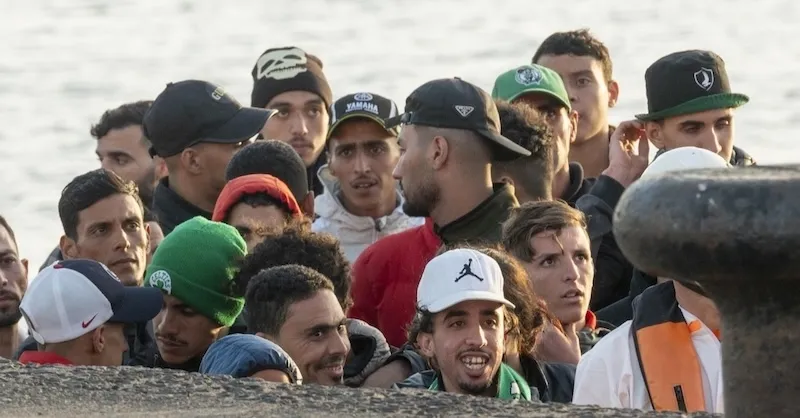

Increasing Migration Trends from Morocco to Ceuta
The past two years have witnessed a significant rise in migration pressure from Morocco towards Spain, particularly through the autonomous city of Ceuta. Recent data indicates that around 3,000 illegal entries have been recorded, with approximately 1,100 Moroccan nationals entering in 2024, 1,400 in 2025, and around 300 in the initial months of 2026. This escalation forms part of a well-documented pattern in the bilateral relations between the two countries, where migration flows and border control are wielded as geopolitical tools of influence.
For Morocco, Ceuta represents a strategic space wherein it can modulate tensions with Spain without overtly escalating the situation to a diplomatic level. By refusing to acknowledge Spanish sovereignty over the city, Morocco perceives the border not merely as a passageway but as a political lever to exert influence. This context reveals that the increasing number of Moroccan nationals crossing into the autonomous city is not solely driven by socioeconomic factors. Instead, it is part of a broader strategy that allows Rabat to disrupt the internal stability of Ceuta, thereby straining public services and intensifying the management of migration flows.
Impact of Moroccan Migration on Ceuta's Stability
The sustained influx of Moroccan adults is accompanied by a particularly sensitive issue: the arrival of unaccompanied minors. The logistical, social, and budgetary implications of this phenomenon are more pronounced for Spain, given the legal obligations surrounding child protection. This deliberate combination of adult and minor migration is not incidental; from a geopolitical viewpoint, Morocco skillfully controls the dynamics of migration in its northern regions. Easing surveillance or permitting the departure of unaccompanied minors sends an indirect diplomatic message to Madrid.
Alongside the rise in migration, Morocco has historically flouted international customs law at the border crossing. The obstruction or restriction of goods, arbitrary enforcement of controls, and the unstable functioning of the Spanish-Moroccan customs agreement—often delayed and renegotiated—generate an atmosphere of economic uncertainty. This behavior aligns with a strategic logic: while the recent data may be particularly striking, the ongoing pressure—both migratory and customs-related—is not an isolated incident but rather a recurring mechanism that Morocco activates based on the prevailing political climate.
Morocco’s capability to 'turn on or off' the migration tap serves as an instrument that intertwines domestic factors—such as social control and local economy—with external goals of calculated diplomatic pressure. Spain must approach this phenomenon not merely as a migration issue but as a hybrid challenge where migration, police action, customs regulation, diplomacy, and security converge.
As the external border of the European Union, Ceuta immediately bears the consequences of this situation: resource saturation, pressure on social services, and structural wear that necessitates rapid, costly, and often improvised interventions. The increase in the number of Moroccan nationals—both adults and minors—coupled with the violation of customs agreements, paints a picture of a deliberate Moroccan strategy aimed at exerting pressure and straining Ceuta’s operational capacity. This is not simply a case of uncontrolled migration phenomena, but rather, movements that are carefully calibrated within the geopolitical landscape of the Strait.
As reported by ceutaahora.com.