
Heightened Tensions: Public Sentiment Against Normalization in Morocco
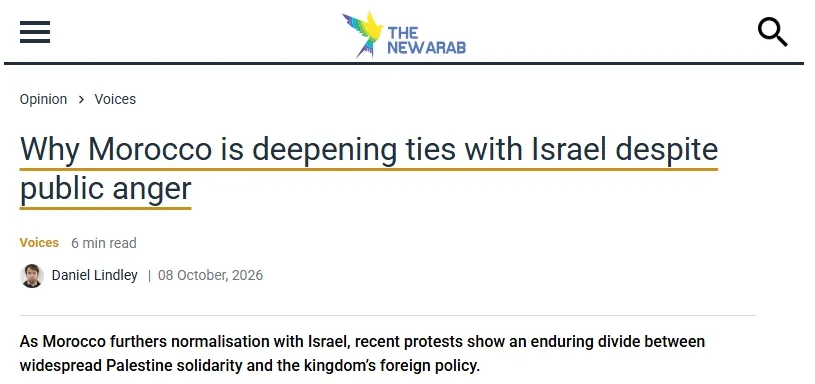
Recent reports from British media outlets have highlighted a significant surge in public anger in Morocco regarding the normalization of relations with Israel. This occurs during a time when the Moroccan government, referred to as "the Makhzen," is actively pursuing closer ties with the Israeli state, which underscores a stark contrast between widespread popular solidarity with the Palestinian cause and the government's foreign policy stance. An article published by the British news site "The New Arab" sheds light on this issue, questioning why Morocco continues to deepen its relations with Israel despite widespread public discontent. The journalist Daniel Lindley notes that a recent survey conducted by the "Arab Opinion Index" revealed that 89% of Moroccans oppose recognizing Israel. Nevertheless, the Moroccan government has announced plans to elevate diplomatic relations with the Israeli state, indicating a significant disconnect between the government and its citizens.
Lindley emphasizes that the normalization with Israel has provoked massive dissent among the Moroccan populace, especially following the recent atrocities in Gaza. Despite this opposition, he predicts that the Makhzen will likely continue its rapprochement with Israel without fear of accountability or repercussions, as public dissent primarily manifests through protests and expressions of outrage rather than through formal political channels. The recent Moroccan elections unfolded in a climate of general frustration and boredom with the political process, further complicating the situation.
During the vote counting process of the recent elections, the Moroccan Front for Supporting Palestine and Against Normalization organized three days of events and protests across 45 cities, expressing their rejection of normalized relations with Israel. It is evident that many citizens view public demonstrations as a more effective means of voicing their concerns and striving to alter their political reality. British activist Lindley believes that the upcoming 2030 FIFA World Cup, which Morocco is co-hosting, could serve as a critical point of contention with the public. He concludes with a grim observation regarding the recent incident in Ceuta, where an estimated 70,000 Moroccans attempted to reach Spain in a desperate bid, resulting in the drowning of 141 individuals—an event that foreshadows troubling times ahead for the country.
Escalating Military Cooperation and the Presence of Israeli Companies
In a related development, the British publication "Middle East Eye" recently reported on the participation of eight Israeli arms companies at an airshow in Marrakech this month, marking a significant milestone in Morocco's military cooperation with Israel. The presence of these companies reflects the accelerating pace of normalization between the Moroccan Kingdom and Israel, a relationship that has strengthened since the signing of the Abraham Accords, driven by Morocco's aspirations for recognition of its purported sovereignty over Western Sahara. French media reports have previously indicated that Morocco has utilized Israeli weapons in Western Sahara, resulting in the deaths of numerous civilians, including children. This alarming trend raises serious questions about the implications of Morocco's military ties with Israel and the ongoing humanitarian crisis in the region.
As reported by aps.dz.