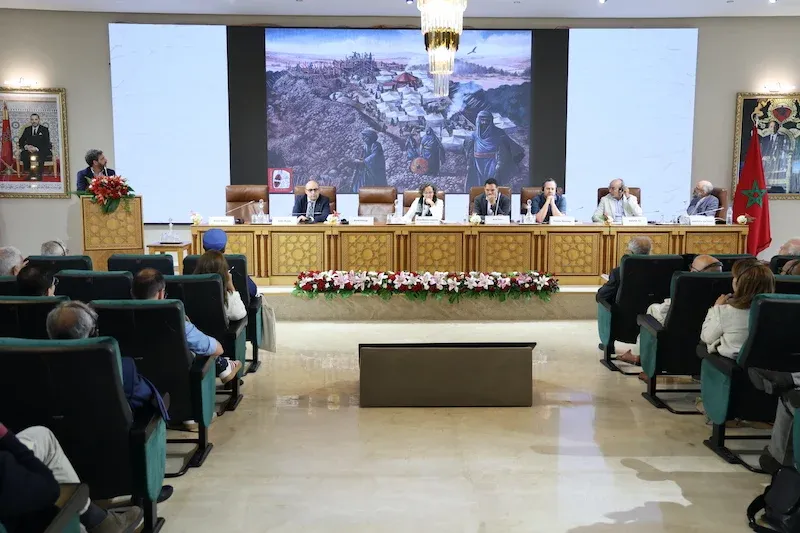

For the second consecutive day, experts specializing in the history of the Almoravids and Almohads from around the world convened in Rabat at the Moroccan Academy, aiming to reassess recent research findings through the lens of archaeology, complex history, and an understanding of the past informed by studies in urban development, military performance, philosophy, and legal frameworks. This gathering also placed significant emphasis on contemporary Moroccan sources.
The discussions on the second day focused on the history of the Almoravid and Almohad cities, their urban development, arts, and archaeological studies, with a particular spotlight on the capital city of Marrakech. Dr. Amira Benison from the University of Cambridge expressed her interest in Marrakech, highlighting the impact of the Almoravids and Almohads on its formation, which evolved from a military camp to the largest urban center in the region by 1150. She noted, “After its establishment, Marrakech expanded immediately and over the centuries… This allowed the Almohads to claim a significant place in the Islamic world.”
Dr. Benison recalled the historical influences on Marrakech’s architecture, referring to examples such as Azouki in present-day Mauritania, as well as southern Moroccan fortifications, including the Qsar of the Wakaqi, Oudaghast, Sijilmasa, and Aghmat. She also discussed the population diversity of the capital, which included residents from Morocco, Al-Andalus, and sub-Saharan Africa, and she touched on the transformation of the region's arid climate through the introduction of gardens and lakes, which played roles in recreation and a sense of belonging, as well as serving as reservoirs for water and food.
David Olson, a researcher from Saint Louis University, presented a lecture titled "From the Mosque to the Market," where he addressed the commercial revolution of the Almohad period. He emphasized that trade during the Almohad era was intertwined with public belief and practice, stating that it was “part of a broader public system of life and family,” evident in measures such as the prohibition of illegitimate taxes. Through a statistical study of Mediterranean trade exchanges during the Almohad period, Olson concluded that this Moroccan state was foundational to the commercial revolution in the western Mediterranean, characterized by an international openness rooted in the Quran and Hadith, as well as the perspectives of scholars like Al-Ghazali on public interest and merchant ethics, leading him to declare this phase as “the dawn of a revolutionary era in trade exchanges.”
Camilo Gómez Rivas from the University of California discussed “Islamic Law as International Law” during that era, elaborating on the organized legal discourse surrounding international exchanges between the Almoravid Muslims and other Muslim entities. He examined the qualitative shifts in Almohad legal discussions with both friendly and unfriendly neighboring Muslims and the negotiations that facilitated the movement of property across the Mediterranean, particularly following the fall of the Taifa kings and the annexation of new lands.
Mohammed Cherif from Abdelmalek Essaâdi University in Tetouan examined the stance of the judge Ibn Iyad in Ceuta during the transition from the Almoravid to the Almohad period, considering it a significant moment of “political and sectarian conflict in the mid-sixth century AH.” He argued that Ibn Iyad’s position was a critique of the Almohad's doctrinal and political foundations and their leadership, reflecting the viewpoint of a Maliki Ash'ari scholar who found himself confronting a redefinition of religious and political authority, rather than merely standing as a representative of the Almoravid power against a new regime.
Among the highlights of the second day was the presentation of new archaeological research pertaining to the Almoravid and Almohad periods, which included historical mosques, cemeteries, and significant sites such as Kelaat and Tinmel, along with architectural advancements. This was underscored by the essential role of “understanding the developments in archaeological research and its qualitative leaps in refining knowledge about the Almoravids and Almohads (…) and the potential impact this has on historical knowledge,” as stated by Abdullah Fili, a professor at the Faculty of Arts and Humanities in El Jadida, in an interview with Hespress.
As reported by hespress.com.