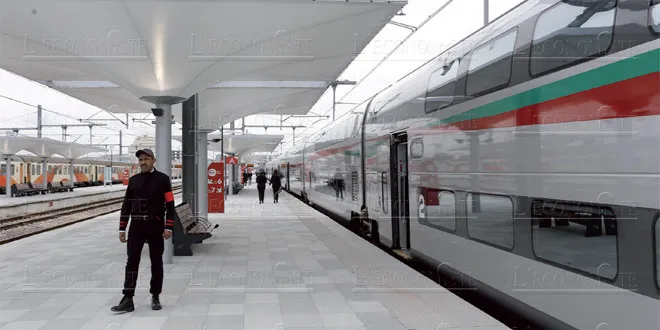
Major Developments in the Kenitra-Marrakech High-Speed Rail Initiative
One year after the inauguration of the high-speed rail project connecting Kenitra to Marrakech by His Majesty King Mohammed VI, the Moroccan National Railways Office (ONCF) is diligently advancing the implementation of this strategic construction effort, which is a cornerstone of Morocco's ambitious national railway modernization agenda. This monumental program, with an overall investment of 96 billion Moroccan Dirhams (MAD), includes the development of a new high-speed rail line along the Kenitra-Marrakech route, allocating 53 billion MAD specifically for infrastructure and equipment. Additionally, it encompasses the acquisition of 168 new trains, representing an investment of 29 billion MAD, aimed at enhancing and renewing the national rail fleet.
Moreover, in alignment with these significant investments, 14 billion MAD has been earmarked for maintaining the performance of the existing rail network. As of April 24, 2025, just one year following the royal launch, ONCF reports substantial advancements across all facets of the project, underscoring its capability to manage large-scale initiatives that promote sustainable mobility, national competitiveness, and regional attractiveness. The construction of the Kenitra-Marrakech high-speed rail line, which spans 430 kilometers, is progressing notably.
All land acquisition processes have been completed, and nearly all construction sites have been cleared, reflecting a robust execution dynamic and effective coordination among all involved stakeholders. Civil engineering works are advancing steadily throughout the entire alignment, with earthworks and the construction of major structures proceeding according to the established timeline. To date, approximately 20 million cubic meters of soil have been excavated and filled. Significant progress has also been made on major structures, with 15 viaducts currently under construction and three covered trenches being developed near the Casablanca airport, Zenata, and Aïn Atiq, totaling 1.5 kilometers.
In addition, work has commenced on 92 structures related to rail and road bridges. The procurement of railway materials is also on schedule, with nearly 2.5 million tons of ballast, 800,000 tons of sleepers, over 100,000 tons of rails, and 220 track switches secured to support the project's progression. Simultaneously, work on operational tracks has commenced on various segments, with track-laying operations actively continuing. The signaling systems are in the preparatory phase, set to be deployed within the designated timelines.
Economic Impact and Future Prospects
Regarding passenger stations, the architectural concept has been finalized, and construction is proceeding in phases. The first phase began in early 2026, with all stations expected to commence operations by July 2026. Beyond its infrastructural significance, this program serves as a potent lever for national economic development. Currently, nearly 150 companies are engaged in various aspects of the project, with about two-thirds being local enterprises. This initiative illustrates the structuring effect of ONCF’s program on Morocco's economic fabric while enhancing local skills, expertise, and industrial excellence.
Thus, the future Kenitra-Marrakech high-speed rail line stands as a pivotal step in the modernization and expansion of Morocco's railway network. Ultimately, it embodies the ambition for sustainable, efficient mobility that is firmly aligned with the economic and territorial development goals of Morocco under the enlightened guidance of His Majesty King Mohammed VI.
As reported by leconomiste.com.