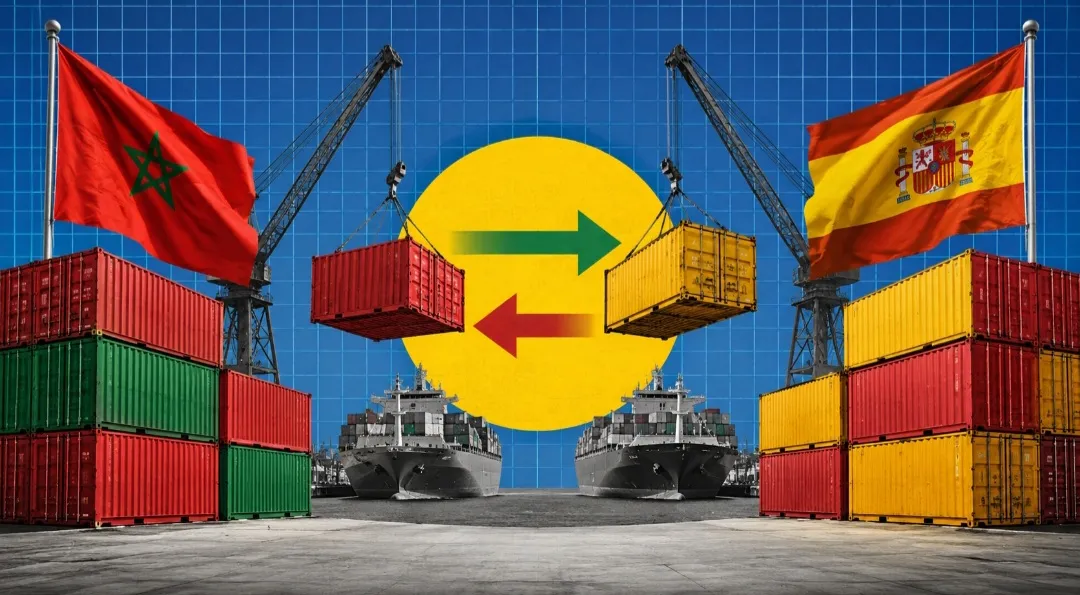

The year 2025 marked an unprecedented transformation in trade dynamics between Morocco and Spain, as the bilateral trade balance shifted in favor of Morocco for the first time, ending decades of Spain's dominance in exports to the Moroccan market. According to data from the United Nations International Trade Database, Spain's imports from Morocco exceeded its exports to Morocco by approximately 3 billion euros, indicating a rapid change in the trade structure between the two nations.
The figures reveal the extent of this shift over a brief period. In 2024, the value of Moroccan exports to Spain was around 16 billion euros, while Spain's imports from Morocco reached roughly 18 billion euros, resulting in a Spanish surplus close to 2 billion euros. However, this equation reversed in 2025, with Moroccan sales to the Spanish market soaring to 19.6 billion euros, while the value of imports from Spain to Morocco decreased to 16.5 billion euros, thereby generating a surplus for Rabat exceeding 3 billion euros.
According to María Ángeles Ruiz Izbellita, a professor at EAE Business School, this development is not merely linked to the political tensions that have occasionally characterized the relationship between the two countries, but rather reflects the significant changes occurring within the Moroccan economy itself. The Spanish expert notes, as published by The Objective, that Morocco has been rapidly increasing its exports, nearly doubling its total external sales within just three years, while also reducing its imports from other markets, including the United States.
The types of goods exchanged provide part of the explanation for this transformation. Liquefied natural gas stands out as one of the primary products that Spain sells to Morocco in terms of value, while cables, electrical components, and equipment dominate the list of Moroccan exports destined for the Spanish market. This highlights the growing significance of Moroccan industrial activities associated with production and manufacturing chains, contrasting with the strong presence of energy in the Spanish side of the trade.
Simultaneously, the growth of Moroccan exports is no longer confined to industrial products; the presence of agricultural and food products has expanded as well, including olive oil and argan oil used in cosmetics and perfumes. Ruiz Izbellita points out that Morocco previously relied on importing agricultural equipment and technology but has now transitioned to exporting more in this sector than it imports, benefiting from advancements in production and changes in access conditions for various agricultural and food products to the European market.
The expert suggests that if the current trajectory continues, Spain may find it challenging to regain its previous trade surplus, as Madrid's capacity to increase exports to Morocco is not limitless. Natural gas, which constitutes its most valuable exports, is tied to needs that do not grow at the same pace as Morocco's expanding exports of industrial and agricultural products. Conversely, Morocco benefits from its geographical proximity to Spain and the European market, gradually boosting its sales.
In conclusion, the figures from 2025 reveal a transformation that goes beyond a temporary deficit in Spanish accounts; they reflect the rise of Moroccan export capacity and the diversification of products that are now finding their way into the largest neighboring European market. If this trend persists in the coming years, the Spanish deficit could evolve from a statistical anomaly to a new characteristic of trade relations between the two countries.
As reported by assahifa.com.