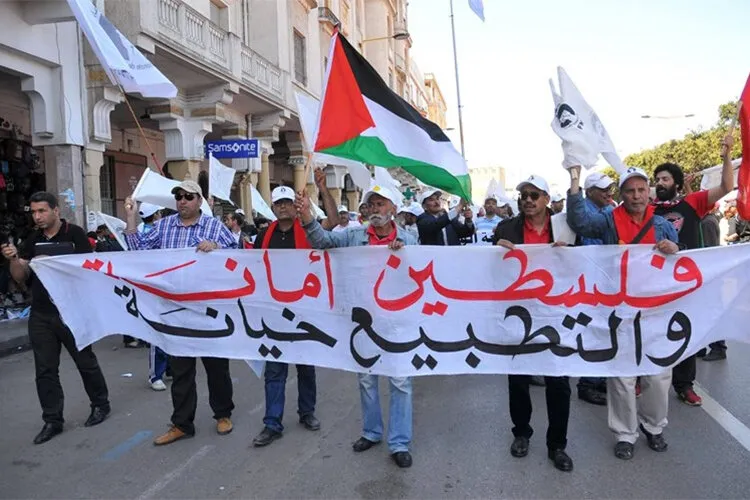

On Friday, Morocco and Lebanon witnessed a surge of popular and religious activities aimed at expressing solidarity with Al-Aqsa Mosque and the Palestinian people, particularly in light of escalating settler incursions during the Jewish holiday season. In Morocco, a significant gathering took place outside the parliament in Rabat, organized by the Moroccan Initiative for Support and Advocacy alongside the National Action Group for Palestine. Demonstrators proudly displayed Palestinian flags and vocally supported the cause, all while demanding an immediate cessation of normalization efforts with Israel.
Abdel Hafiz al-Sariti, the coordinator of the National Action Group for Palestine, articulated the critical situation facing Al-Aqsa Mosque, urging for a united Arab and Islamic response to safeguard this revered site. He emphasized that the Moroccan populace is unwavering in its support for Palestine, declaring, “Al-Aqsa Mosque is in danger and everyone must act.” This demonstration in Rabat was part of a larger wave of activism that spanned multiple Moroccan cities, all aimed at championing the Palestinian cause and opposing normalization with Israel, which has been a contentious issue since Morocco resumed diplomatic ties with Israel in late 2020, a relationship that had been suspended since 2002.
Meanwhile, in Lebanon, numerous mosques dedicated their Friday sermons and solidarity initiatives to Al-Aqsa Mosque, responding to calls for a “Day of Anger and Support for Al-Aqsa.” At Sayyidna Ibrahim Mosque in Sidon, Sheikh Mahmoud Samhoun underscored that supporting Al-Aqsa is a shared responsibility that transcends national borders, urging both the Arab and Islamic nations and individuals to remain vigilant and active in raising awareness about the situation at the Mosque. Such sentiments echoed in other mosques, including Dawood al-Ali Mosque in Wadi al-Zeina, Saadiyat Mosque, and Abu Bakr al-Siddiq Mosque in Qaraoun, where congregants condemned Israeli assaults on holy sites and rallied in support of Al-Aqsa and the Palestinian cause.
The solidarity initiatives extended into Palestinian refugee camps and communities across Lebanon, where the focus remained on Jerusalem, Al-Aqsa Mosque, and the urgent need to prevent the normalization of repeated attacks against the Mosque. These actions coincided with a noticeable increase in settler incursions into Al-Aqsa Mosque, especially during the Jewish holiday season. The Jerusalem governorate reported that between September 12 and October 1, a staggering 11,409 settlers entered Al-Aqsa Mosque, with 9,138 of those during the first five days of Sukkot, from September 27 to October 1.
Palestinian organizations have issued warnings that such incursions are part of a broader strategy to alter the status quo at the Mosque and undermine its historical and legal significance. Al-Aqsa Mosque is administered by the Jerusalem Islamic Waqf, which is affiliated with Jordan’s Ministry of Awqaf, and is recognized as an exclusively Muslim place of worship. The events in Morocco and Lebanon reflect a deep-seated commitment to defending Al-Aqsa Mosque and advocating for Palestinian rights amid ongoing tensions.
As reported by en.abna24.com.