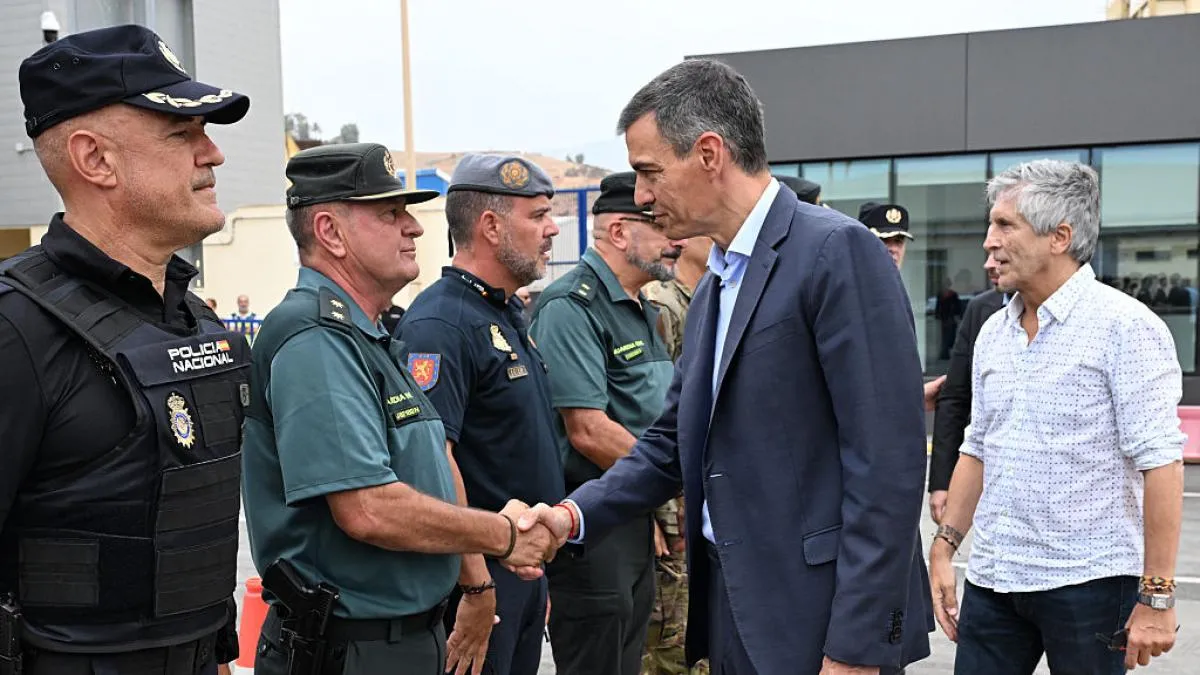

A recent study published by the Democratic Arab Center for Strategic, Political, and Economic Studies in Berlin has indicated a significant shift in Spain's approach to its national security policies regarding immigration. The convening of Spain's National Security Council this month and the activation of emergency laws mark a crucial turning point, highlighting Madrid's transition from a localized security stance to a broader European-oriented sovereign security strategy. This transformation is underscored by the analysis conducted by international law expert Qutaiba Qasim Al-Arab, who explored the future trajectories of bilateral relations between Madrid and Rabat by dissecting the rebound power dynamics and high-stakes shared interests.
The study emphasizes that the Spanish state, with the backing of the European Union, is attempting to develop both legislative and procedural mechanisms that would facilitate the expedited expulsion of migrants at the border fence of Ceuta, all while avoiding international legal condemnation. Spain's adoption of a stringent legislative approach, influenced by strict European policies, is fundamentally aimed at transferring the burden of border confrontations with Morocco from a bilateral framework (Madrid-Rabat) to a collective one (Brussels-Rabat). However, the success of this legal engineering remains contingent upon the delicate balance of field dynamics and the geopolitical pragmatism dictated by the significant mutual interests between the two countries.
Implications and Pressures
The study also notes that the recent events in Ceuta have caused a political rift within Spain's coalition government. The public contradictions in the government's statements extend beyond mere communication failures among ministries; they intersect directly with the pressures of electoral consumption and party fortification within Spain. Prime Minister Pedro Sánchez maneuvers under intense scrutiny and fierce contention from right-wing opposition parties, which are leveraging the immigration issue as a pivotal tool to attract voters and destabilize the government. The summoning of the National Security Council and the internationalization of the issue in 2026 was not merely a responsive measure; it was designed to serve as a domestic political shield. Through this, the government aims to demonstrate its resolve to the Spanish public while preempting right-wing exploitation by transforming the responsibility of border protection into a joint institutional and financial success with the European Commission in Brussels.
Moreover, the activation of Spain's provisions under the new European Migration and Asylum Pact is anticipated to incur a substantial financial cost to transform Ceuta into an 'advanced border processing and sorting area.' Madrid is heavily reliant on funding from the European Union's 'Asylum, Migration and Integration Fund' and the Internal Security Fund to implement these changes.
Strategic Approaches and Dynamics
The study highlights that Spain's approach has not been limited to drafting decrees and amending internal laws; rather, Madrid has swiftly transitioned to an actual procedural internationalization of the crisis within the halls of the European Commission in Brussels. The Spanish government has submitted an urgent official request to the European Commission to activate the 'Exceptional Emergency Fund' from the European Asylum, Migration and Integration Fund, aimed at transferring the immediate financial burden of managing the flow from Ceuta and covering the costs associated with processing centers and the care of 2,500 unaccompanied minors to the collective European budget.
Spain is acutely aware that Morocco vehemently opposes the internationalization of the borders of Ceuta and Melilla, viewing them as territories it claims sovereignty over. Morocco perceives any presence of joint European forces, such as Frontex, as an attempt to establish an international boundary by a collective European decision. Therefore, Spain's hinting at institutionalizing international support and activating emergency assistance is seen as a pressure tactic on Rabat to tighten its field surveillance to avert a scenario of border internationalization and the imposition of an institutional reality backed by Brussels.
The analyst concludes that Spanish-Moroccan relations operate within a grey area governed by a delicate balance between new European deterrent tools and the leverage that Morocco possesses, particularly in terms of strategic intelligence cooperation against terrorism. It is anticipated that Rabat and Madrid may arrive at a form of quiet diplomacy to manage the current reality.
Ultimately, the study by the Democratic Arab Center for Strategic, Political, and Economic Studies dismisses the prospect of internationalizing conflict or reconfiguring the rules of engagement, as this path is contingent upon a sudden field collapse and the loss of control by the Spanish government over its front lines due to exceptional influx waves. This scenario would compel Madrid to seek full shelter under the European umbrella by requesting an intensified deployment of Frontex forces, which Morocco would strategically reject, as it infringes upon its sovereign vision for the region and delineates an international border by collective European decision. This could lead Rabat to take radical actions, including suspending trade agreements and plunging bilateral relations into a comprehensive diplomatic confrontation.
Despite the periodic tremors that Spanish-Moroccan relations experience due to the immigration issue and sovereign security pressures, they remain governed by a ceiling of high interests that prevents them from slipping into total conflict or structural collapse. The joint project for the organization of the 2030 World Cup (Spain, Morocco, Portugal) emerges as a geopolitical and strategic brake at this juncture, as decision-makers in Madrid and Rabat recognize that the success of this global event necessitates unprecedented political stability and security coordination across the Mediterranean.
In conclusion, the cost of diplomatic failure or confrontation would be exceedingly high for both countries' images before FIFA and anticipated global investments. Consequently, political pragmatism and mutual economic interests will continue to be the compass guiding both nations to absorb the current crisis and transform lines of confrontation from a legislative and security battleground into a file managed through quiet security coordination and balanced bilateral agreements.
As reported by hespress.com.