
Spain's Response to the Migrant Crisis in Ceuta
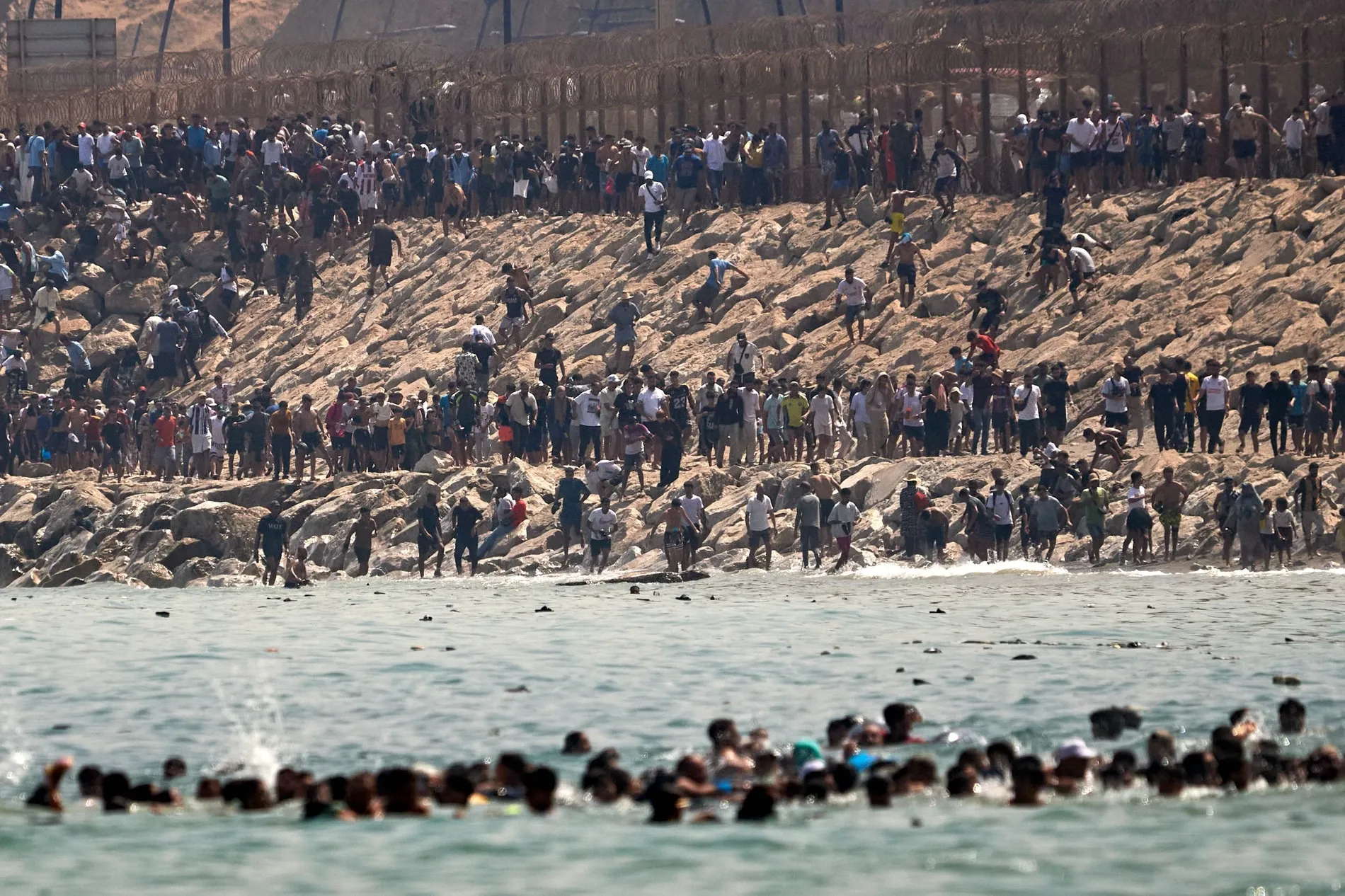
In a significant move to address the overwhelming influx of migrants at the border of the North African exclave of Ceuta, Spain has deployed soldiers to support the local police, who have been struggling to manage the situation. This announcement came from the office of Spanish Prime Minister Pedro Sánchez, who is set to visit Ceuta on Friday. Reports indicate that more than a thousand individuals had already managed to swim to the Spanish side the previous week, and recent updates suggest that Thursday saw several thousand more attempting the same. According to RTVE, estimates range from 2,000 to 3,000 new arrivals, while the news agency EFE reported instances of migrants climbing over the border fence. Tragically, within a 24-hour period, ten bodies of drowned individuals were recovered.
The regional president of Ceuta, Juan Jesús Vivas, has called not only for military assistance but also for the declaration of a national state of emergency in response to the crisis. The leader of the conservative opposition, Alberto Nuñez Feijóo, characterized the situation as a "national security crisis" and demanded government intervention. In light of the escalating situation, the European Union has offered support through its border protection agency, Frontex.
Urgent Measures for Migrant Repatriation
Morocco has attributed the surge to "criminal organizations" and emphasized that its collaboration with Spain on migration issues is exemplary, as reported by the news agency Europa Press, citing diplomatic sources in Madrid. The governments of both nations have reportedly agreed to expedite the repatriation of migrants who have entered Spain illegally. The Spanish Interior Ministry has indicated that they are maintaining close communication with Moroccan authorities. Historically, Morocco has used migrants as a political bargaining chip against Spain. In May 2021, Moroccan border police allowed over 8,000 Moroccans to flood into Ceuta. However, this time, Moroccan security forces have actively attempted to halt migrant crossings.
A potential trigger for the recent surge may be a ruling by Spain's Supreme Court, which prohibits security forces from immediately returning migrants to Morocco when they arrive by sea in the exclaves of Ceuta and Melilla. Such "hot" deportations, as they are known in Spain, are only permissible when migrants have breached the border barriers, which consist of towering fences. Over the past few years, numerous large groups of African migrants have made attempts to breach these barriers.
Ceuta, a Spanish city with a population of around 80,000, has been grappling with the dire situation in its sole reception center, which has been hopelessly overcrowded for several days. Many migrants have been seen wandering soaked through the streets, where they have also been forced to sleep. Disturbing images have emerged of individuals in the water clinging to flotation devices and car tires, including women and children. Migrants often find themselves in the sea for three to four hours before they are rescued or manage to reach Ceuta with their last ounce of strength, and not everyone makes it. As of Thursday, the number of individuals who have drowned at the border in 2026 has risen to 38.
As reported by faz.net.