
Rabat's Official Media Praises Spain's Leadership While Reiterating Territorial Claims
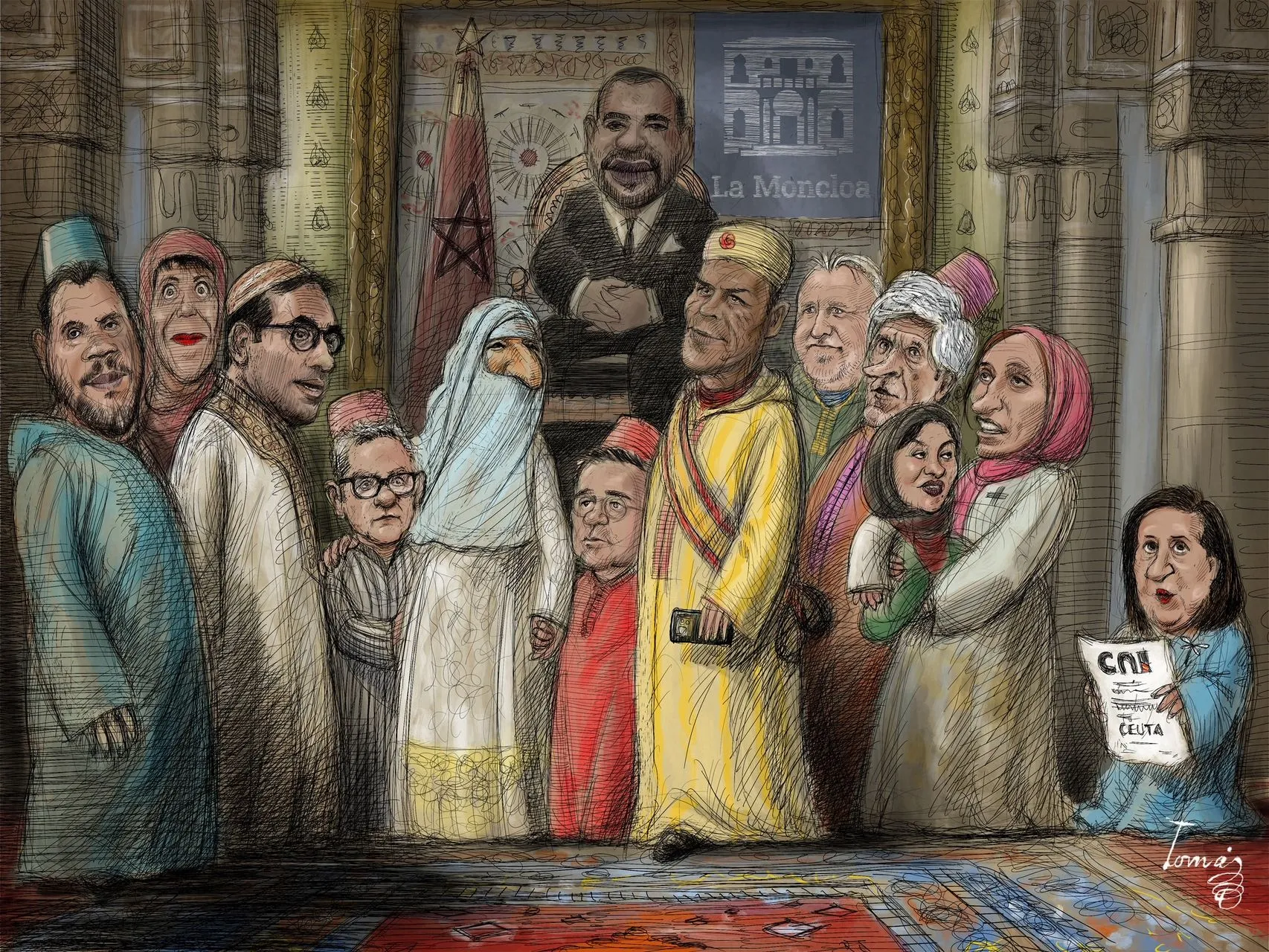
This week, the official press of the Moroccan regime in Rabat has notably praised Spanish President Pedro Sánchez and his ministers, particularly for their assertion that Morocco bears no responsibility for the recent invasion of Ceuta. However, this acknowledgment is juxtaposed with a reaffirmation of Rabat's claims over the two autonomous cities and even the tiny islet of Perejil. Furthermore, the media has highlighted the ongoing conflict between Fernando Grande-Marlaska and Margarita Robles, with Robles revealing in Congress that the National Intelligence Center (CNI) has deployed 25 agents in Morocco.
The Moroccan press has especially celebrated the remarks of Spanish Foreign Minister José Manuel Albares, who, during a congressional session, attributed the invasion of Ceuta not to Morocco but rather to social media influencers and the disinformation propagated by Vladimir Putin's regime. The financial newspaper _L'Economiste_, based in Casablanca and published in French, emphasized that Albares "lauded Rabat's cooperation, deeming it essential for managing the crisis," which saw 90% of the invaders leave Ceuta within 48 hours. When questioned about potential hybrid actions by Morocco, Albares refrained from making accusations against the Kingdom, stating, "I am not Morocco's foreign minister. I am Spain's foreign minister."
Internal Divisions in Spain Highlight Broader Diplomatic Challenges
As the situation unfolds, the media aligned with the Moroccan regime has extensively covered the rift between Marlaska and Robles regarding whether the CNI had foreseen the massive influx of migrants expected on July 30. Samir Bennis, editor of _Morocco World News_, interprets the discord as indicative of "not a crisis between Morocco and Spain but rather a fracture within the Madrid government itself." He asserts that if a genuine bilateral crisis existed, Spain would have summoned its ambassador for consultations or called in the Moroccan ambassador to demand explanations. Instead, Albares convened the Italian ambassador in Madrid to express discontent over Giorgia Meloni's criticisms of Sánchez.
This internal conflict raises questions about the Spanish government's preparedness in preventing the crisis and casts doubt on the speculation that Morocco orchestrated the events as a form of leverage against Spain. In a separate article, _Morocco World News_ sardonicly remarked on the supposed blackmail that Sánchez faces from Morocco, particularly following the revelation that his phone had been targeted by the Pegasus spyware. The article concludes that "Spain spies on its critics and opponents but fails to safeguard its own secrets," highlighting a broader narrative of political turmoil and surveillance controversies plaguing the Spanish government.
Ultimately, the Moroccan media sends various signals to Spain concerning the unprecedented migration crisis in Ceuta. It underscores that Morocco is a "sovereign partner" and asserts that it is neither the policeman nor the guardian of Europe in managing migration. Analysts warn that portraying Ceuta as a fortress against Morocco could incite internal tensions within the autonomous city, questioning how local Muslims might perceive their place in this geopolitical narrative. As this situation develops, it is evident that the complexities surrounding Spain's territorial integrity and its diplomatic relations with Morocco remain fraught with challenges.
As reported by elespanol.com.