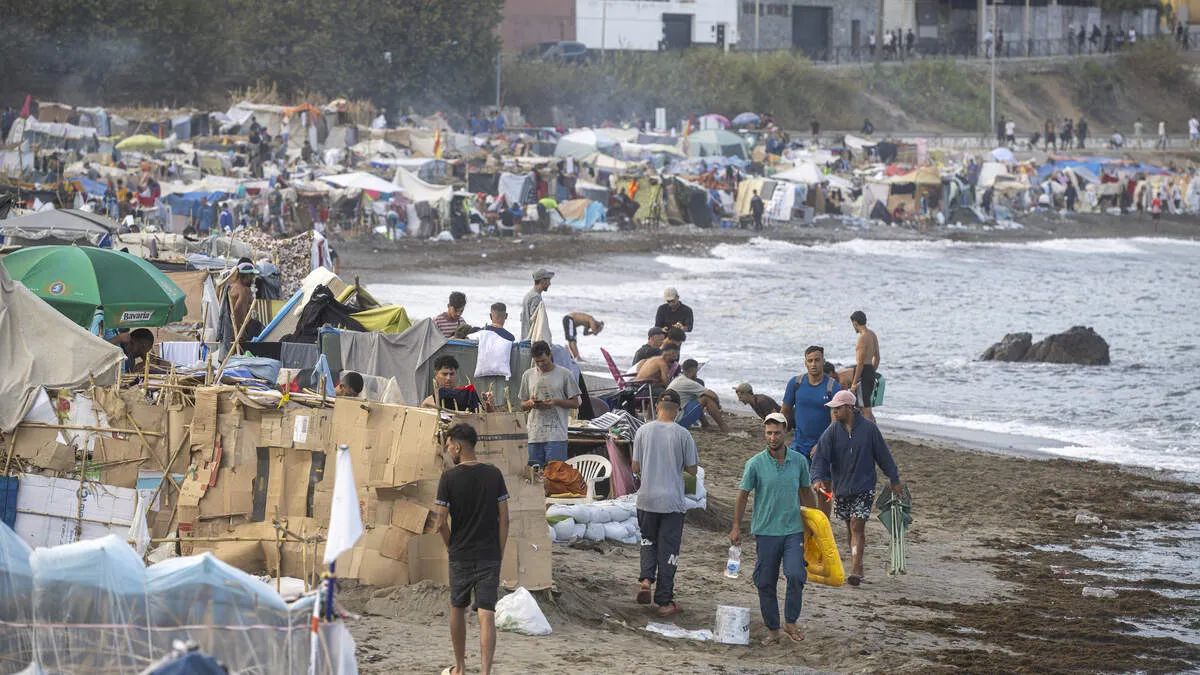

Spain's Central Government Takes Action Amid Migrant Crisis
The Spanish central government has taken decisive steps in response to the ongoing migrant crisis by establishing a tent camp for migrants at the port of Ceuta, a move that has drawn both support and criticism. Prime Minister Pedro Sánchez has defended this crisis management strategy, even though security agencies had previously categorized the coordinated mass influx of migrants as an extreme risk. Notably, Morocco has been kept out of the crossfire in this politically charged situation.
Amid rising tensions, demonstrators in Spain have taken to the streets, chanting slogans like "Ceuta does not sell out, Ceuta does not surrender." As the sun sets, the atmosphere becomes increasingly volatile, reflecting the intensity of public sentiment surrounding the migrant situation.
Environmental Challenges and Community Resilience
In addition to the migrant crisis, Spain is currently grappling with environmental challenges. Hundreds of firefighters have successfully stabilized a forest fire in the Valencia region, while recovery efforts continue following significant flooding in Tarragona caused by heavy rains. The forest fire has forced hundreds of residents to evacuate as smoke and flames threaten homes, prompting authorities to order swift evacuations to ensure public safety.
As the summer tourist season approaches, European vacation destinations are experiencing a surge in visitor numbers. However, this growth has reached a tipping point in some areas, where hospitality is turning into frustration among locals. The Spanish government’s recent decision to set up a tent camp for 1,500 migrants in Ceuta has been described as a "ray of hope" for local residents, amidst the chaos of the ongoing crisis.
In a different context, scientists from NASA are preparing to observe a solar eclipse from various locations worldwide, with a former village church in Europe selected as one of the observation points. Meanwhile, agricultural and educational initiatives continue to thrive at the "Biohaff Witry," showcasing a commitment to sustainable and fulfilling work during challenging times.
As political dynamics shift, the SPD in Mecklenburg-Vorpommern has overtaken the AfD in the final polling moment, attributed largely to the efforts of their leading candidate and Minister-President. In Luxembourg, the Michelin Guide has recognized a luxury residence in Luxembourg City as one of the world's top newcomer hotels, adding to its allure as a "small hotel full of surprises." Amid rising rental prices and fluctuating interest rates, purchasing property is not just about having a roof over one’s head; it represents a strategic decision both personally and financially.
Amid the evolving landscape of cultural institutions in Luxembourg, high budgets and strong opportunities contrast sharply with a scarcity of applicants for directorial positions, highlighting the challenges faced by these organizations. As the cycling professional Jempy Drucker reflects on his career, he expresses that now is the right time for him to retire, while enjoying newfound freedoms at the Skoda Tour after convincing his team of his decision. The transition into a new season also brings fresh developments to the Philharmonie, including a new music director and an exciting app that promises to enhance the audience experience.
Overall, the current socio-political climate in Spain and the environmental challenges it faces illustrate a complex interplay of humanitarian, political, and ecological factors that demand careful consideration and action from both government and community leaders.
As reported by wort.lu.