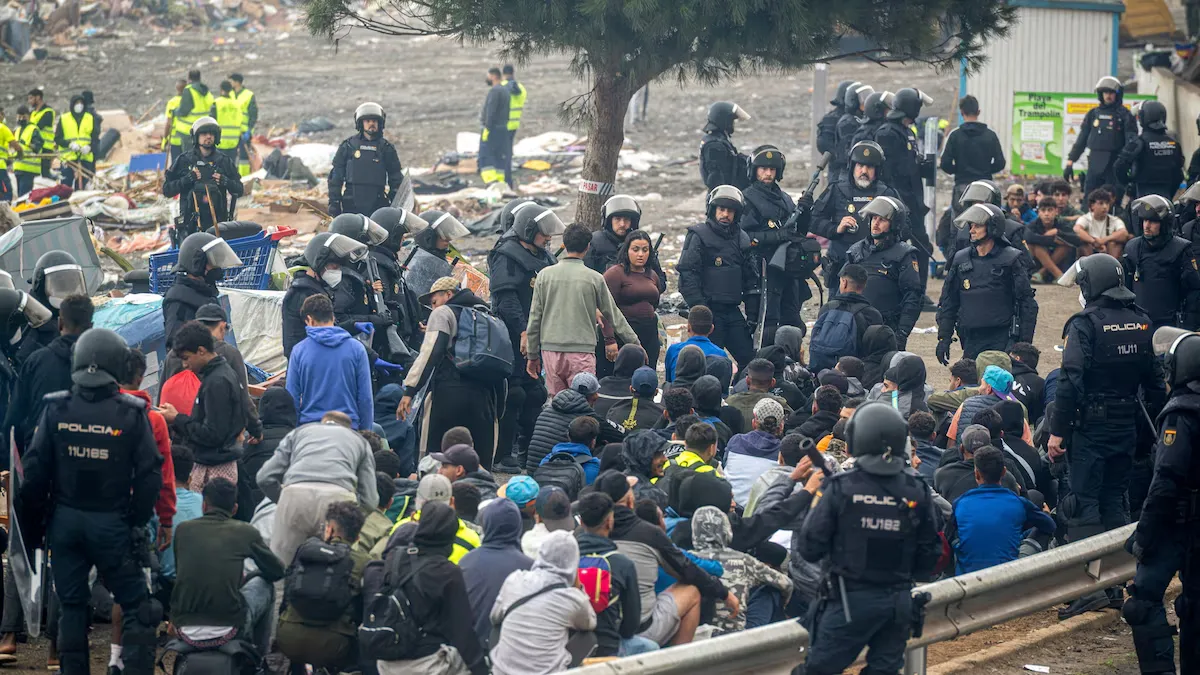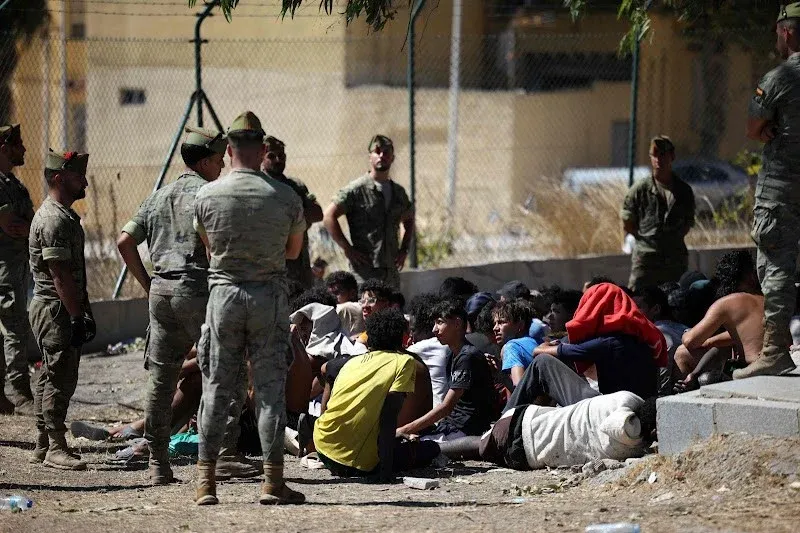
The recent systematic leak of the report from the Spanish National Center for Migration and Borders (CENIF), concerning the events in Ceuta on July 30 and 31, 2026, represents yet another attempt to export Spain's internal crises onto Morocco. A careful examination of the 55-page document, commissioned by the Spanish National Court (Audiencia Nacional), reveals a fragile narrative that lacks substantial evidence and is riddled with glaring contradictions that undermine the report’s own hypotheses. Instead of providing a sound security analysis based on accurate data, the report relies on conjectural conclusions, body language analysis, and a disregard for Spain's own failures, in a desperate attempt to transform Morocco from a reliable strategic partner in border management into a scapegoat for purely political and judicial grievances in Madrid.
Absence of Material Evidence
The logical structure of the report is based on a central paradox and stark contradictions that fundamentally undermine its credibility. It accuses the Moroccan state of orchestrating a "well-organized and planned operation," yet it simultaneously acknowledges in the fifth level of the report (dedicated to "leadership") a complete inability to identify any senior responsibility or sponsoring entity for this alleged operation! How can a security agency assert the existence of a strategic directive that exceeds the capabilities of smuggling networks while simultaneously admitting in the same document that it has no evidence linking this supposed movement to the Moroccan state or its institutions? In an attempt to fill this intelligence gap, the report's authors resorted to what they deemed "behavioral analysis" of open-source images and videos. Ironically, accusations attributed to a sovereign state are based on evaluations of the clothing of certain irregular migrants, their footwear, or their physical build, or merely their calm demeanor while deviating from the typical migration path, labeling them as "dynamizing agents." This slip from investigative security analysis to mere visual impressions drains the report of any legal, intelligence, or security value and proves that the "names and images" that the Spanish media claimed intelligence had are nothing more than weak and fanciful conclusions that do not reach the level of material evidence necessary to accuse friendly security agencies that collaborate in protecting Mediterranean security.
Double Standards Logic
One of the most significant analytical failings of the report is its use of the events of August 15 as a condemning piece of evidence against Morocco, employing a reversed and absurd logic. Moroccan authorities demonstrated their high competence and strict commitment by proactively and decisively thwarting the infiltration attempts called for in mid-August. Instead of acknowledging the effectiveness of the Moroccan security approach, the Spanish report distorts this success into a new accusation, claiming that Morocco's ability to control the situation in mid-August is evidence of its deliberate leniency during the events at the end of July. The report goes further by adopting a fantastical hypothesis that considers the August 15 alert as merely a "whitewashing maneuver" for the late July events, presenting Morocco with an impossible equation under the current Spanish security mentality: if security measures fail against sudden massive human migration, it is "collusion," and if they succeed in thwarting another similar wave, it is a "staged performance" to clean up its image! This Spanish absurdity reflects a selective use of facts that hints at premeditated intentions to criminalize Morocco regardless of its field behavior, ignoring the complexities of managing human crowds that often surpass the capabilities of any security apparatus in the world, including European agencies themselves, and also disregarding the human losses and material damages sustained by Moroccan security in confronting the initial waves of migration on July 30 and 31.
The report carries a clear and documented condemnation of the Spanish agencies themselves, a condemnation that Spanish media attempts to obscure by focusing on Morocco. The document unequivocally acknowledges the existence of early Spanish warnings starting from July 27, followed by an official alert from CENIF on July 29 regarding the likelihood of major breaches, followed by successive warnings about the danger of "border collapse." Nevertheless, the Spanish authorities did not take sufficient proactive measures to address this internal intelligence issue. More alarmingly, the Spanish report admits to an unprecedented state of informational confusion within its institutions; even by late August, Spanish authorities were unable to determine an accurate number of people who entered or exited Ceuta, with estimates fluctuating randomly between 49,000 and 85,000 individuals. How can an entity that cannot even count who entered Ceuta, and ignored alerts from its internal agencies, position itself as an arbiter to assess the strategic intentions of a neighboring and allied state? Highlighting Morocco is merely a desperate attempt to evade internal accountability for the structural weaknesses in the Spanish response to the current migration crisis.
In its effort to establish the theory of "prior organization," the report focuses on digital campaigns that preceded July 30 through communication platforms such as Facebook, TikTok, and WhatsApp, basing its findings on the high density of Moroccan phone numbers (90.8%) in the studied groups, implicitly suggesting Moroccan institutional involvement! However, it quickly contradicts itself by admitting its inability to identify the owners of these numbers, overlooking an obvious fact: the geography of the event will naturally produce a local digital presence, and this does not necessarily imply state sponsorship of those events. The report deliberately marginalizes the most significant factor fueling this wave, which is the misinterpretation and viral spread of the Spanish Supreme Court's ruling (which was circulated among migrants as a rule: "If you enter swimming, you will not be deported"), where the viral dynamics of social media can mobilize tens of thousands within mere hours, whether it concerns a protest, a legal rumor, or the illusion of crossing into the "European paradise." Any attempt to dress this complex sociological and digital phenomenon in the guise of an "intelligence conspiracy" reveals a lack of understanding of modern migration dynamics, which no longer require "classic leadership" to fuel them; it is enough to have the triggering factors for them to explode spontaneously.
It is impossible to dissociate the leak of this report and the nature of its conclusions from the acute polarization characterizing the Spanish political arena. We are presented with a document prepared in a judicial context at the request of Judge María Tardón, initially withheld from the political leadership series, to the extent that Interior Minister Grande-Marlaska and Prime Minister Pedro Sánchez declared the absence of any incriminating data against Morocco. The involvement of politically affiliated police unions like JUPOL, which did not hesitate to accuse Spanish officials of "colluding with Moroccan intelligence," and the entry of secessionist figures like Carles Puigdemont into the fray to demand an "end to the colonization" of Ceuta and Melilla, confirms that the entire issue is not about borders but about warring factions in Madrid. It has become clear that Morocco is paying the price for Spain's internal conflicts. The state that deploys thousands of security personnel daily to guard its borders, and that has borne the brunt of managing irregular migration flows toward Europe for years, cannot be belittled or have its roles questioned based on a judicial-security report filled with gaps, assumptions, and an obsession with Morocco. Furthermore, the persistent use of Morocco's name as a tool for settling Spanish political accounts will only undermine the foundations of strategic bilateral cooperation, which remains the true safeguard for the entire region, including the security of Spain that heavily relies on its security partnership with Morocco.
As reported by hespress.com.