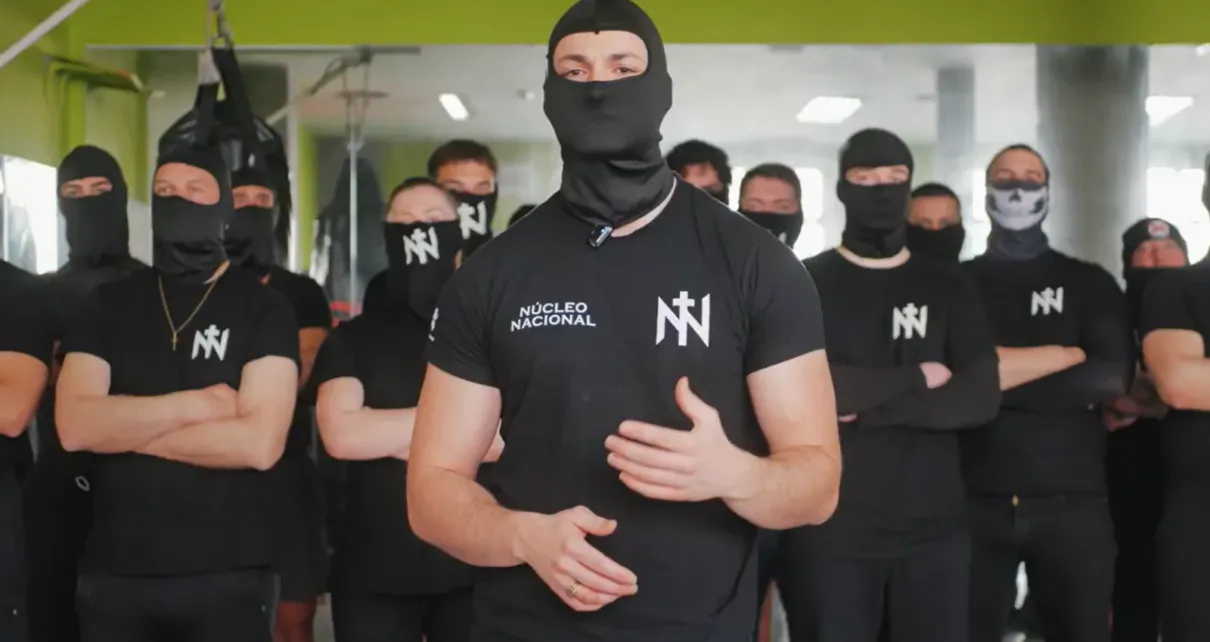

The recent migration crisis in Ceuta has provided a significant opportunity for Spain's neo-Nazi far-right factions to intensify their mobilization efforts against Morocco and the Muslim community. The group Nucleo Nacional is at the forefront of this movement, transitioning its anti-Moroccan rhetoric from online platforms and protests into tangible street actions within the Spanish enclave. This development signals a concerning escalation in the far-right's tactics, as they seek to capitalize on the socio-political climate surrounding immigration and national security.
Nucleo Nacional has emerged from a coalition of neo-Nazi, Falangist, and other far-right groups, explicitly branding Morocco as an adversary and framing migration from the country as a broader existential threat to Spain. Statements from Spanish media outlets and the group’s social media activities highlight their aggressive stance, promoting a narrative that vilifies Moroccan migrants as hostile elements in the country. The rhetoric has become increasingly aggressive, with the group's leader, Ivan Rico, characterizing the arrival of migrants as an “invasion” and suggesting that it serves as a precursor to a potential Moroccan offensive aimed at Ceuta and Melilla, as reported by Le360.
On July 31, during a demonstration outside the Moroccan embassy in Madrid, notable figure Isabel Medina Peralta publicly ripped up a court ruling that upheld her conviction for inciting hatred against Moroccans and Muslims, subsequently performing a Nazi salute. This act exemplifies the normalization of anti-Moroccan sentiment within the group’s activism. The very next day, a contingent of approximately ten Nucleo Nacional activists, led by Rico, traveled to Ceuta, where they faced backlash from local residents and were escorted away by Spain’s National Police, indicating a growing resistance to their provocative actions.
Peralta's involvement underscores how deeply entrenched anti-Moroccan rhetoric has become within Nucleo Nacional’s agenda. In 2021, during a previous migration crisis, she had similarly protested outside the Moroccan embassy, labeling the situation as “racial substitution” and declaring “death to the invader.” This history of incitement to hatred led to her conviction by a Madrid court, highlighting the legal consequences of such inflammatory speech. The group has adopted slogans like “Moors out of Spain” and advocates for the idea of “remigration,” a concept prevalent among European far-right movements that calls for the expulsion of immigrants. Their leaders openly embrace their identities as “racists or racialists,” with an organizational agenda that firmly opposes multiculturalism while promoting a so-called defense of racial purity.
In a strategic pivot, Nucleo Nacional is now aiming to expand its influence beyond street demonstrations. It has registered a political arm known as Noviembre Nacional, which is set to contest elections, thereby seeking to legitimize its platform within the formal political arena. This transition could potentially broaden the group’s appeal while maintaining its focus on race, immigration, and hostility towards Morocco and Islam, raising concerns about the normalization of extremist ideologies in mainstream politics.
While the actual size and electoral impact of Nucleo Nacional remain uncertain, police intelligence suggests that its membership could be around 1,500 as of 2025, a figure that has yet to be independently verified. The evolution of this group and its rhetoric warrants close attention, as it reflects a troubling trend in the political landscape of Spain and the broader European context.
As reported by northafricapost.com.