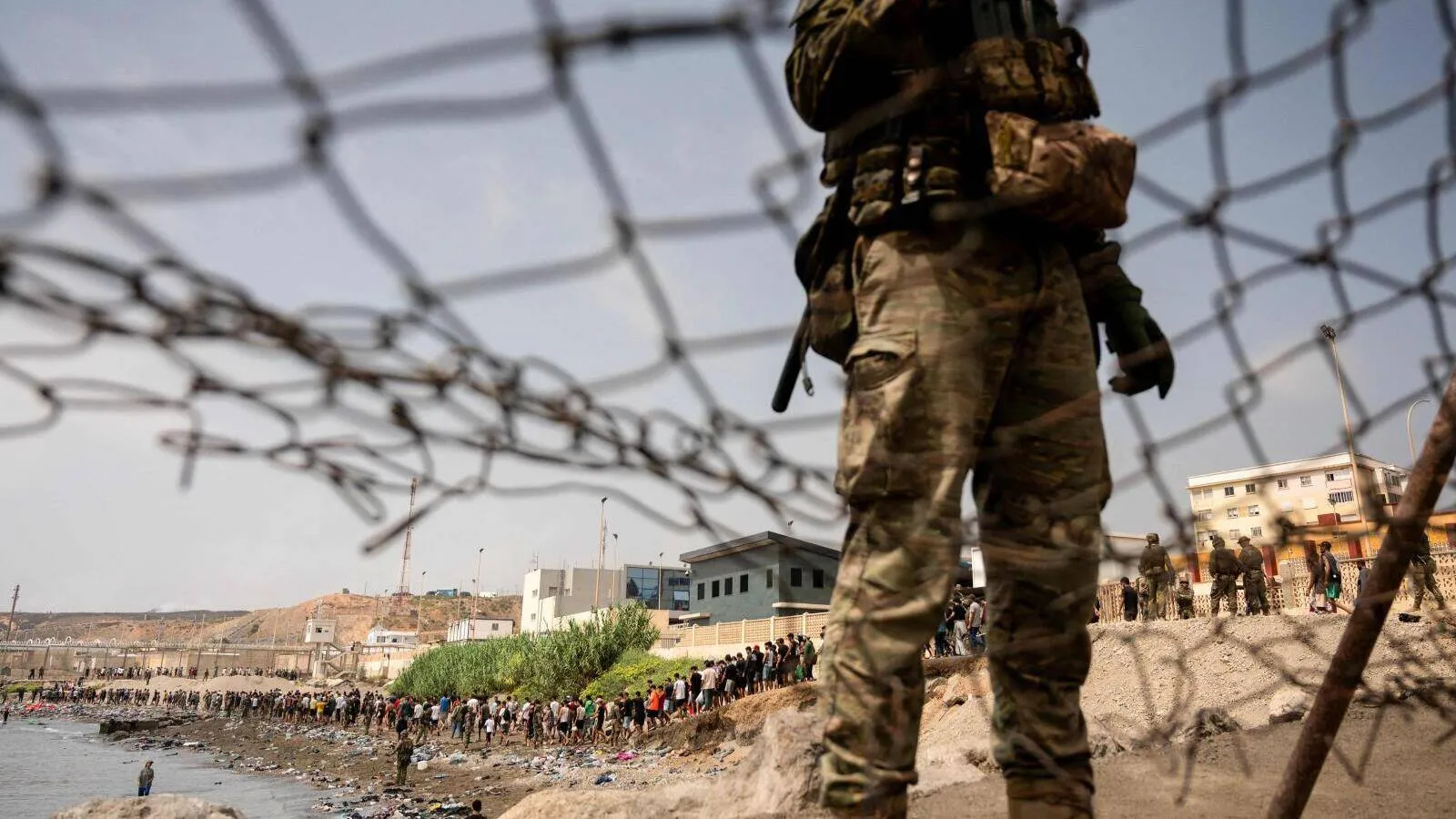

A recent report from the Spanish police has cast doubt on Morocco's involvement in the significant influx of migrants to Ceuta at the end of July. The document highlights a "significantly reduced deployment than usual" and the "permissiveness" of Moroccan police, which could potentially put the Spanish government in a difficult position. This situation arose as Spain has consistently absolved Morocco of any responsibility for the sudden and massive arrival of tens of thousands of migrants into the small Spanish territory in North Africa on July 30 and 31, a stance that has faced criticism from various opposition members.
The report, which was reviewed by AFP, has emerged as a key point of contention, particularly after El Español revealed some of its findings. Throughout the day, the Ministry of the Interior issued several statements from high-ranking police officials, asserting that "no report has been issued attributing the responsibility of the assault to any government, service, or individual, as to date, the intellectual author of the said assault remains unknown." However, this defense may be undermined by the insights provided in the report.
Significantly Reduced Police Deployment
The investigators from the National Center for Immigration and Borders (CENIF) noted that despite the official celebrations for the Throne Day in Rincón/M’Diq, the number of migrants entering Ceuta on July 30 coincided with a remarkably lower police presence along the border between Morocco and Ceuta than what is typically observed. They stated, "Beyond the formal events of the Throne Day, it is certain that the declarations of a significant number of migrants who entered Ceuta on that day confirm that the police deployment was markedly less than usual." Moreover, they emphasized that the Moroccan police response to the massive influx of migrants was characterized by total permissiveness, with no serious attempts made to reduce, disperse, or prevent the crowd from approaching the border on July 30.
Furthermore, the investigators highlighted that the geographic proximity of public security measures due to the Throne Day celebrations should have facilitated a much firmer control, particularly on July 31. Instead, a progressively slower response was noted, which was inadequate for a situation of this nature. The statements from the migrants interviewed, as well as video footage disseminated through media and social networks, revealed behaviors consistent with facilitating irregular immigration, suggesting a level of oversight and control over the entry and exit process.
Spanish Government's Discomfort
These findings complicate the official stance of Pedro Sanchez's government, which reiterated its position on Monday by claiming that "no intelligence service with which the Spanish government typically collaborates indicated any doubt regarding the participation, in one way or another, of Moroccan authorities." In response to the report mentioned by El Español, Spanish Interior Minister Fernando Grande-Marlaska requested the police chief to inform him about its contents, which allegedly implicated Moroccan security forces in the massive assault on the Ceuta border during the specified dates.
Later that afternoon, the director of the Spanish police denied the existence of any report linking Moroccan law enforcement to the large-scale entry of migrants into Ceuta, a denial that was reiterated multiple times throughout the evening in communications from the Ministry of the Interior. Some analysts speculate that this crisis could have been a message from Morocco to Spain concerning the Western Sahara issue—a territory largely controlled by Morocco but claimed by the Polisario Front, which is backed by Algeria—following Sanchez's visit to Algeria in July.
As reported by letemps.ch.