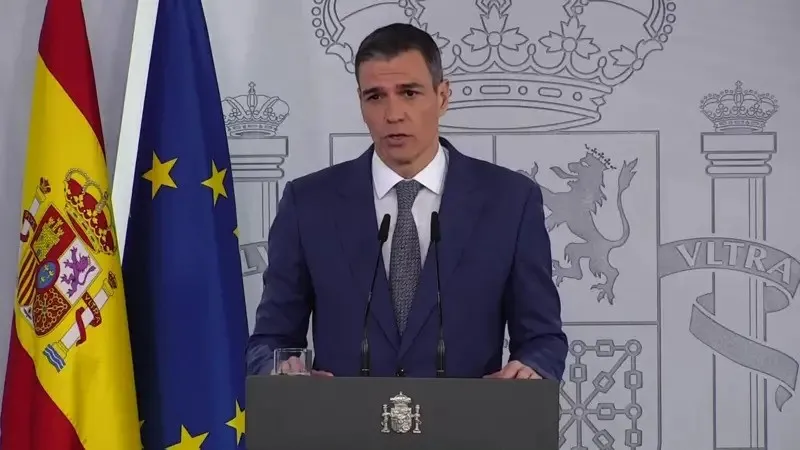

Pedro Sanchez Rejects Accusations Against Morocco
In a robust defense of Morocco's role during the recent migrant crisis in Ceuta, Spanish Prime Minister Pedro Sanchez has categorically dismissed allegations suggesting Moroccan complicity in the mass crossings that occurred at the end of July. Speaking during an interview on Cadena SER’s Hoy por Hoy program on August 31, Sánchez praised the Moroccan authorities for their prompt and positive cooperation, particularly during the tumultuous events of July 30 and 31, when an unprecedented number of migrants crossed into the Spanish enclave.
Confronted with speculation regarding Morocco's involvement, Sánchez relied on intelligence assessments from both Spanish and international agencies to refute claims of any Moroccan orchestration. He stated, “There is no information from the State security forces and corps, nor from the National Intelligence Centre (CNI), nor from any intelligence center with which the Spanish government usually collaborates, that allows any doubt to be cast on the participation, in one way or another, of the Moroccan authorities.” This assertion underscores the seriousness with which Sánchez regards the accusations, describing them as “serious, dangerous and gratuitous.” He attributed the surge in crossings to distorted reports about a Spanish Supreme Court ruling related to border returns, which were amplified by human trafficking networks and extremist elements on social media.
The Importance of Bilateral Cooperation
Sánchez further emphasized the swift response from Morocco during the crisis, recalling that the Moroccan authorities maintained constant communication with Spanish officials. He noted that by July 31, operational measures were already being deployed in the Fnideq area to manage the influx of individuals attempting to enter the autonomous city of Sebta irregularly. Beyond migration issues, Sánchez highlighted the importance of bilateral relations with Morocco, which encompass economic, cultural, social, and security cooperation, especially in the fight against terrorism. He remarked, “On the migratory level, cooperation with Morocco is frankly positive,” pointing out that irregular entries via the Western Mediterranean are significantly lower than those observed on the Central Mediterranean route towards Italy.
The prime minister urged that the ongoing crisis should be addressed through collaboration rather than fostering distrust towards Morocco, which could exacerbate an already complex situation in Ceuta. In the heated political discourse that has followed the crisis, both left and right factions in Spain have occasionally launched opportunistic attacks against Morocco, often prioritizing short-term political gains over the facts and long-term diplomatic relations. Some right-wing segments have invoked historical anti-Moroccan rhetoric, while certain left factions have propagated unfounded claims of Moroccan orchestration, disregarding the consensus among intelligence communities and the effective cooperation that has enabled the return of most migrants who crossed the border.
Highlighting the results of diplomatic and security dialogues with Morocco, Sánchez noted that of the roughly 70,000 individuals who crossed into Ceuta during the peak days, a staggering nine out of ten have already been returned. “Since August 10, 3,222 people have returned voluntarily. This return is continuing and, fortunately, there is no significant entry of migrants across this border,” he stated. Sánchez also addressed the issue of unaccompanied minors, assuring that returns would align with legal protocols and parental requests.
As reported by northafricapost.com.