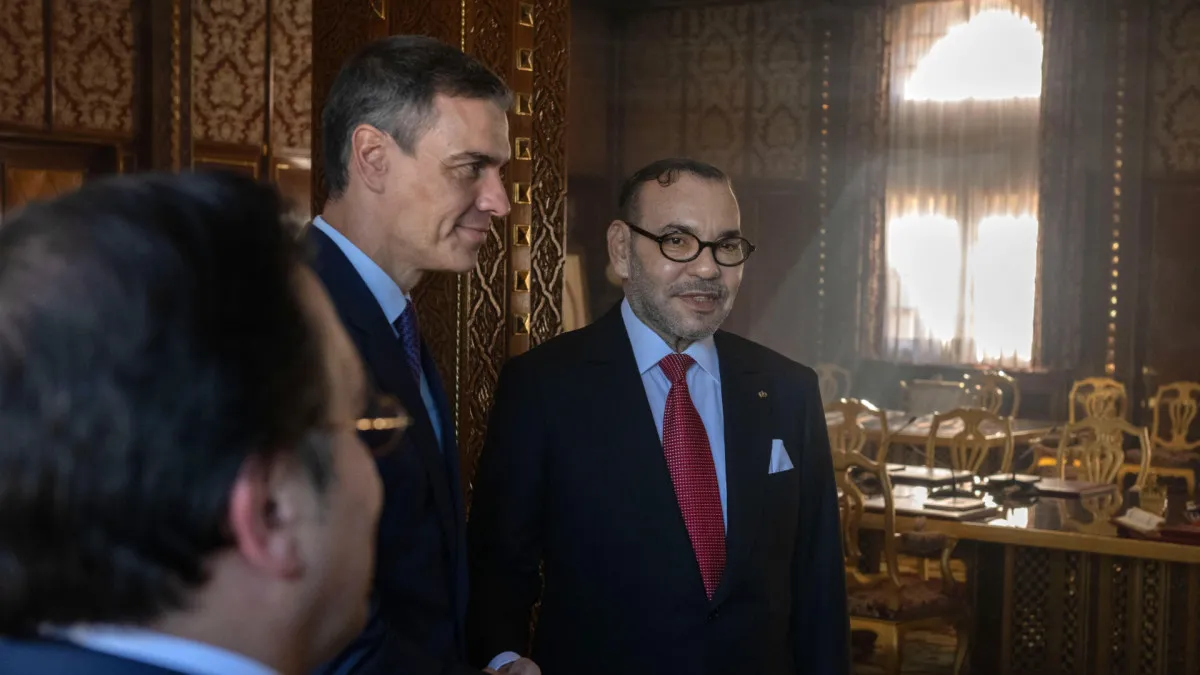

In the midst of the ongoing Ceuta crisis, a striking 77.6% of Spaniards express a negative view of King Mohammed VI of Morocco. This sentiment transcends various spheres of society, as evidenced by the fact that 61.9% oppose the idea of Spain and Portugal co-hosting the 2030 FIFA World Cup with Morocco. The discontent towards the Moroccan government is widespread, cutting across ideological boundaries and even permeating the beliefs of socialist voters. A survey conducted by Cluster17 for _Agenda Pública_ during the crisis, specifically between August 22 and 25, unequivocally captures this rejection. Nevertheless, despite the negative perceptions, there appears to be no overwhelming desire to sever diplomatic ties; in fact, only 3.1% would advocate for suspending diplomatic relations as a primary option in the event of another large-scale irregular entry into Ceuta or Melilla.
Widespread Rejection Across Political Blocks
As the principal political figure of Morocco, King Mohammed VI receives the most unfavorable ratings among politicians. A notable 56.7% of Spaniards rate him a zero, while another 21% give him a score between one and three. Conversely, a mere 5.2% rate him seven or higher. Among all the political figures assessed, including Giorgia Meloni, Donald Trump, Mark Rutte, and Emmanuel Macron, the Moroccan king receives the lowest evaluation. This widespread disapproval is reflected in the relatively small gap between different voter bases. For instance, 88.7% of Vox voters rate him below three, as do 83.2% of PP voters. Among PSOE voters, the rejection stands at 80.3%, and for Sumar voters, it is at 75.6%.
The potential co-hosting of the 2030 FIFA World Cup has emerged as another indicator of public sentiment. A significant 61.9% of respondents are firmly against Spain and Portugal organizing the tournament alongside Morocco, compared to just 10% who support the idea. An additional 23.6% hold neutral views. However, political differences become more pronounced in this context, with 86.9% of Vox voters opposing the collaboration and 78.7% of PP voters sharing the sentiment. In contrast, only 42.7% of PSOE voters oppose the idea, which still remains the predominant perspective compared to the 17.3% who support co-hosting with Morocco. For Sumar voters, the figures are 46% against and 11% in favor, respectively.
Initially, the joint bid was framed as a means of cooperation between Spain, Portugal, and Morocco, serving as a bridge between Europe and Africa. The notion of sharing the tournament was intended to showcase collaboration beyond typical issues such as security, immigration, or trade. However, the current survey results reveal that Spanish citizens' rejection has transformed the political dimension of the World Cup into a far less consensual matter.
Responses to Future Crises
Following the massive entries on July 30 and 31, numerous dates for potential future arrivals have been proposed. When faced with the possibility of more large-scale arrivals in Ceuta or Melilla, the majority of Spaniards do not view suspending diplomatic relations with Morocco as the primary solution; only 3.1% would choose this course of action. Instead, the preferred approach is to seek direct intervention from the European Union, including a possible deployment of Frontex, with 23.9% supporting this option. Close behind are immediate returns at the border, with 23.6%. Other options include military deployment to control the border perimeter at 14.6%, economic sanctions against Morocco at 12.4%, and humanitarian reception with individual asylum application processing at 11.7%. Negotiating with Rabat for economic concessions to strengthen border control garners support from 5.5%.
Preferences for these responses vary significantly depending on the voter base queried. Among PSOE voters, EU intervention tops the list at 28.7%, followed by humanitarian reception at 23.4%. Immediate returns receive support from 11.5%. In Sumar, humanitarian reception is favored by 29.7%, followed closely by EU intervention at 23.6% and economic sanctions at 17.5%. Conversely, the right-leaning voters have different preferences: 36.4% of PP voters opt for immediate returns, while 24.4% would request EU intervention, and 17.5% would deploy military forces. Among Vox voters, 40.4% favor immediate returns and 35.1% advocate for military deployment, with EU intervention receiving 13.7% support.
In summary, the negative perception of King Mohammed VI resonates across diverse electorates, yet there is no consensus regarding solutions. Political parties may be influencing these demands, shaping voter preferences in ways that align with their own frameworks. For instance, if the government emphasizes EU intervention, it is reasonable for PSOE and Sumar voters to lean towards this option. Conversely, the securitization discourse from Vox and PP would naturally lead to the survey results observed.
The discontent also significantly affects socialist voters, with 80.3% of PSOE supporters holding a negative view of Mohammed VI, and the option to reject the World Cup if organized with Morocco being the most prevalent. This is a crucial data point for a government that has pursued a close and stable relationship with Rabat. The Spanish shift regarding the Western Sahara in 2022, which pivoted the executive's stance to favor Morocco's 2007 autonomy proposal, was the most visible manifestation of this policy. Notably, the rapprochement between Madrid and Rabat extends to other core issues for Spain, such as immigration, security, counter-terrorism efforts, trade, and border management in Ceuta and Melilla.
According to Marc López Plana, editor and director of _Agenda Pública_, Morocco could emerge as one of the areas where the PP and PSOE showcase divergent views on Spanish foreign policy. With Cluster17's data in hand, part of that distinction is elucidated through the preferred tools for addressing a future crisis. Moving forward, Spain will continue to require cooperation from Morocco on immigration, security, trade, and border management. The survey results paint a picture of a public opinion that is highly critical of Mohammed VI and largely against co-hosting the World Cup, yet not inclined to sever relations. In the face of a new crisis, EU intervention, albeit narrowly, is the most supported option.
As reported by agendapublica.es.