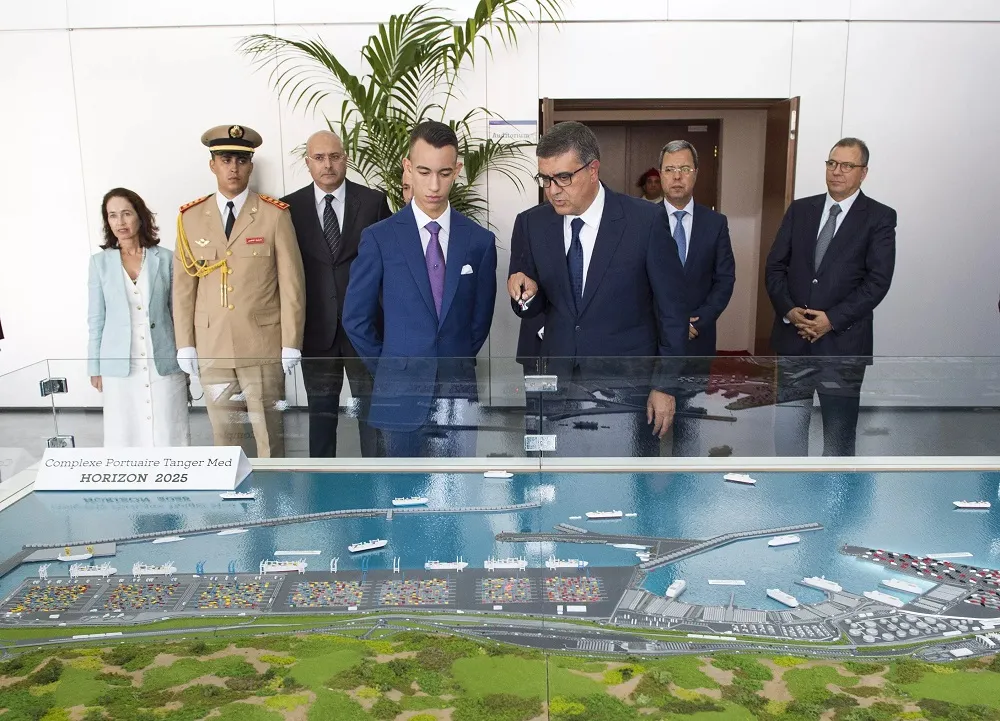

Morocco's Ascendancy in Maritime Logistics
The Strait of Gibraltar is undergoing significant transformations in maritime transport and international trade dynamics, with Moroccan ports emerging as key players striving to solidify their position as a global logistics hub connecting Europe, Africa, and other international markets. This shift occurs against a backdrop of intensifying competition between Morocco and Spain, each vying for dominance over cargo traffic transiting through one of the world's most vital maritime corridors.
A recent Spanish study highlights that Morocco has notably enhanced its standing in recent years, largely due to strategic investments in the Tangier Med Port and the new Nador West Med Port project. These developments have allowed Morocco to become an increasingly important alternative to Spanish ports, particularly the Port of Algeciras.
The study emphasizes that these projects extend beyond mere infrastructure development; they align with a broader vision aimed at expanding Morocco's economic influence. This vision includes linking new ports to industrial and logistical zones capable of attracting international investments and boosting transshipment activities.
Data from maritime transport indicates that Tangier Med Port has played a pivotal role in reshaping competitive balances within the strait. Since the launch of its first phase in 2007 and its expansion in 2019, the port has witnessed consistent growth in handling volumes, surpassing ten million containers in 2024, which significantly exceeds the less than five million containers processed at Algeciras.
This development reflects a gradual shift in logistical weight towards the southern shore of the strait, as Morocco relies on an integrated port system characterized by automation, procedural simplification, and enhanced cargo processing speeds. Economic and regulatory factors, including additional costs imposed by European environmental policies on maritime shipping, have also contributed to this progress. Ships docking at European Union ports must now pay fees related to their carbon emissions, prompting many shipping companies to prefer offloading their cargo in non-EU ports like Tangier Med to avoid these costs, thus giving Moroccan ports an additional competitive edge in attracting transshipment movements.
Future Prospects and Challenges
Morocco is banking on the Nador West Med Port project to further solidify its positioning, with the first phase expected to commence operations between the end of 2026 and early 2027, initially capable of handling 3.5 million containers annually, with potential for expansion to over five million in subsequent phases. This project is anticipated to enrich Morocco's port network, especially since it will include an industrial complex and energy facilities, including infrastructure related to liquefied natural gas, reflecting a broader intention to enhance the role of Moroccan ports in the energy and industrial sectors.
Analyses suggest that competition in the strait extends beyond container transport, encompassing logistics services related to energy and international supply chains, particularly in light of global market shifts following the COVID-19 pandemic. These changes have driven many countries to reassess their logistics hubs, which Morocco aims to leverage by positioning itself as a transit hub for goods coming from Africa and Latin America to Europe.
Conversely, Spanish ports face challenges related to the need for infrastructure modernization, as new Moroccan ports utilize contemporary operating systems that reduce cargo processing times and enhance operational efficiency. Observers note that maintaining this disparity could lead to a gradual shift in maritime trade routes, especially if shipping companies continue to seek cost-effective and faster solutions.
Moreover, international financing for the Nador West Med project reflects financial institutions' confidence in its viability. European entities have contributed to financing part of its costs alongside Moroccan government funding, which is expected to attract global shipping companies and connect the port with industrial zones capable of generating sustainable commercial activity.
These projects, according to the same analysis, surpass mere economic considerations and encompass geopolitical dimensions. Morocco is striving to enhance its role as a regional nexus linking Africa and Europe, particularly as it seeks to develop initiatives aimed at facilitating access for Sahel countries to Atlantic and Mediterranean ports.
As reported by assahifa.com.