
AGADIR, Morocco — In an era where unmanned aircraft systems (UAS) are revolutionizing military tactics, U.S. and Moroccan forces are joining hands to enhance their operational capabilities through advanced training. This collaboration is particularly significant as it not only fosters skill development but also promotes mutual understanding and interoperability between the two nations' military forces.
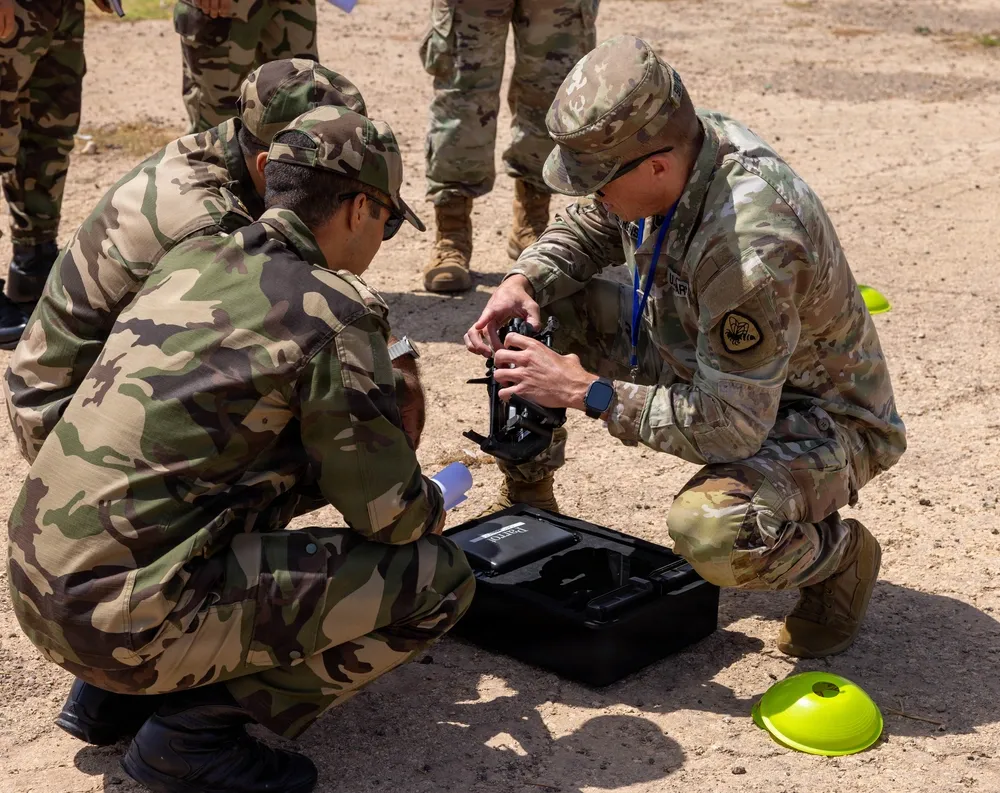
In September, a significant training initiative was launched involving U.S. Africa Command, the Royal Moroccan Armed Forces, and the Utah National Guard. This collaboration resulted in a specialized small unmanned aircraft system (SUAS) cadre course held in Agadir, Morocco. The training program saw participation from various U.S. military organizations, including the Combined Arms Training Center and the 7th Army Training Command, both of whom are based in Germany. The primary objective was to cultivate proficient UAS operators and instructors, thereby enhancing the synergy and information exchange between U.S. and Moroccan military personnel.
This training initiative builds upon the Utah National Guard's longstanding 23-year partnership with Morocco, which has been marked by consistent military cooperation and exchanges. In 2027, both nations will commemorate 250 years of diplomatic relations, a history that began when Morocco recognized the United States as an independent nation in 1777. During this time, Sultan Sidi Muhammad Ben Abdullah (Mohammed III) granted American vessels the right to enter Moroccan ports freely. Such a robust legacy continues to thrive today through various military exchanges, professional development programs, and collaborative training efforts aimed at sharing knowledge and celebrating the rich cultural heritage of both nations.
Lt. Col. Corbett Baxter of the Southern European Task Force - Africa remarked, "Events like this provide us with a unique opportunity to harness emerging capabilities and translate them into practical applications for our forces." By engaging in joint training with Moroccan counterparts, both nations aim to enhance their interoperability and effectively integrate unmanned systems into broader military operations, thereby increasing the lethality and effectiveness of their forces.
For the Utah National Guard, this engagement also plays a crucial role in establishing a budding drone program aimed at bolstering homeland defense capabilities, while simultaneously collaborating with active-duty military units and Moroccan partners. Sgt. 1st Class Andrew Santiago, a master instructor at the Combined Arms Training Center, emphasized the course's dual focus: first on developing skilled operators and then on training instructors, all while fostering a shared operational understanding between U.S. and Moroccan forces. "Integrating our training for joint exercises enables us to align our knowledge and planning structures, leveraging the strengths of both forces," Santiago noted.
The training course extends beyond the mere operation of unmanned aircraft. Participants, both from the U.S. and Morocco, engage in comprehensive planning, doctrinal discussions, and practical exercises designed to seamlessly incorporate UAS into military strategies. This foundational knowledge is essential for future collaborative training endeavors. Santiago observed a keen eagerness among participants to absorb the training content, highlighting their recognition of the importance of advanced instruction in this critical domain.
Utah National Guard 1st Lt. Jake Sorenson, who is instrumental in developing Utah's drone program, views the course as a valuable opportunity to learn from the Moroccan military's approaches to UAS training and integration. Sorenson, who recently transitioned to a logistics manager role at the Utah Training Center, is focused on defining the capabilities necessary for the program, exploring partnerships within the industry, and determining how UAS can be effectively utilized for homeland defense both domestically and internationally. "We are in the initial phases of this joint drone program," he stated, emphasizing the significance of establishing a holistic training approach that will ultimately support both domestic and foreign military partners.
As the course progressed, participants such as Technical Sgt. Michael Bennion from the Utah Air National Guard's 151st Security Forces Squadron found themselves gaining invaluable hands-on experience in a realm where they previously had limited exposure. Having served as his unit's counter-UAS representative without prior experience in flying drones, Bennion expressed his initial apprehension regarding drone operation. However, the course provided him with practical skills in areas such as stabilized and unstabilized flight, controller sensitivity, and diverse operating modes of UAS platforms. He highlighted the importance of developing UAS proficiency, especially as these systems become integral to modern military operations. "It's the future of warfare," Bennion asserted, noting the necessity of staying ahead of the curve in understanding and utilizing these technologies.
Chief Warrant Officer 2 Kenton Hemsley, the UAS manager at Camp Williams and a member of the Utah Army National Guard’s 65th Field Artillery Brigade, is dedicated to cultivating a universal drone operator capability across the force. He advocates for a comprehensive approach that allows different military occupational specialties (MOS) to integrate UAS technology into their specific missions. Hemsley explained that drones possess remarkable versatility, making them applicable across a wide array of military operations, both offensive and defensive. As unmanned aircraft become increasingly commonplace on the battlefield, Hemsley emphasized the need for all servicemembers to acquire knowledge about UAS, not only for operational purposes but also for defensive strategies.
Beyond the technical training, the course serves as a platform for personnel from Utah and Morocco to exchange valuable experiences and methodologies concerning unmanned aircraft training. This collaborative effort involves U.S. Africa Command (AFRICOM), CATC, 7th Army Training Command, and U.S. Army Garrison Vilseck, as well as the Utah National Guard and Moroccan Royal Armed Forces. Each organization plays a vital role in augmenting UAS knowledge and training capabilities while reinforcing the enduring partnership between the United States and Morocco. Hemsley noted, "The wealth of knowledge we've gained from our Moroccan counterparts, particularly their unique perspective on integrating UAS from both hobbyist and professional angles, has been immensely beneficial. The insights gained from this engagement are invaluable."
As reported by dvidshub.net.