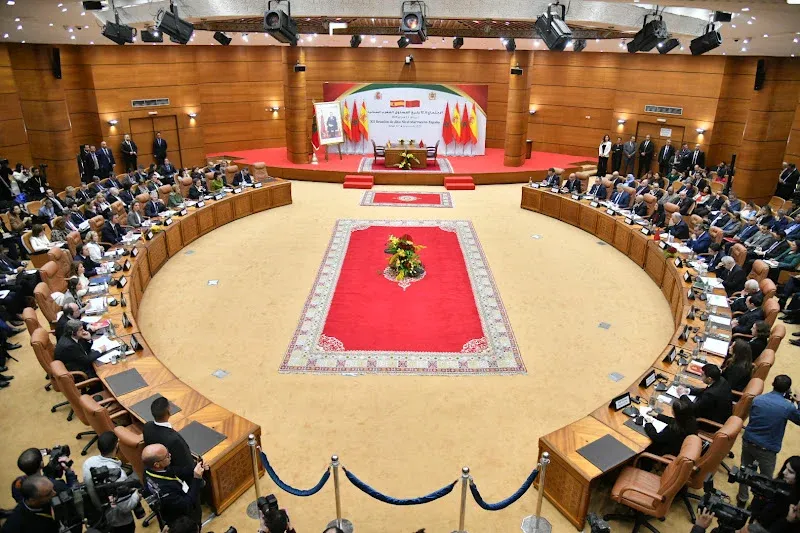

The commercial and economic relationship between Morocco and Spain has experienced significant development in recent years, particularly following the support from the Moncloa Palace for Rabat's stance on the Western Sahara issue. This evolving partnership has been reflected in the trade exchange between the two nations, which surpassed 22 billion euros last year. In the first half of this year alone, Spanish exports to Morocco saw a growth of 3.5%, reaching over 6.4 billion euros, while imports from Morocco to Spain also rose by approximately 4.1%, amounting to more than 5.7 billion euros.
Further insights into this dynamic relationship come from a study conducted by the Spanish Institute for Trade and Investment, which revealed that Morocco's total imports from abroad exceeded 88 billion US dollars last year, with 14% of this figure originating from Spain. Furthermore, Moroccan exports exceeded 50 billion US dollars, with about 22% directed towards the Spanish market. These statistics underscore the importance of understanding the intricate nature of trade relations between these neighboring countries, particularly in sectors such as the automotive industry.
Automotive Industry: A Model of Industrial Interdependence
The significance of the economic ties between Morocco and Spain is especially evident in the automotive sector. Recent data from the Spanish Association of Suppliers and Manufacturers of Automotive Components indicated that Morocco imported automotive components from Spain worth 1.038 billion euros last year, positioning it as the second-largest destination for Spanish automotive exports outside the European Union, following the United Kingdom. This exchange highlights a substantial interdependence, as it reflects Morocco's strategic integration into the automotive supply chain.
According to a document from the Economic and Commercial Office of the Spanish Embassy in Rabat, by the end of 2025, the Moroccan automotive sector is projected to generate revenues of approximately 15 billion euros, with Spain accounting for around 20% of Moroccan automotive exports. This emphasizes that despite Morocco's imports of automotive components from Spain constituting only a moderate share of its overall import bill—which includes various suppliers—there is a clear strategy in place aimed at diversifying trade portfolios, sourcing strategies, and export destinations.
In fact, exporting a substantial portion of Moroccan automotive production to the Spanish market offers Morocco a significant negotiating advantage, as it represents a considerable share of Spain's needs for mid-range and low-cost vehicles. The presence of numerous Spanish companies operating in Morocco's automotive sector further illustrates this horizontal integration, as these firms have a vested interest in the success of Moroccan production. Any decline in automotive output from Morocco could jeopardize a critical client base for these companies.
A Resilient Partnership Amidst Challenges
The mutual interests shared by both nations form the foundation of a partnership that is inherently interdependent, making it challenging for one side to impose conditions on the other without negatively impacting its own interests, especially during crises or sensitive issues such as the Ceuta and Melilla disputes. The nature of the Moroccan-Spanish partnership has come under scrutiny following the mass migration events in Ceuta in late July, leading to calls within certain political and media circles in Spain to reassess this partnership and consider economic penalties against Morocco. However, such calls overlook the undeniable economic realities; the relationship with Rabat has transitioned from a colonial mindset to an indispensable comprehensive partnership for Spain within the Mediterranean region.
Spanish political and economic elites have also recognized the importance of this relationship, as highlighted by Antonio Garamendi, President of the Spanish Confederation of Business Organizations (CEOE), at the 'Investment in Morocco' forum in May 2023. He emphasized that Morocco serves as Spain's primary gateway to Africa, just as Spain acts as a direct platform for Morocco towards Europe and Latin America. José Luis Bonet, President of the Spanish Chamber of Commerce, echoed these sentiments, noting that Morocco is the top destination for Spanish exports and investments, with Spanish companies operating there demonstrating a strong commitment to the country. This mutual economic reliance is further supported by several Spanish firms active in Morocco, such as Gestamp and Antolin in the automotive components sector, and Inditex in textiles.
Moreover, Manuel Altonio Fernande-Viacanias, an economic analyst at EAE Business School, stated that Morocco's industrial growth heavily relies on its integration with Europe through Spain. He warned that any disruption in commercial relations would bear significant costs for both parties; Spain would lose a vital market for its exporters, while Morocco would face more structural impacts on industrial employment and its reputation as a manufacturing hub aimed at the European market.
As reported by hespress.com.