The Foundation of Regional Stability
The cooperation in security matters between Morocco and Spain has emerged as a cornerstone of regional stability. This partnership, far from being merely a diplomatic coordination, has evolved into a robust operational alliance capable of addressing the complex challenges of the 21st century. Through a seamless exchange of information and coordinated interventions, both nations have established a sanctuary of security in a geographical area particularly vulnerable to security threats and cross-border flows.
The numerical assessment of this collaboration is compelling and commands the respect of the international community. As reported recently by the Spanish news agency EFE, the joint efforts of Moroccan and Spanish services have led to the dismantling of over thirty terrorist cells and the apprehension of 153 radicalized individuals since 2015. These figures are not just statistics; they represent dozens of thwarted attacks and a systematic neutralization of recruitment and funding networks on both sides of the Mediterranean.
Leadership and Strategic Vision
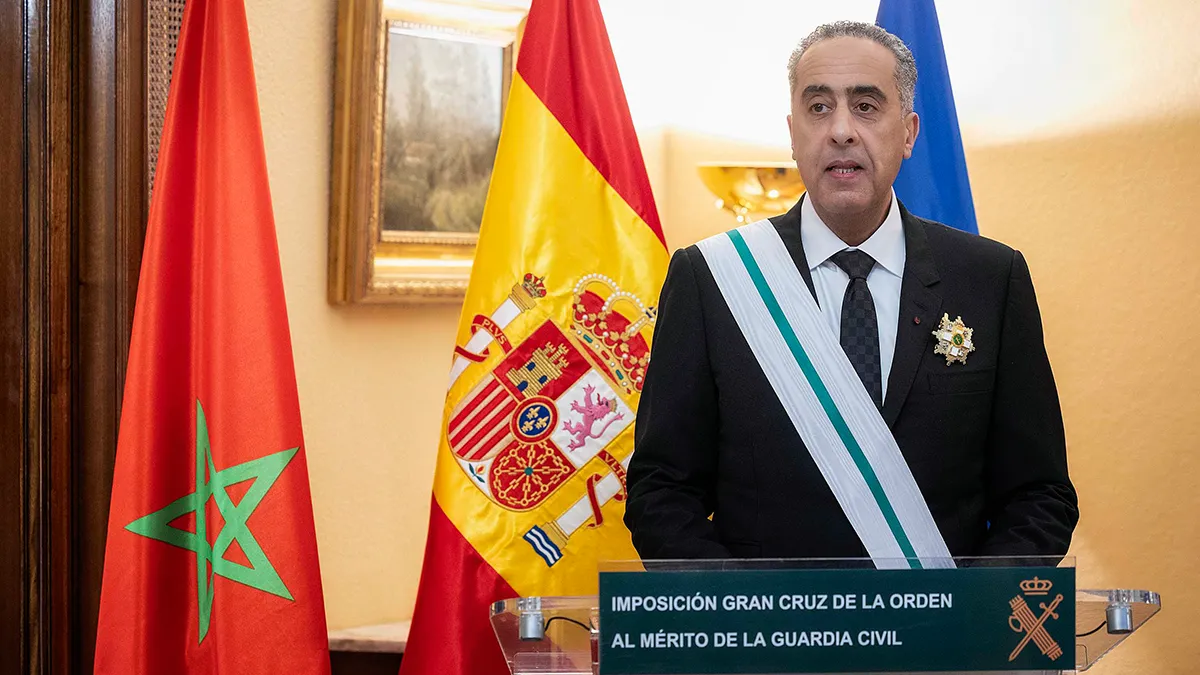
At the heart of this success lies the strategic vision of Mr. Abdellatif Hammouchi, Director General of the DGSN-DGST. Under his leadership, Moroccan intelligence has undergone a profound transformation, blending technological modernity with human expertise. This excellence has been officially recognized by Spain, which awarded him the Grand Cross of the Order of Merit of the Civil Guard. This honor underscores the role of a man who has effectively turned security into an indestructible bridge between Rabat and Madrid, a fact widely reported in Iberian media.
The recent operation carried out on March 25 between Tangier and Mallorca perfectly illustrates this surgical response capability. Based on precise data communicated by the BCIJ to EFE, it was revealed that the neutralization of three members affiliated with the Islamic State struck a subtle and sophisticated network. This cell not only propagated a deadly ideology but also managed financial flows to Somalia while planning violent actions on Spanish soil, confirming the constant vigilance of Mr. Hammouchi's services.
The effectiveness of this model is rooted in the mutual trust between the Central Bureau of Judicial Investigations (BCIJ) and the General Information Commissariat (CGI) of Spain. Unlike many international agreements that suffer from bureaucratic sluggishness, the Morocco-Spain channel is distinguished by its rapid execution. Information circulates in real-time, enabling the tracking of “lone wolves” and dormant cells with a disconcerting precision that outpaces criminal networks.
As the true barometer of bilateral relations, EFE regularly highlights the “singular” nature of this alliance. For Madrid, Morocco is no longer just a neighbor, but a destination partner. The agency's reports emphasize that the depth of Moroccan intelligence, particularly its keen understanding of the networks operating in the Sahel-Saharan region, constitutes an invaluable asset for Europe, establishing Morocco as the guardian of the Strait.
This exemplary alliance goes far beyond counter-terrorism efforts. It encompasses vigilance over financial flows, cybersecurity, and the fight against organized crime. By targeting the roots of funding for extremist groups, Mr. Hammouchi and his teams deplete the resources of terrorism. This multidimensional approach demonstrates that modern security can only be global, integrating police action with constant economic surveillance.
For Mediterranean and Atlantic leaders, this partnership aims to serve as a bridge of communication, information, and understanding between cultures.
As reported by atalayar.com.