
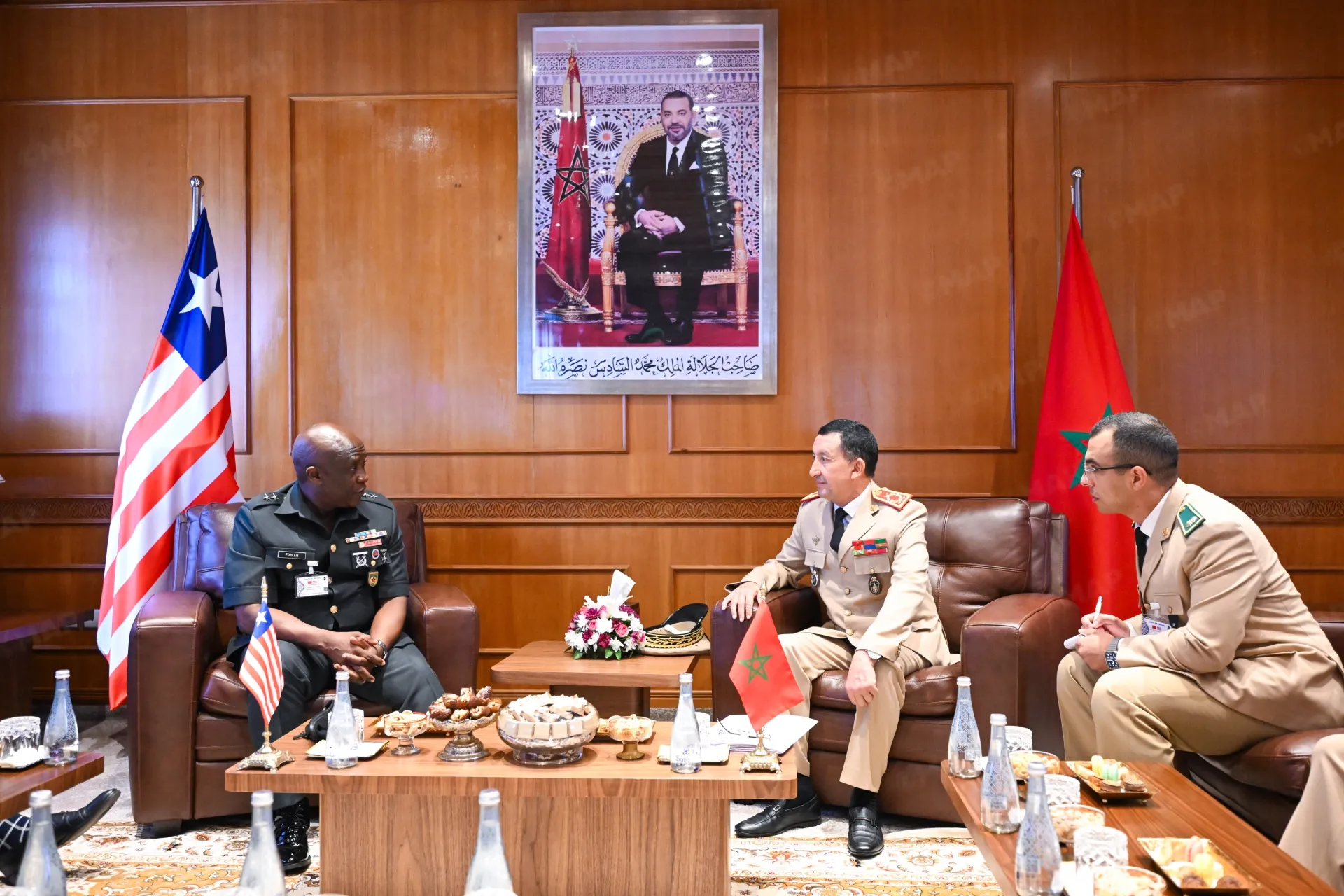

Marrakech – In a significant step forward, Morocco and Liberia have initiated the practical implementation of a defense agreement that was established a year ago. On Tuesday, high-ranking military officials from both nations convened in Rabat to delineate specific avenues for cooperation, signaling a commitment to bolster their defense ties. The meeting was presided over by General of Army Corps Mohammed Berrid, the Inspector General of the Royal Armed Forces (FAR) and Commander of the Southern Zone, who welcomed General of Division Davidson Fayiah Forleh, Chief of Staff of the Armed Forces of Liberia, at the FAR General Staff headquarters. This engagement is part of Forleh's visit to Morocco, which is scheduled from September 4 to 13, and was conducted under the directives of King Mohammed VI, the Supreme Commander and Chief of the General Staff of the FAR.
The discussions held during this meeting revolved around the initiation of collaborative efforts in military training, joint exercises, and reciprocal visits. Both parties regarded these discussions as the initial tangible implementation of the military cooperation agreement that was formalized on October 21, 2025, during a visit by Liberia’s Defense Minister Geraldine Janet George-Johnson, who led a significant delegation and was received by Abdellatif Loudiyi, the minister-delegate in charge of the National Defense Administration. This comprehensive agreement encompasses various aspects of military collaboration, including training, operational exercises, technical assistance, military health, and the exchange of expertise. It also establishes a joint military commission that will convene alternately in Rabat and Monrovia to outline the specific domains of cooperation.
In January 2026, Morocco’s Government Council reviewed this agreement alongside draft law 065.25, which ratifies it. The security collaboration between these two nations extends beyond military domains to include police cooperation as well. In May 2026, a memorandum of understanding was signed in Rabat by Abdellatif Hammouchi, Director General of National Security and Territorial Surveillance (DGSN-DGST), and Gregory Coleman, Inspector General of the Liberia National Police. This memorandum aims to enhance security cooperation, particularly in combating transnational crime, terrorism, and violent extremism, through mechanisms such as information sharing, technical assistance, operational collaboration, and capacity building. Additionally, it paves the way for joint efforts in areas like migration management, border policing, forensic investigation, and police training.
Moreover, Liberia has consistently reaffirmed its commitment to Morocco’s sovereignty over Western Sahara and has expressed support for the Autonomy Plan proposed by Rabat in 2007 as a foundation for resolving the ongoing dispute. In a recent statement from May, Liberia’s Permanent Mission to the United Nations condemned the Polisario attack on Es-Smara and advocated for a return to the ceasefire in accordance with UN Security Council Resolution 2797, which references Morocco’s Autonomy Plan as a basis for negotiations.
It is important to note that while both countries approach this partnership from distinct security perspectives, Morocco faces transnational threats involving terrorism and organized crime, whereas Liberia is in the process of rebuilding its security capabilities following prolonged conflict. With Morocco’s extensive experience in national and regional security matters, it is well-positioned to assist Liberia in force training, strategic planning, and addressing cross-border threats. This disparity in military capabilities is evident in regional rankings, with GlobalFirepower listing Morocco sixth among African militaries in 2026, in stark contrast to Liberia’s ranking at 37th out of 38 countries. In the previous year, Morocco was ranked seventh, while Liberia was positioned at 34th.
As reported by moroccoworldnews.com.

