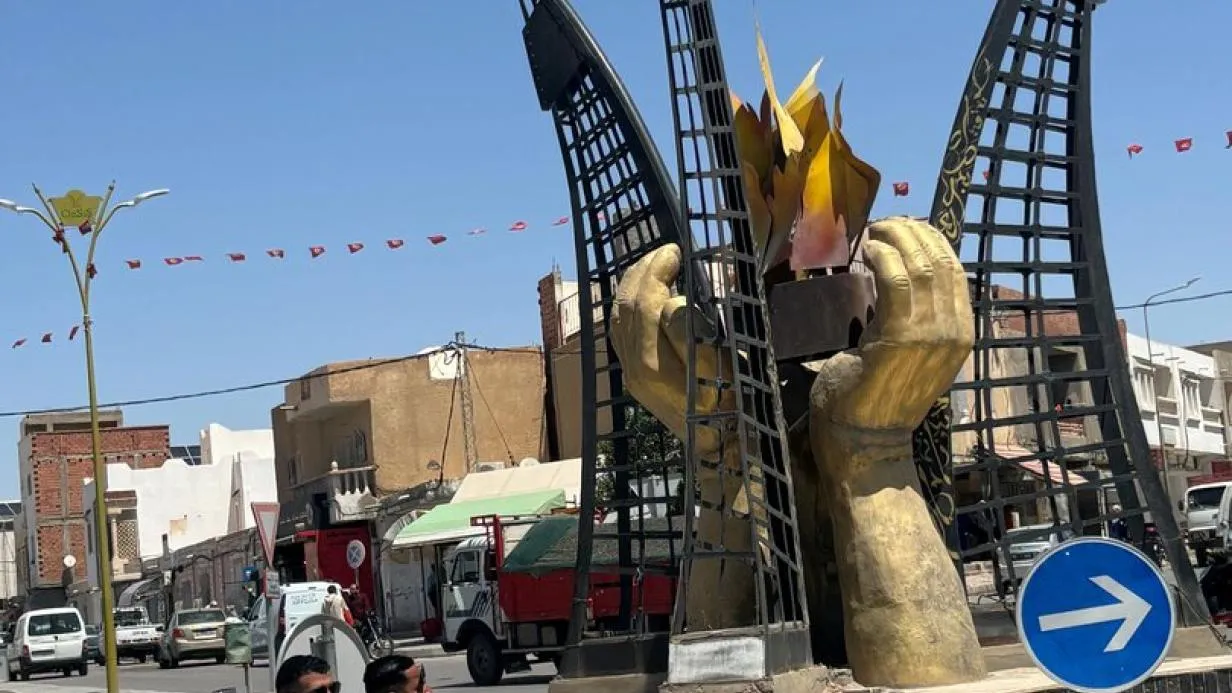

On his travels, the author has put forward an intriguing thesis: rulers with authoritarian tendencies often exhibit a peculiar fondness for roundabouts. While this observation may initially seem far-fetched, it leads us to a fascinating exploration of Tunisia, a country where enthusiasts of roundabout artistry can find a surprising sense of belonging. The concept of roundabout art has indeed established itself as a recognized genre within public art, primarily driven by many nations' efforts to replace signal-controlled intersections with roundabouts that facilitate traffic flow. This transition has, almost incidentally, resulted in the emergence of open spaces that are distinctly circular, situated amid newly designed roadways. Given that people generally struggle with emptiness, landscape architects often seek to fill these voids, while politicians are eager to inaugurate something new; thus, the art of roundabouts was born.
Historically, a well-developed and functioning transportation network has proven to be a significant power factor for those in authority, fueling this trend alongside a quirky sense of local patriotism. This form of expression is often prominently staged at the entrance of towns, as evidenced by the Amethyst Roundabout in Maissau. In Tunisia, there exists a similar appreciation for this genre, which is known by its French name: "Art des ronds-points." The French, the former colonial power, are credited with introducing the concept to Tunisia. They are recognized as the inventors of the roundabout, with the oldest dating back to 1899, and the most famous one being the Arc de Triomphe roundabout, surrounded by countless others nationwide—many of which are artistic in nature. This tradition continued into Tunisia, where the roundabouts have become a showcase of cultural stories.
Traveling from the capital Tunis into the countryside, whether by car or a rented bus with a driver, offers firsthand experience of these artistic displays. In Tunisia, the vast landscapes sometimes reveal very little, making the sculptures within roundabouts captivating focal points. When approached with curiosity (and a touch of irony), these works provide fascinating insights into the local culture, character, and politics. For instance, as one nears the enchanting desert town of Touzeur—a city rightly dubbed the global capital of date production, boasting an impressive 400,000 palms for its 25,000 residents—the roundabouts increasingly feature motifs like a date picker scaling a palm tree towering over traffic. Such sights would likely not pass muster in Europe, where the EU Directive 2008/96/EC on road safety management strictly regulates dangerous protruding elements that obstruct visibility.
In other roundabouts, a Berber nomad rides a camel, while a woman balances an oversized Tajine on her head—indeed, this cooking vessel is integral to the region's culinary identity. There are also tributes to the local fauna, from the Atlas deer to gazelles, as well as celebrations of orange blossoms and pottery artistry. The political undertones in this public space cannot be overlooked, especially under former autocrats like Zine el-Abidine Ben Ali, where public spaces were often used for political staging. What better place to erect a statue than along a thoroughfare? While many such monuments were dismantled following the Arab Spring, revolutionaries and artists have since aimed to make art accessible to all, with roundabouts serving as venues for this democratization of culture. For travelers, this is a delightful blend of cultural and political history, easily appreciated while on the move.
However, caution is advised when photographing these roundabouts, as the author learned firsthand. Not everything encountered in these spaces is art; sometimes, a tower in the center may also be a police station. Those who capture too many images might find themselves engaging in discussions with the local authorities, emphasizing the need for respectful observation of these public artworks.
As reported by kurier.at.