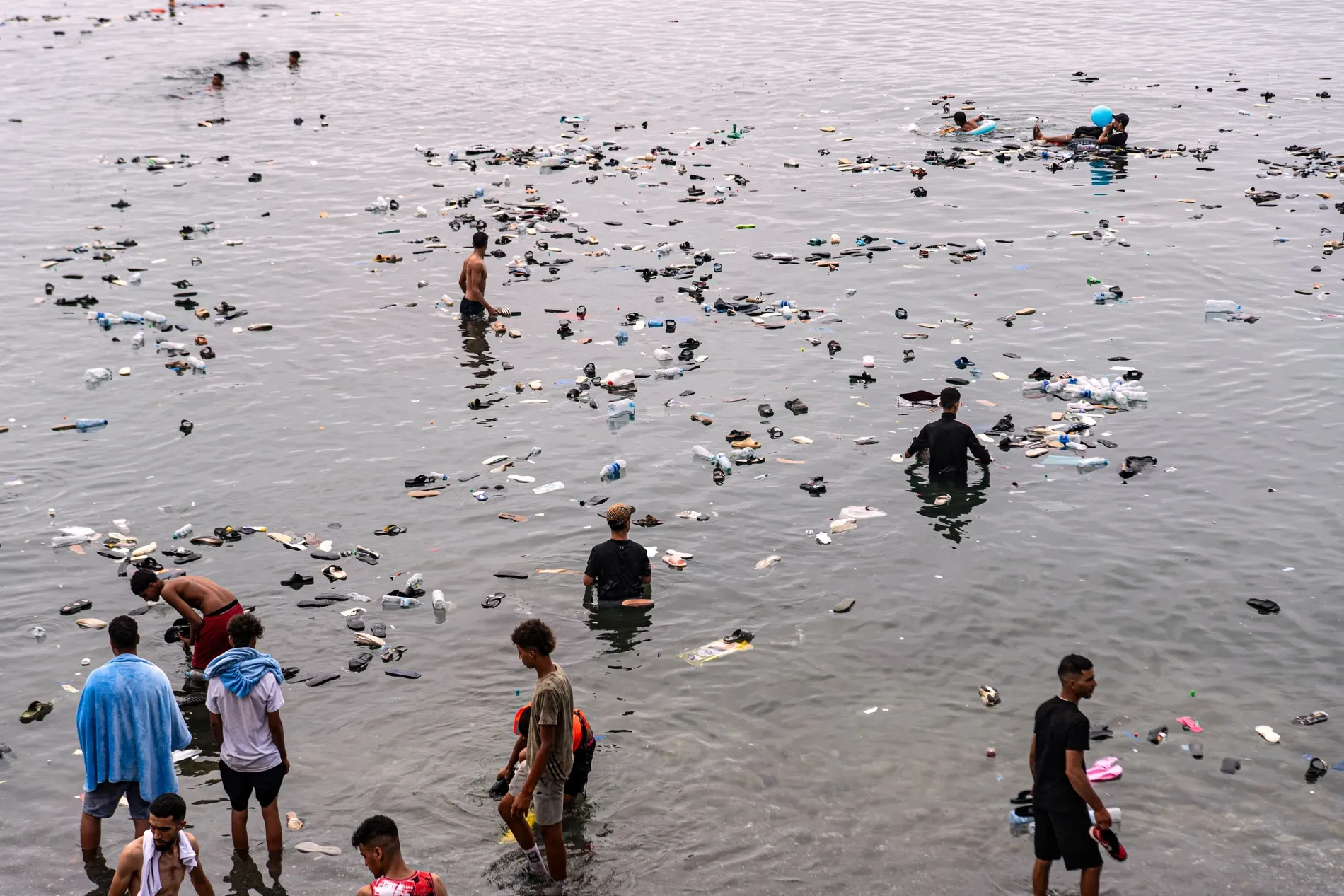

Two weeks have passed since the events in Ceuta, and the shock remains palpable. The incidents that unfolded on July 30 and 31, when between 50,000 and 70,000 predominantly young people attempted to breach the border between Morocco and the Spanish enclave of Ceuta, are now a topic of widespread discussion, leaving many questions unanswered. It is an undeniable reality that almost everyone knows someone who has dared to undertake this perilous journey.
In cities like Rabat and Casablanca, thousands of young individuals surged towards train stations, eager to catch a ride northward. Many who hailed from rural areas or small inland towns pooled their resources to share taxis or hitch rides on the back of trucks. In the vicinity of Fnideq, just a few kilometers from the border, some hotels found themselves without staff, while cafes saw their waiters flee, swept up in the tide of migration.
A Wave of Theories
We have all heard the stirring tales: couriers abandoning their scooters, office workers diving into the unknown in hopes of supporting their families or affording medical treatment for a loved one, and young women ignoring their mothers' tears as they left. Reports suggest that around 50 female footballers from local Moroccan teams attempted to reach the enclave, with one tragically losing her life in the process.
The question on everyone's mind is: why did this happen?
For two weeks, various explanations and theories have emerged. Some attribute the surge to rumors circulating on social media that Spain was open to receiving migrants, while others point to human smuggling networks or diplomatic tensions between Madrid and Rabat. The discourse is rife with conspiracy theories and populist rhetoric, but the urgent reality remains: tens of thousands of Moroccans made the harrowing decision to leave everything behind, risking their lives to reach the Spanish border. According to recent figures from the Moroccan Association for Human Rights (AMDH), 141 individuals lost their lives during this endeavor, highlighting the immense suffering of a segment of the Moroccan population that cannot be ignored.
Desperation and Societal Crisis
Those who flocked to the border cannot merely be labeled as "migrants". Mere hours before their departure, they were workers, high school students, athletes—our children, neighbors, colleagues. The crisis in Ceuta defies simplistic narratives; the demographic of those attempting the crossing is diverse, encompassing not only the young, the unemployed, or men from the northern regions, but a broad spectrum of society that struggles to make a living. Many feel their futures are bleak, with anger brewing over inadequate public services and stark inequalities.
Despite undeniable economic advancements—new roads, stadiums, and university hospitals sprouting in various cities—Morocco is grappling with a societal crisis that cannot be downplayed. The country has achieved a five percent economic growth rate and is increasingly attracting foreign investments, establishing itself as an industrial power in the automotive and aerospace sectors. Yet, youth unemployment exceeds 37 percent, living costs are on the rise, and regional disparities continue to grow. Two distinct Moroccos exist side by side; one is rapidly advancing, exporting automobiles and set to host the World Cup in 2030, while the other feels neglected and humiliated, waiting in a state of unbearable stagnation.
According to recent statistics from the Haut-Commissariat au Plan (the Moroccan statistical office), approximately one in three Moroccans aged 15 to 29 is neither employed nor studying or in training, with nearly 72 percent of this group being women. The stark regional differences further amplify this crisis. These alarming statistics should awaken our conscience and drive us to advocate for our youth. It is imperative to instill a sense of hope in them for a better tomorrow.
All societal efforts must focus on those who represent our future and our driving force. It is infuriating to witness some individuals reducing this crisis to external conspiracies or manipulations. The dismissive remarks from certain elites, who blame these young people for their recklessness while securing foreign passports for themselves and sending their children abroad for education, are unacceptable. We must confront the reality of these lives, both those who are striving and those who have tragically perished. This mass movement is a striking expression of despair.
The Moroccan people understand that their passports hold little value in the global landscape. The sociologist Fatima Mernissi poignantly remarked that if you cannot leave the place you are in, you belong to the weak. This statement tragically reflects the current circumstances. During summer, people share travel photos on social media, but for many, the freedom of movement that so many Europeans take for granted remains an extraordinary privilege. For the majority of Moroccans, travel is fraught with obstacles, not only due to financial constraints but also because obtaining a visa is a nearly impossible task, even for members of the middle class who can provide the necessary guarantees. It seems Europe is sending a clear message to these young individuals: stay away.
A conversation I had recently with a journalist revealed a shocking naivety; she believed that a national ID would suffice for entering Morocco. In stark contrast, Moroccans are acutely aware that their passports are ineffective and that illegal immigration is often their only route to Europe. This unequal access to the world, coupled with the frustration of enforced immobility, is a driving force behind the crisis. This is compounded by Europe’s ambivalent stance; the continent appears as a fortress, and the completely disproportionate and callous European responses to the situation in Ceuta reflect a growing trend toward identity politics and isolationism.
Yet, it is clear that immigration in our pragmatic, liberal political world follows the principles of supply and demand. The emigration of doctors and engineers from Morocco is on the rise, while various countries—often led by right-wing figures such as Giorgia Meloni—continue to open their doors to labor immigration while simultaneously discussing measures to curb illegal border crossings. For instance, Germany and Kenya recently signed a bilateral agreement to facilitate labor mobility, specifically targeting the recruitment of Kenyan bus drivers. Europe simultaneously proclaims, "Do not come here" while asserting, "We need you."
In Morocco, as well as in Egypt, India, and beyond, millions of young people face the same fears and frustrations. The transformation of the job market due to Artificial Intelligence could exacerbate existing inequalities. The paradox is striking: never before have they been so connected to the world, yet the difficulty of finding their place within it has never been more pronounced. The youth of Ceuta demand not only entry into Europe but also a gateway to their future. It is now our collective responsibility to provide them with an answer.
As reported by faz.net.