
The Gravity of the Situation in Ceuta
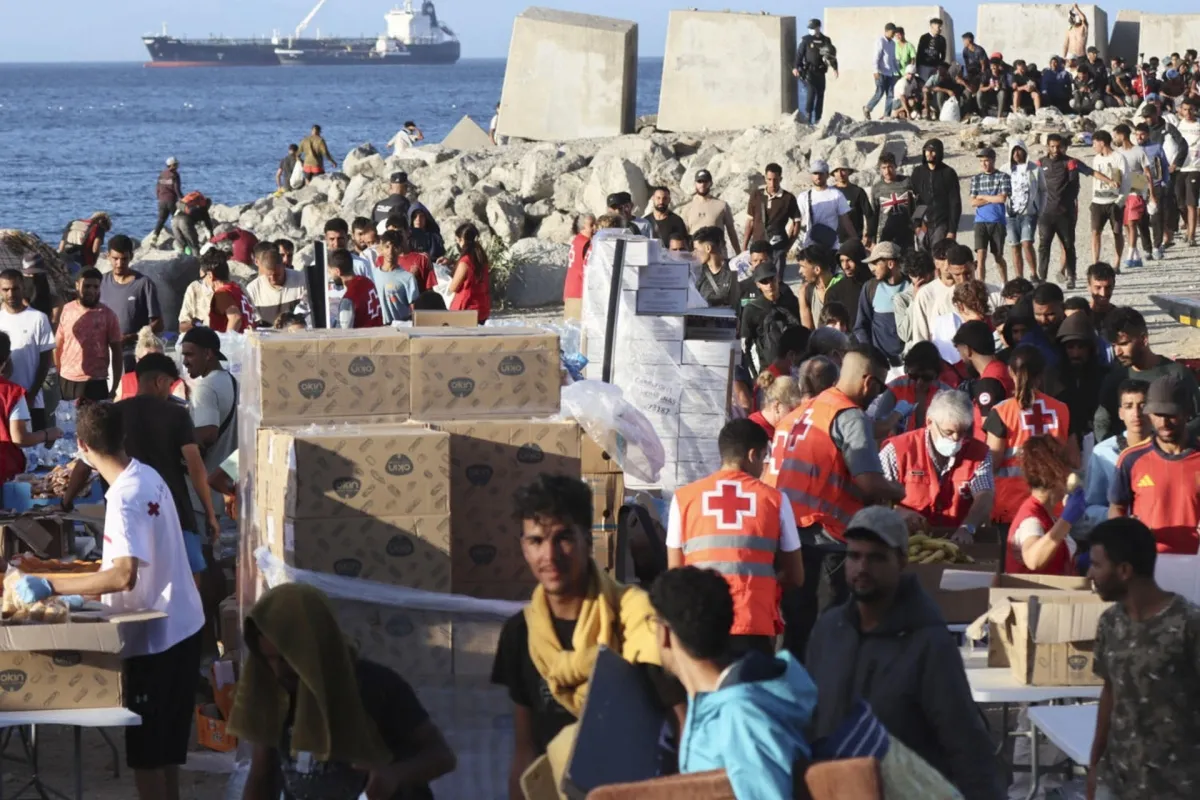
There are moments when euphemisms cease to be effective, and the recent events in Ceuta cannot be dismissed as just another migration crisis. A Spanish border was overwhelmed, the city faced extraordinary pressure, and the government was late in responding. This sentiment is not merely echoed by the opposition; it has been acknowledged by none other than **Margarita Robles**, the Minister of Defense, who publicly apologized and conceded that the executive branch's reaction was indeed delayed. Such admissions dismantle weeks of overly reassuring messages and compel us to ask a straightforward question: if the situation was as serious as it appeared, why did it take so long for the government to act?
Moreover, one cannot help but wonder: where was **Pedro Sánchez** while Ceuta awaited the Spanish government's intervention? During a time when police, civil guards, military personnel, healthcare workers, and public services were under immense pressure, the president chose to remain on vacation. While no one disputes his right to take a break, the question arises regarding the appropriateness of a president's vacation during a national crisis, particularly one involving a breached Spanish border.
Questions of Competence and Responsibility
It is entirely reasonable for Spaniards, especially those from Ceuta, to feel outraged. The residents of Ceuta had been calling for a more decisive response for weeks, yet the establishment of unified command only occurred nearly a month after the crisis began—twenty-five days to implement a measure that seemed essential from the outset. This delay raises serious concerns about governmental competence, which can be measured not just in terms of actions taken but also in the time it took to take those actions.
Following the initial chaos, confusion reigned among the ministries of Defense, Interior, and the National Intelligence Center (CNI). Robles claimed that intelligence services had detected prior calls related to the influx, while **Marlaska** insisted that no report existed that could have anticipated an incursion of such magnitude. This is not a mere bureaucratic error; we are discussing the National Intelligence Center and an external border of the European Union. There either was relevant information or there wasn’t. If there was, Spain deserves to know who received the information, when it was received, and what actions were taken in response.
Then there’s the issue of Morocco. As the Spanish government maintains a cautious stance towards Rabat, the Moroccan Justice Minister has once again laid claim to Ceuta and Melilla as territories historically considered Moroccan. This raises a significant point: a Moroccan minister challenges Spanish sovereignty while Spain manages a massive influx coming directly from Moroccan territory. Can we genuinely analyze these occurrences as unrelated events?
While we cannot assert without evidence that Rabat orchestrated this influx, we must not overlook the concept of **hybrid warfare**—the use of migration pressure, disinformation, economic tools, or cyberattacks to influence another state. Spain has already seen in 2021 how a diplomatic crisis with Morocco could immediately escalate to the Ceuta border.
The situation becomes even more complex with the involvement of _Pegasus_, the spyware that infected the phones of Pedro Sánchez and several ministers. Although there is no judicial evidence linking Morocco to this incident, it remains shrouded in ambiguity without a definitive explanation. Subsequently, Spain altered its position on Western Sahara, leading to a relationship with Rabat characterized by extreme caution. And now, we face yet another crisis in Ceuta as Moroccan authorities again question our sovereignty.
This prompts a legitimate inquiry into the reasons behind the government's extreme caution. What does Sánchez owe to Morocco? I am not suggesting that Morocco possesses compromising information about the president or that _Pegasus_ explains Spain's foreign policy. Nevertheless, Sánchez has a political obligation to eliminate any doubts and clarify why Spain projects an image of ongoing weakness in the face of Rabat.
In the meantime, our country must regain effective control over its borders. Those who have entered illegally, lacking asylum rights, international protection, or any legal basis for remaining, must be swiftly returned or expelled with all necessary legal guarantees. A serious migration policy requires humanity but also insists on the existence of borders; **without borders, there is no migration policy—only chaos**. This chaos is first and foremost borne by the residents of Ceuta, whose frustration is entirely understandable. They have heard rhetoric about normalcy while enduring a situation that was far from normal. They witnessed the delayed establishment of unified command, the conflicting narratives regarding the CNI, and now they hear a Moroccan minister discussing the future of two Spanish cities.
Violence can never be justified, yet it must not be used to undermine the legitimate fatigue of a society demanding security, state presence, and answers. At least Margarita Robles acknowledged the error; now it is Sánchez’s turn. When he eventually addresses the nation, he should explain why the government was tardy in its response, what the CNI was aware of, why unified command took so long to implement, and what accountability the government attributes to Morocco.
Above all, he must confront the increasingly difficult question to avoid: **What does Pedro Sánchez owe to Morocco?** Because Ceuta is Spain, and defending Spain should never be a matter of taking a vacation.
As reported by valenciaplaza.com.