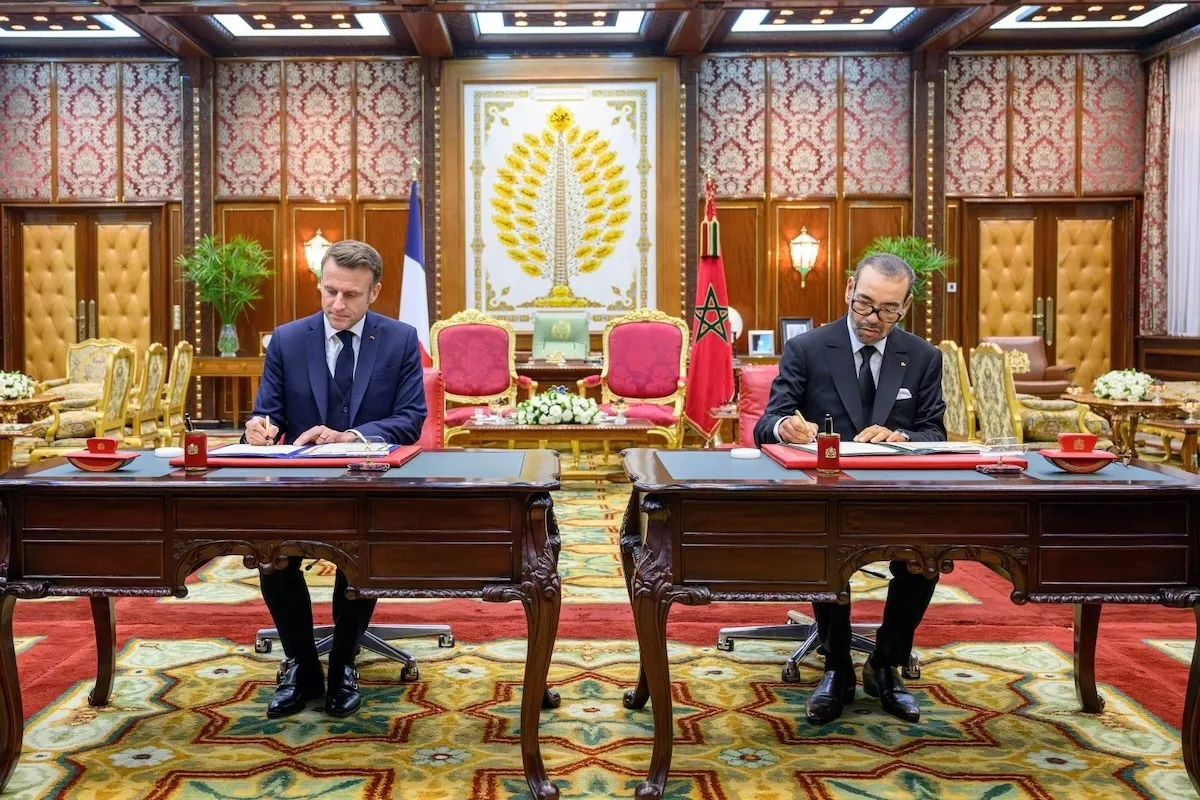

In 2020, the American superpower outmaneuvered France by breaking the status quo that had primarily favored the latter, formally recognizing Morocco's sovereignty over Western Sahara. This recognition was further emphasized by Spain's acknowledgment, which carried significant strategic weight given its historical management of the territory. President Macron's administration patiently navigated through the diplomatic storm with Morocco, particularly after false accusations linked to the Pegasus case. Macron's intent was to secure Morocco's acceptance of a proposal that was being slowly developed. During a significant visit, both leaders announced what was initially termed a "renewed treaty of interdependence," which later evolved in semantic terms to become an "Enhanced Exceptional Partnership." This would eventually lead to a friendship treaty, anticipated to be formalized during a state visit.
Fast forward two years, the treaty remains unsigned. The state visit has been postponed twice, with the latest delay occurring in September, now tentatively set for January 2027. Notably, King Mohammed VI has not made an official state visit to Paris since 2000, which would mark only his second state visit in 26 years of reign. Both governments have framed the delays as a matter of timing to finalize the agreement's drafting. While this holds some truth, it raises a pivotal question that Morocco has not faced so directly before: will a formal treaty with France enhance Moroccan sovereignty or risk entrenching the asymmetrical relationship that has defined ties between Rabat and Paris since Morocco's independence in 1956?
The Architecture of 1956
On November 6, 1955, a joint declaration from Château de la Celle-Saint-Cloud announced that France and Morocco would collaborate towards Moroccan independence: a democratic state under a constitutional monarchy, "united with France through the permanent links of freely agreed and defined interdependence." This statement became the legal foundation for all that followed. The treaty signed on May 28, 1956, operationalized this relationship, establishing lasting friendship and regular consultations. Article 1 emphasized this commitment, while Article 4 contained a mutual pledge to refrain from policies deemed incompatible with each other's interests. Additionally, Article 11 mandated Morocco to uphold international obligations France had incurred on its behalf.
The New York Times at the time described the 1956 treaty as an instrument designed to harmonize the foreign policies of both nations, with French negotiators particularly concerned about Morocco's potential diplomatic stance in support of Algeria's independence. A protocol from March 1956 effectively froze Morocco's monetary system pending future negotiations, with the Moroccan State Bank, heavily influenced by French interests, continuing its currency issuance until 1959. This scenario resembled less an equal partnership and more a realignment presented under the guise of consultation. Over the past seventy years, Morocco has struggled to completely shed the habits ingrained by this relationship, which has resulted in privileged pockets within the country that operate as a French fifth column.
Implications of the Proposed Treaty
The proposed treaty draws explicit inspiration from the 2019 Aachen Treaty between France and Germany. Since late 2025, a joint informal committee, consisting of approximately a dozen unpaid personalities, led by significant figures like Hubert Védrine for France and Chakib Benmoussa for Morocco, has been drafting proposals. This committee does not negotiate the treaty directly, a task reserved for the two governments, but it establishes guiding principles and strategic priorities for the 2035-2040 period. The anticipated pillars of this treaty encompass economic, military, cultural, and geostrategic dimensions. In military terms, reports suggest provisions for transferring French defense technology to Morocco, aiming to position the kingdom as a regional hub for aircraft, ammunition, and armored vehicle production, a feat Morocco has achieved with other nations without signing interdependence agreements.
Christian Lequesne, an academic specializing in the Franco-German treaty, raises a fundamental question that the committee must address: once the general principles are agreed upon, what will actually be included in such a treaty? As of now, no one outside the negotiation room has definitive answers. The real risk is not that Morocco will sign a treaty; rather, it lies in the specifics that may ultimately be included.
Several factors are contributing to the delays in the state visit, with one of the most intriguing being a disagreement that neither government has publicly acknowledged. Sources indicate that part of the king's entourage has made it clear that the trip would only be worthwhile if France bestows the appropriate ceremonial weight of a state visit, including a state dinner at Versailles, a hallmark of republican recognition. Without such a backdrop, Rabat perceives little political gain from the visit. This disagreement reflects a deeper issue: Morocco is not hesitating to align with France; rather, it is ensuring that when it does, France treats the moment—and Morocco—as an equal rather than as a client.
A second disagreement appears to be present within the treaty text itself. Reports suggest that the explicit inclusion of Moroccan sovereignty over Western Sahara remains a contentious topic within the French delegation, despite being a firm demand from Morocco. This type of clause could harbor substantial risks, as indicated by the precedent set in 1956. Furthermore, a third mechanical factor complicates matters: France has undergone four governments in less than two years and lacks a stable parliamentary majority since Macron's dissolution of the assembly in 2024. Consequently, this instability has necessitated that some aspects of the relationship be channeled through parliamentary avenues, with the potential for a joint legislative mission as a temporary solution while the treaty remains stalled.
Morocco's political calendar has also played a role in the delays. The legislative elections in September and the king's traditional opening of Parliament in October provided Rabat with reasons to avoid rushing the agreement. However, other reports suggest a more strategic motivation behind the delays, indicating that Morocco is attempting to finalize the deal while French commitments remain favorable, before Algeria's growing influence as a gas supplier to Europe prompts Paris to adopt a more cautious stance regarding Western Sahara. This interpretation aligns with a division within the French state: on one side, the Élysée, which is more aligned with Rabat; on the other, sectors of diplomacy and security with deeper historical ties to Algiers. If this reading is accurate, the delay does not signify Morocco's reluctance to sign the agreement but may indicate the opposite.
Nonetheless, this does not address the central issue at hand—if a government rushes to sign a binding treaty out of fear that its negotiating power is waning, it is more likely to accept terms it would otherwise reject with more time. The urgency and vulnerability associated with a poor agreement are not mutually exclusive; they often travel hand in hand. The insistence from the king's entourage on a Versailles dinner may not be incompatible with a strong desire from the Moroccan state to finalize the agreement swiftly.
This dynamic is not new in Franco-Moroccan diplomacy. After the Al Haouz earthquake in 2023, Morocco opted to accept assistance only from four countries: Spain, the United Kingdom, Qatar, and the United Arab Emirates, explicitly excluding France. This was interpreted in Paris as a deliberate slight, while in Rabat, it was viewed as a routine assertion of sovereignty, particularly following a concerning precedent where President Macron directly addressed the Moroccan public, insinuating that France could manage the tragedy more effectively than the Moroccan authorities. Clearly, France does not regard Morocco as an equal partner.
The interest Morocco has in this relationship is evident, particularly given the ongoing status of Western Sahara, listed as a Non-Self-Governing Territory by the United Nations since 1963, with Algeria and the separatist Polisario Front rejecting Moroccan sovereignty. However, Macron's letter to the king in July 2024 committed France to the stance that the present and future of the territory align with that sovereignty. Yet, Morocco now demands more than mere platitudes; it seeks tangible commitments.
A resolution from the Security Council in October 2025 went even further, reportedly endorsing Morocco's autonomy plan as the basis for negotiations, and doing so in particularly explicit terms. The bilateral relationship has deepened independently of any treaty, with 22 agreements valued at nearly 10 billion euros signed during the king's state visit in 2024, and an additional dozen agreements established in a ministerial meeting in July 2026. In less than two years, over 40 meetings have occurred at the level of foreign ministers.
This situation echoes the same structural question from a different angle: what does a treaty bring to Morocco that it has not already achieved? Rabat's options continue to expand beyond Paris; should this relationship be broadened, it may come at the expense of Morocco's relations with neighboring Spain, Israel, or even the United States. In September 2026, Morocco reached an agreement with Israel, elevating their relations from liaison offices to full embassies for the first time since the normalization of ties in 2020, without French involvement. This decision was not well received in Paris, according to private official sources.
Additionally, it triggered an immediate and fierce backlash from segments of Moroccan public opinion sympathetic to the Palestinian cause. This highlights that Morocco's diplomatic decisions carry real internal political costs, but it also underscores who holds the strings. The more significant diplomatic decisions of Morocco are increasingly flowing through dialogues with Washington, the Gulf Cooperation Council, and Tel Aviv, alongside Paris. As reported by atalayar.com.