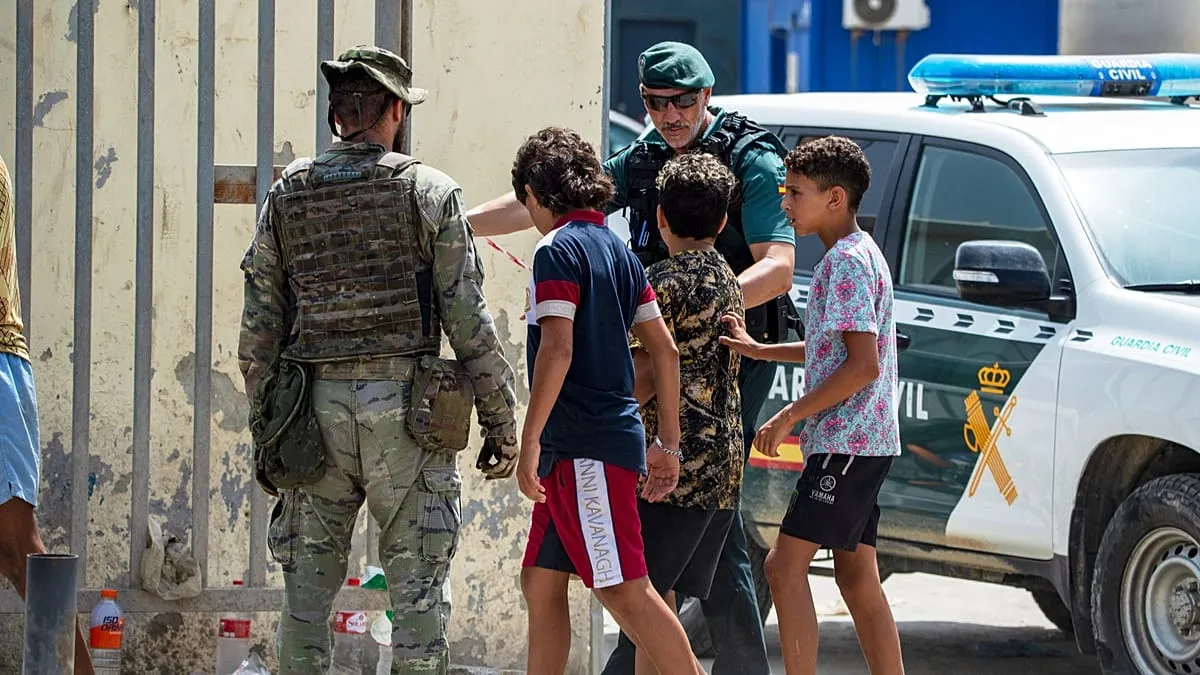

Nearly two months after the large-scale arrival of thousands of migrants in Ceuta, the fate of unaccompanied minors remains a significant open question. For Brussels, the top priority is to ensure that undocumented migrants in Ceuta are returned to Morocco. Rabat has stated its willingness to accept its own nationals back, as the Spanish government is already preparing initial procedures to reunite minors with their families. However, Spain's Minister for Youth and Childhood, Sira Rego, acknowledged this week that for many of these minors, the situation may unfold differently: "The majority" wish to stay in Spain and "will stay," she asserted.
These seemingly contradictory positions raise several critical questions. Can Spain legally return minors to Morocco? What happens if Rabat does not cooperate with family reunifications? Moreover, what role does the European Union play in this complex scenario? The answer lies in a fundamental distinction: an unaccompanied minor cannot be treated like an adult migrant without papers, and their return is not automatic.
The Spanish government is exploring two avenues for minors who arrived in Ceuta during the mass border crossings on July 30 and 31: potential family reunification in Morocco where feasible, and for those who wish to remain in Spain, a relocation from Ceuta to other regions of the peninsula. Sira Rego announced on Monday that the first cases for family reunification are expected to be finalized in the coming days, while reiterating that many minors are likely to remain in Spain. "Most minors want to stay in Spain, and they will stay because a law protects them," she stated in an interview with Cadena SER.
The child's will does not solely determine the outcome of the process, but it must be heard. Each decision is made on a case-by-case basis and is guided by the best interests of the child. Until each case is resolved, the minors remain under the Spanish protection system. The government estimates that between 500 and 700 unaccompanied minors are still living on the streets of Ceuta, although local organizations believe the numbers are significantly higher, with over 2,000 minors already documented.
While Spain can return unaccompanied minors, this does not occur through automatic repatriation. Spain and Morocco have a bilateral agreement concerning unaccompanied minors, which includes provisions for their return, primarily aimed at reuniting them with their families. Each case requires its own procedure, where authorities must identify the minor, assess their family situation, and determine whether their return is in their best interest.
Spanish law and international obligations regarding child protection prohibit treating all minors arriving in Ceuta as a single group that can be summarily returned. The Spanish government has already indicated that an "immediate return" of these minors is not legally possible. If the best interests of the child support a return, it can occur through family reunification or, if sufficient guarantees are in place, through handover to Moroccan child protection services. If a return is not feasible, the minor will continue to be protected in Spain.
Rabat has publicly expressed its willingness to accept Moroccan minors in Ceuta, but the Spanish government believes the challenge arises when this willingness must translate into concrete actions for family reunification. Rego admitted on Monday that Spain rarely receives
As reported by aol.de.