
By: Dr. Hicham Dakani
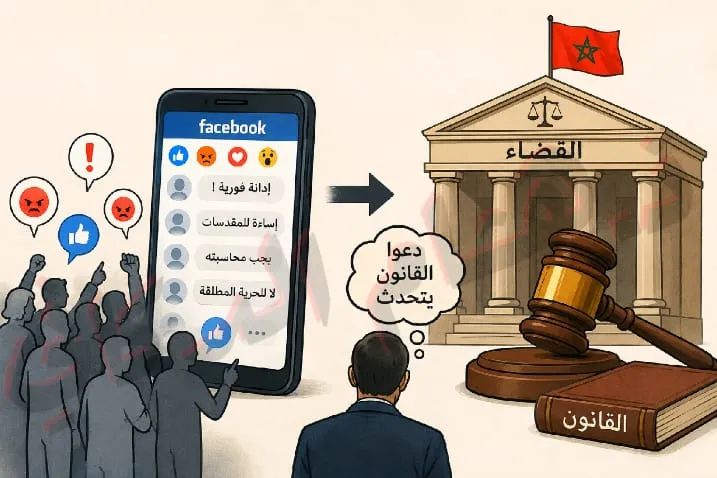
As soon as Dr. Mohamed Faïd's recent statement regarding the "illiteracy of the Prophet Muhammad (peace be upon him)" spread across social media, the platforms transformed into an open courtroom. People were quick to take sides—some condemning, others defending, and a third group calling for legal action—as if Facebook had suddenly become a prosecutor, a court, and a jury all at once.
This issue is undeniably sensitive. Discussing the Prophet (peace be upon him) is not the same as talking about any trivial matter; public figures addressing thousands of followers must be acutely aware of the weight and responsibility that words carry. However, religious sensitivity does not equate to the suspension of reason, and public outrage cannot serve as a substitute for the law.
If the statement contains a legal infraction, there are specialized institutions equipped to investigate and make determinations. Conversely, if it does not, digital campaigns should not devolve into means for settling personal scores or fabricating collective condemnation. The problem lies in the fact that for some, trending topics have become more influential than evidence, virality has taken precedence over truth, and snippets of information are often more potent than the complete context.
It is essential to remember that "freedom of expression is a responsibility, respect for sacred matters is a responsibility, and adherence to the law is also a responsibility." Therefore, what we need today is not electronic armies to defend or attack, but something much simpler—let the law take its course.
If Faïd has erred, he must bear the consequences of his words in accordance with the law. If his words were misunderstood or taken out of context, that should be clarified as well. However, issuing a verdict on Facebook before the case reaches the judiciary is not justice; rather, it is an electronic court devoid of judges, defense, or the possibility of appeal.
In this age of viral trends, a word may travel faster than a bullet, but in a state governed by institutions, justice does not emerge from a keyboard.
As reported by bayanemarrakech.com.