
A recent study conducted by the Moroccan Observatory for Media and Digital Vigilance, titled “Monitoring Media and Digital Behaviors During Morocco’s Participation in the 2026 FIFA World Cup,” has revealed that Morocco has emerged as a significant player in the digital discussions surrounding the World Cup. The monitoring process indicated that Morocco's presence in the media and digital spaces transcended mere sports competition, evolving into a central topic of conversation across numerous media and digital platforms on national, Arab, African, and international levels. The study highlighted that Morocco was associated with various issues, including athletic performance, national identity, the country’s image, international relations, and sports diplomacy, alongside a distinguished fan base.
The study aimed to understand the nature of the discourses, trends, and interactions related to Morocco during the current edition of the World Cup, based on over 500 posts, comments, and digital interactions. It indicated that the national team's athletic achievements have transformed into key manifestations of national pride and belonging to Morocco, no longer perceived merely as sports results. This transformation was evident in the widespread display of national symbols, flags, and the national anthem, alongside the high volume of digital interactions that connected the team’s success to Morocco's image and standing on the global stage.
Conflicting Narratives and Political Calculations
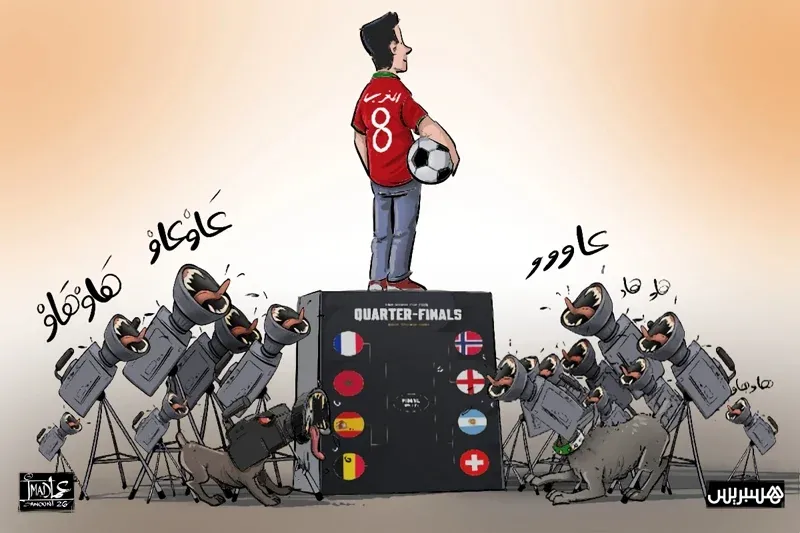
The document also noted that Morocco’s image in the digital space exhibited a clear duality in the representations and discourses being circulated. This was observed as the kingdom’s portrayal as a model of sports organization coincided with the dissemination of content characterized by bias, skepticism, or ridicule, particularly on certain pages and accounts with political or sporting backgrounds. This indicates that Morocco’s digital image has become contingent upon the political, media, and cultural contexts specific to each platform and country.
Furthermore, the study pointed out that the formation of Morocco’s digital image increasingly depends on the contributions of influencers, content creators, audiences, and individual accounts, whose impact sometimes surpasses that of traditional media. Short videos, live broadcasts, comments, and interactive content have become primary sources of public perceptions within and outside Morocco, underscoring the importance of digital vigilance in keeping pace with these transformations.
The Moroccan Observatory for Media and Digital Vigilance confirmed that digital platforms have transformed into arenas for competition over countries’ images and reputations, moving beyond mere match outcomes on the field. Fans, influencers, and media from various countries have worked to highlight the positive image of their nations or downplay that of their competitors, making the digital space a battleground for symbolic competition over identity, reputation, and media influence, alongside sports rivalry.
Provocative Content and National Strategies
The study indicated that emotional reactions to provocative content enhance susceptibility to digital manipulation. A segment of Moroccan users quickly engages with posts, videos, or comments that insult Morocco or its symbols through intense responses, re-shares, or heated discussions. This behavior, in many cases, contributes to the amplification of provocative content and gives it additional momentum, serving the objectives of certain content creators or accounts seeking increased visibility and interaction.
Moreover, the aforementioned observatory highlighted that artificial intelligence has become one of the most influential variables in the media and digital environment accompanying the World Cup, producing images, videos, and posts that can sometimes be indistinguishable from genuine content. Fake news and misleading information have also emerged as significant challenges accompanying the tournament; a wave of such content targeting various teams and countries, including Morocco, has been prevalent. These ranged from fabricated statements to old images and videos republished out of context, as well as inaccurate information widely circulated without verification.
The study emphasized that major sporting events have evolved into integrated media and digital systems that extend beyond sports competition to include the management of countries’ public images and influence on public opinion, highlighting national identities. It pointed out that fake news and media manipulation pose an increasing threat to national images, as they have become tools for influencing national perceptions and reshaping public discourse, necessitating early monitoring, rapid verification, and proactive communication as essential elements to mitigate the effects of media and digital disinformation campaigns.
In conclusion, the study recommended the establishment of a national system that continuously monitors and analyzes media and digital trends, enabling early detection of disinformation campaigns and content that may affect Morocco’s image. It also called for mechanisms for early warning to identify organized digital campaigns and fake news in their initial stages, allowing for swift interaction and limiting their spread. Additionally, the study urged national institutions, experts, journalists, and content creators to enhance their presence on international platforms, especially multilingual ones, to highlight the Moroccan narrative and engage in global discussions. A national strategy for digital diplomacy should be established to mobilize various stakeholders and institutions to strengthen Morocco’s image and address issues relevant to the kingdom on the international stage, coupled with developing national capacities in monitoring and analyzing AI-generated content, and training human resources to tackle the new challenges posed by these technologies.
As reported by hespress.com.